
Samsung Files Patent for Turning Time-Ordered Actions Into Graph Data
Samsung has patented a method for taking a sequence of actions — logged in time order — and restructuring them as a graph, a web-like map of connections that can then be compressed into a form machines can analyze. It's abstract infrastructure, but graph-based data structures are increasingly the backbone of AI reasoning systems.
What Samsung's action-to-graph encoding actually does
Imagine you're recording every step a factory robot takes to assemble a product — tighten bolt, move arm, pick up part — each logged with a timestamp. That list of steps is useful, but it's flat. What Samsung is patenting is a way to take that kind of time-stamped action log and reshape it into a graph: a structure that shows not just what happened, but how each action relates to the others around it in time.
Once the actions are in graph form, the system compresses them into a compact mathematical representation called encoding data. Think of it like turning a long recipe into a single barcode that a machine can read and work with efficiently.
The patent doesn't spell out a specific product — it's describing a general-purpose method. But this kind of pipeline is the kind of foundational plumbing that shows up in AI systems that need to understand processes, not just snapshots.
How the system maps actions onto a time-based graph
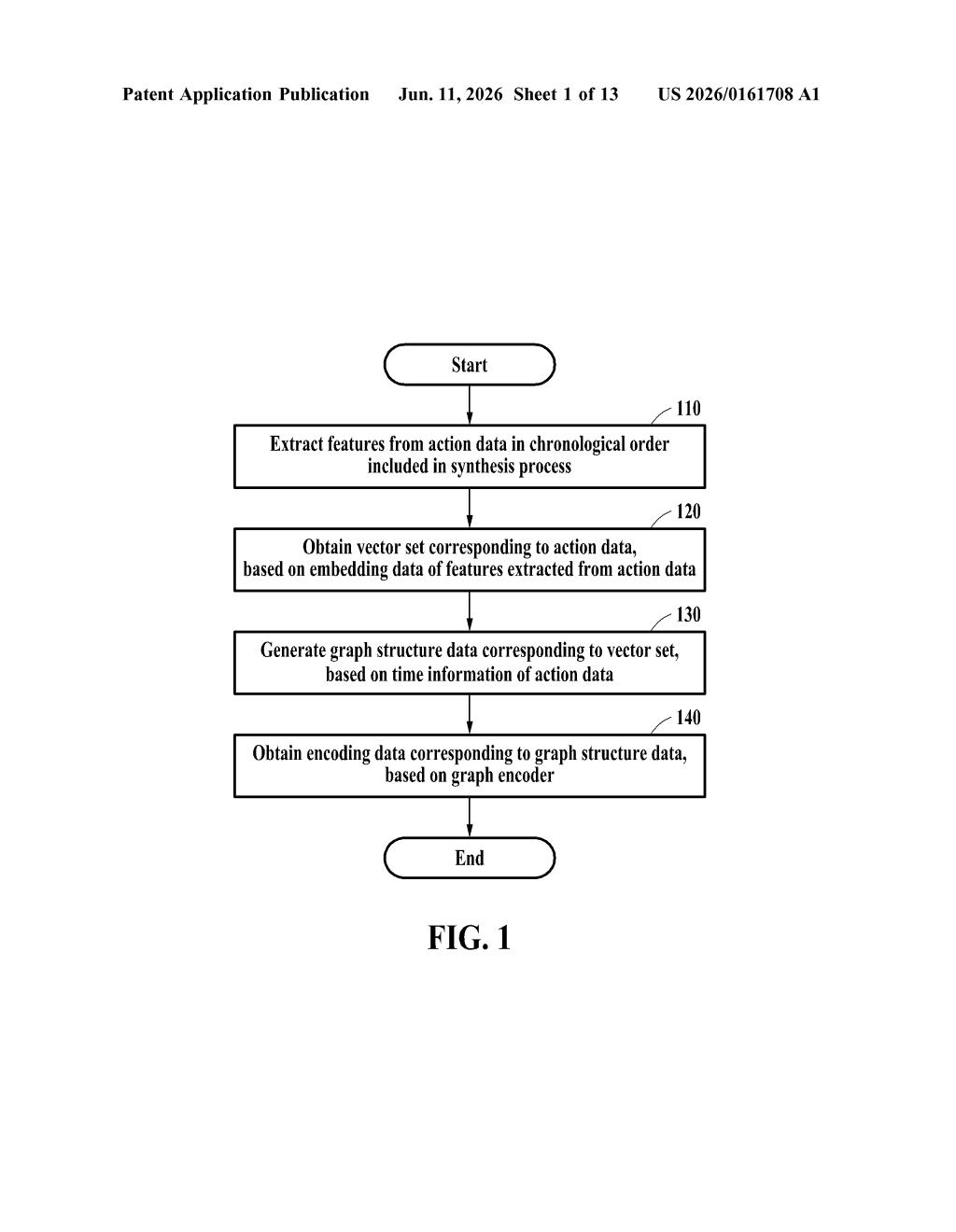
The patent describes a four-step pipeline for processing sequential action data:
- Feature extraction: The system pulls meaningful signals out of each action in the sequence — essentially finding the patterns worth keeping.
- Embedding: Those features are converted into vectors (lists of numbers that represent each action in a mathematical space machines can compare and manipulate).
- Graph generation: Using the time information attached to each action, the system builds a graph structure — a network of nodes and edges where the connections reflect how actions relate to one another across time.
- Encoding: The graph is then processed into a compact encoding — a dense representation that downstream AI models can consume.
The phrase "synthesis process" in the claim is intriguing but vague — it likely refers to some kind of production, assembly, or generative workflow that the action data is drawn from. The claim is written broadly enough to apply across manufacturing, software logging, or even user-interaction tracking.
The graph-based approach is meaningful because flat time-series data misses structural relationships between steps. Graphs can capture things like "action A always precedes action C, but only when action B also occurred," which is harder to express in a simple list.
What this graph encoding method could power in Samsung products
Graph neural networks — AI models that reason over graph-structured data — are one of the hotter areas in applied machine learning right now, used in everything from drug discovery to recommendation engines. A patent that covers how you build the graph in the first place from real-world action logs sits at a useful chokepoint in that pipeline.
For Samsung specifically, this could connect to manufacturing automation, where process logs from chip fabrication or device assembly are exactly the kind of time-ordered action data described here. It could also apply to on-device AI that learns from your usage patterns — but that's speculation the patent itself doesn't support.
This is a low-glamour infrastructure patent — the kind that never makes a keynote but quietly underpins real systems. The claim is written broadly, which is standard practice but makes it hard to assess what Samsung actually built versus what it's staking out as territory. Without more context on what 'synthesis process' means in Samsung's internal roadmap, this reads as foundational IP housekeeping rather than a signal of a specific upcoming product.
There are more where this came from
We read every patent application Big Tech publishes and send you the ones worth knowing. Plain English, free, every week.
Want this weekly breakdown for a company we don't cover? Patentlyze Pro →