
Samsung Patents an AI That Rewrites Its Own Task Plan Mid-Execution
Most AI assistants make a plan and stick to it — even when things go sideways. Samsung's new patent describes a system that watches its own work in real time and rewrites the plan the moment it detects something isn't going right.
What Samsung's self-correcting AI task planner actually does
Imagine asking an AI assistant to book you a flight, reserve a hotel, and add everything to your calendar. Halfway through, the first flight option sells out. A typical AI might freeze, fail silently, or hand the error back to you. Samsung's patented approach tries to fix that.
The system continuously watches what's happening as a task unfolds — not just at the start or the end, but the whole time. It collects live data as the job is in progress and uses that stream of information to decide whether the original plan still makes sense.
If something changes — an unexpected result, a blocked step, new information coming in — the system updates its own task plan on the fly and keeps going. The goal is an AI that doesn't need you to babysit it through every hiccup.
How the token-monitoring loop catches and fixes plan failures
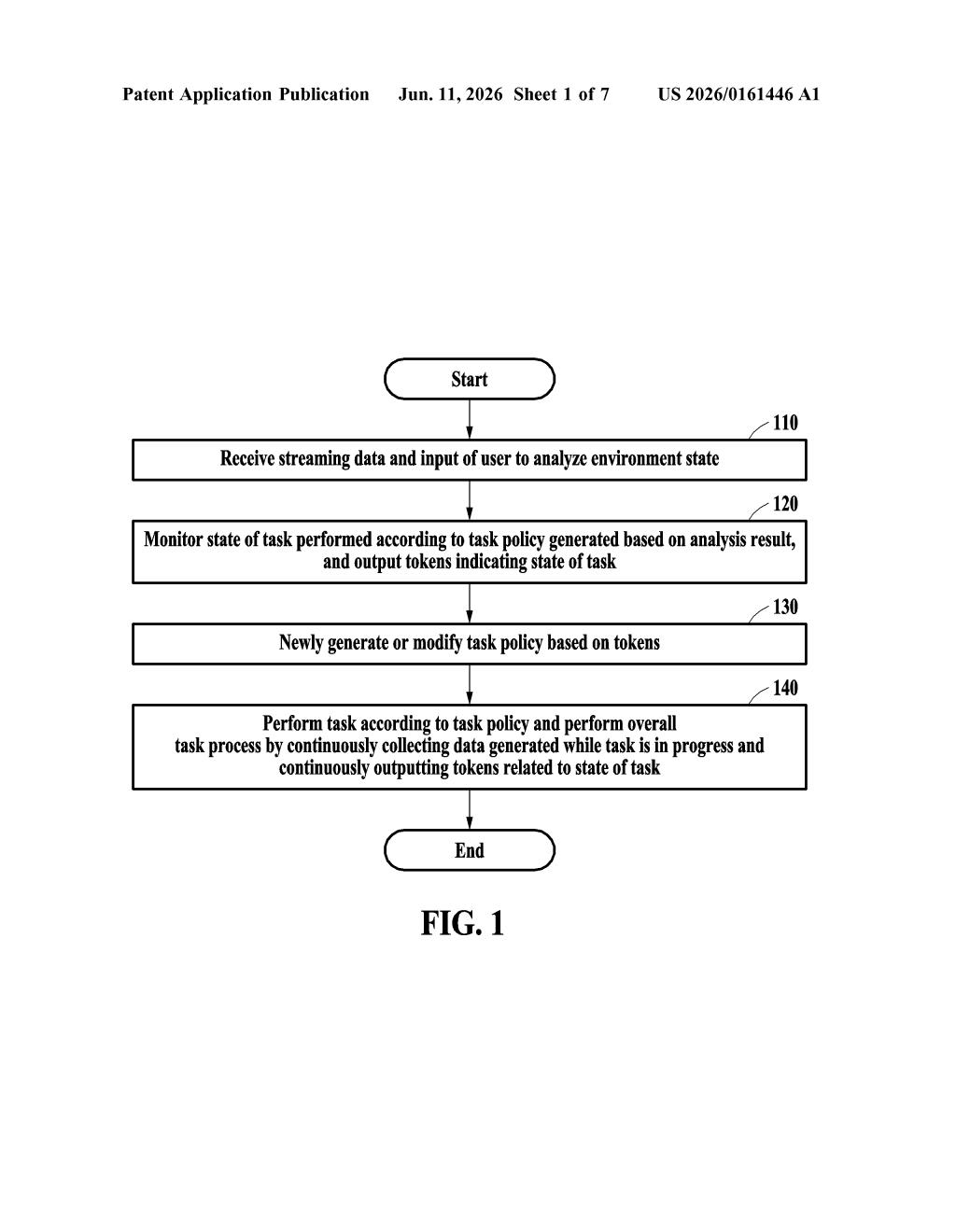
The patent describes a four-step loop that runs continuously while an AI is working through a complex task.
- Environment analysis: Before and during execution, the system reads the current state of whatever it's operating in — a device, an app, a data feed — and takes in streaming data (live, ongoing information rather than a static snapshot).
- Task policy generation: Based on the input and that environmental read, it builds a "task policy" — essentially a structured plan for how to complete the overall job.
- State monitoring via tokens: As the task runs, the system continuously outputs tokens (small, structured signals, similar to how large language models produce text one piece at a time) that describe what's happening at each moment.
- Policy modification: Those tokens feed back into the planner. If the tokens signal a problem or a change in conditions, the system rewrites the task policy and adapts — without stopping the overall process.
The key technical idea is the feedback loop: the monitoring output directly drives plan revision, making this a closed-loop system rather than a fire-and-forget one. The use of streaming data throughout means the planner is never working from a stale picture of the world.
What this means for AI assistants that handle multi-step tasks
Multi-step AI agents — the kind that browse the web, write and run code, or manage files on your behalf — are only as reliable as their ability to recover from unexpected situations. Right now, most agent frameworks handle errors poorly: they either halt, loop, or require human intervention. A system that continuously monitors its own execution state and replans in real time would be a meaningful step toward agents you can actually trust to finish a job.
For Samsung, this fits into the broader race to build capable on-device or cloud AI agents — the kind that might run on a Galaxy phone or smart home device. Reliable task completion, not just task initiation, is what separates a useful agent from a demo.
This is a solid, practical patent aimed at a real problem in AI agent design — the brittleness of fixed task plans. It's not a splashy research breakthrough, but it describes infrastructure that would need to exist for any serious AI assistant product. Samsung filing this now signals they're thinking seriously about agents, not just chatbots.
There are more where this came from
We read every patent application Big Tech publishes and send you the ones worth knowing. Plain English, free, every week.
Want this weekly breakdown for a company we don't cover? Patentlyze Pro →