
Qualcomm Patents In-Car Headset Visuals Delivered Live From Remote Servers
Qualcomm is patenting a way to pipe cloud-rendered extended reality experiences directly into a moving vehicle — blending what's happening outside the car with what a passenger sees through an XR headset, all processed off-device.
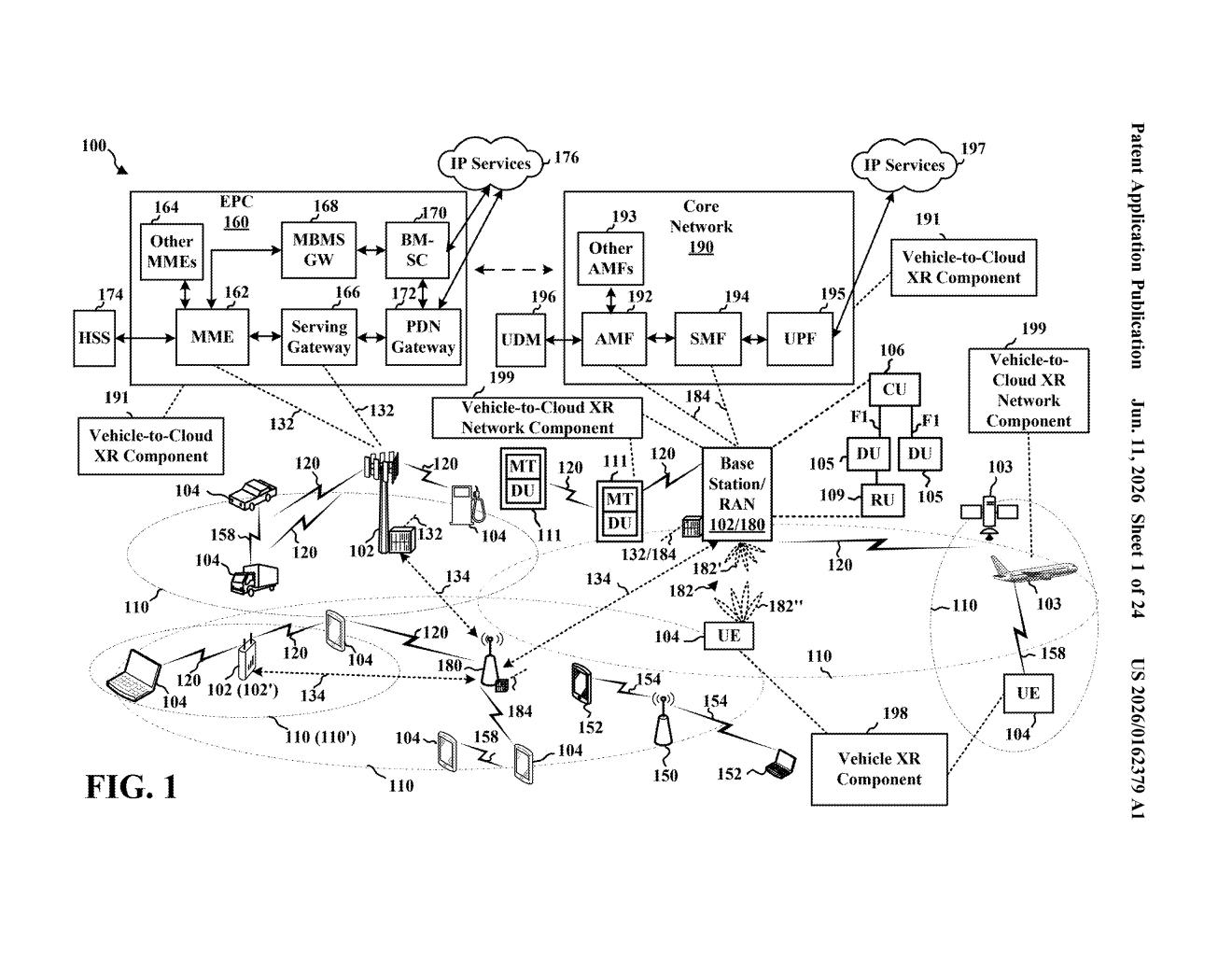
What Qualcomm's cloud-rendered in-car XR actually does
Imagine riding in a car and putting on a mixed-reality headset that doesn't just show you a movie — it knows you're in that specific vehicle, traveling that specific route, and wraps a digital layer around the real world you're actually moving through. That's the core idea here.
Qualcomm's patent describes a system where your XR device sends information about both you (your head position, what you're looking at) and the vehicle you're in up to a cloud server. The server does the heavy rendering work and sends back a finished visual stream tailored to your exact situation. No big onboard computer required.
The key twist is that the experience is tied to the vehicle, not just to your headset. Your XR session knows the car's context — speed, direction, surroundings — and factors that into what you see. It's designed for passengers, not drivers.
How the vehicle data and user data merge into one XR stream
The patent describes a vehicle XR session — a type of extended reality experience that has two distinct data components baked in:
- Vehicle XR component: data about the vehicle itself (its position, movement, environment)
- User XR component: data about the specific passenger wearing the headset (head orientation, gaze, physical context)
The user's device (a phone, headset, or other wireless equipment) transmits both streams of uplink information — essentially sending raw data up to the cloud rather than doing all the rendering on the device itself. This is sometimes called cloud rendering or split rendering, where the heavy graphics work happens on powerful remote servers instead of a mobile chip.
The cloud server processes this combined data and sends back rendering information — the finished visuals — which the device then displays. Because the server knows the vehicle context, it can correctly anchor virtual objects to the moving real world around the passenger.
The patent covers the signaling protocol between the device and the network — specifically how a device requests a vehicle XR session, how it formats and transmits the combined data, and how it receives the finished rendered output.
What this means for passengers in connected and autonomous vehicles
As autonomous and semi-autonomous vehicles become more common, passengers will have more free time during trips — and XR headsets are a natural entertainment and productivity play for that captive audience. The challenge has always been that good XR rendering requires serious computing power, and putting that hardware in every headset is expensive and battery-intensive. Offloading to the cloud is a practical solution, but it requires very low-latency wireless connections (think 5G or beyond) and a smart protocol for bundling vehicle and user data together.
Qualcomm is positioning itself as the company that defines how that data handshake works — which matters enormously because Qualcomm makes the wireless chips inside most mobile devices. If this protocol becomes standard, Qualcomm's hardware would be the natural implementation path.
This is a forward-looking infrastructure patent, not a consumer product announcement. Qualcomm is staking out the protocol layer for in-vehicle XR before the hardware to run it is even widely deployed — a classic standards-positioning move. Whether it gets used depends heavily on how fast autonomous vehicles and 5G/6G low-latency networks converge, but the filing makes clear Qualcomm is thinking about vehicles as a serious XR venue, not an afterthought.
There are more where this came from
We read every patent application Big Tech publishes and send you the ones worth knowing. Plain English, free, every week.
Want this weekly breakdown for a company we don't cover? Patentlyze Pro →