
Intel Patents a Way to Make AI Video Analysis Skip the Parts That Aren't Moving
When an AI watches video, it wastes enormous computing power analyzing parts of the frame that haven't changed at all. Intel has patented a way to automatically skip those still parts — cutting the workload without missing what matters.
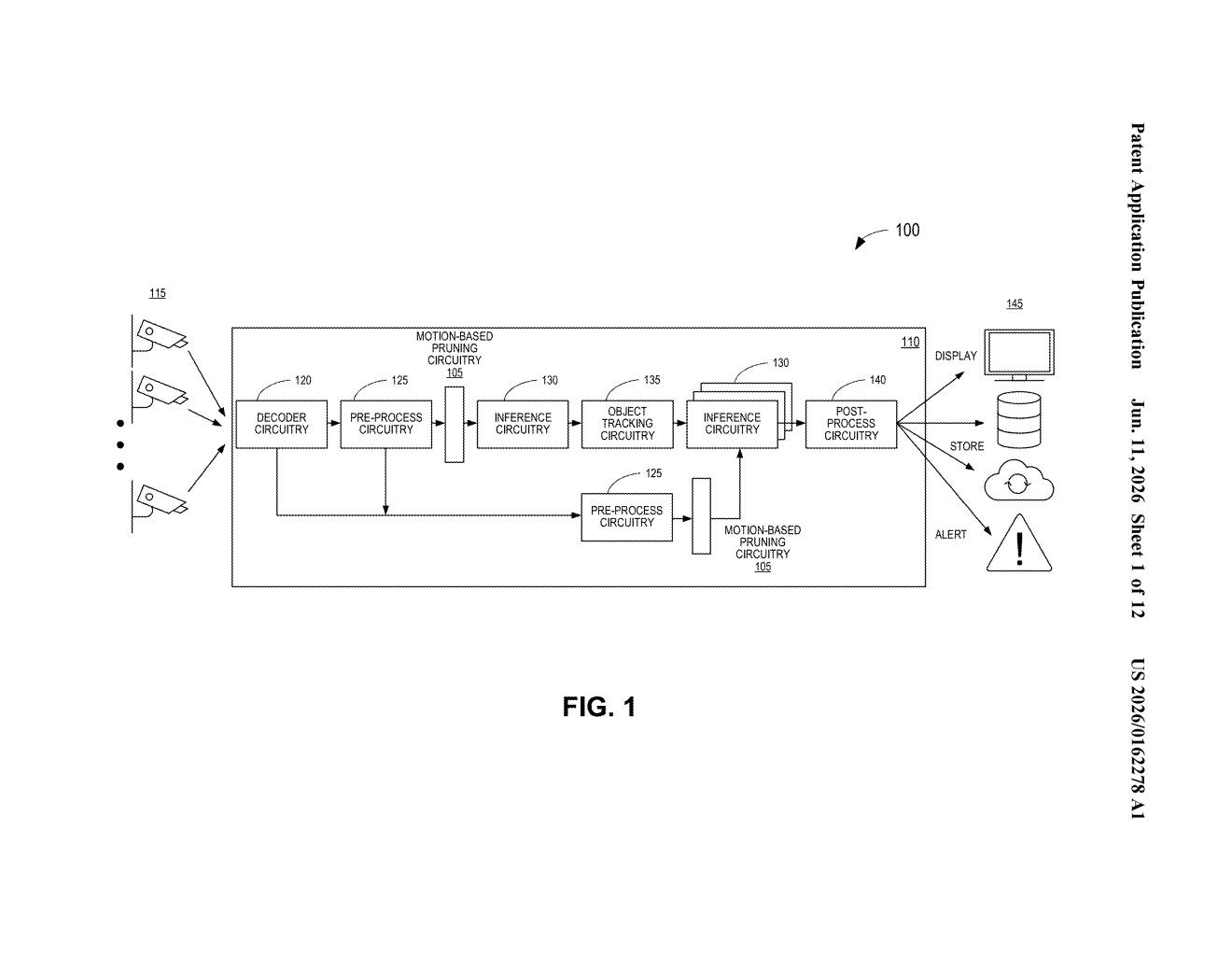
How Intel's motion-based video AI shortcut works
Imagine a security camera watching a parking lot. For most of a given minute, the parked cars, the fence, and the pavement aren't moving at all. But an AI system analyzing that footage usually looks at every part of every frame anyway — burning through processing power and battery life just to confirm, again and again, that nothing changed.
Intel's patent describes a system that first checks which parts of a video frame are actually moving before handing the footage to an AI model. The still parts get quietly dropped from the queue. Only the moving regions — a person walking, a car pulling in — get the full AI treatment. The AI then makes its predictions ("person detected," "vehicle entering") based on that slimmed-down input.
The system can also dial the aggressiveness of this shortcut up or down based on how hot the device is running or how much power it has left. More heat or less battery? Drop even more of the still image data. It's a practical efficiency trick aimed squarely at making AI video analysis cheaper to run on real hardware.
How the pruning system scores and drops still-frame tokens
The patent describes a pipeline that slots in before a large AI vision model processes video. Here's the sequence:
- Frame segmentation: Each video frame is divided into small tiles called patches.
- Motion classification: The system uses either motion vectors (compression data already baked into most video streams) or optical flow (a technique that tracks pixel movement between frames) to label each patch as "moving" or "still."
- Token pruning: In AI vision models, each patch gets converted into a token — a packet of data the model processes. Tokens representing still patches are pruned (removed) before they reach one or more layers of the AI model.
- Adaptive pruning ratio: How aggressively tokens are pruned isn't fixed. A pruning ratio adjusts dynamically based on system conditions — device temperature and available power — so the system backs off when it has headroom and cuts harder when resources are tight.
The remaining tokens flow through the multimodal foundation model — a large AI that handles both image and text inputs — to produce outputs like object detections or action labels. The patent claims this approach lowers latency, memory use, and power consumption while keeping accuracy close to running the full token set.
What this means for AI cameras and edge devices
AI video models are notoriously power-hungry, which is why most serious video AI still lives in the cloud. Intel's approach targets edge devices — cameras, drones, automotive hardware, industrial sensors — where you can't just throw more server racks at the problem. Cutting the number of tokens the AI has to process by focusing only on motion-relevant regions is a direct lever on both speed and energy draw.
For you as a user, this is the kind of work that makes real-time AI features practical on a device in your home or car rather than something that requires a constant internet connection to a data center. It's unglamorous infrastructure, but it's the kind of thing that determines whether on-device AI actually ships.
This is a solid, pragmatic engineering patent — not a research moonshot. The core insight (still video regions are wasted compute) is well-known, but Intel's specific approach of tying the pruning ratio to live hardware telemetry like temperature and power is genuinely useful for shipping real products. Edge AI efficiency is one of the few areas where incremental patents like this translate directly into product differentiation.
There are more where this came from
We read every patent application Big Tech publishes and send you the ones worth knowing. Plain English, free, every week.
Want this weekly breakdown for a company we don't cover? Patentlyze Pro →