
Apple Patents a Smart Load-Balancing System for Hub Devices and Accessories
When you have a house full of smart home accessories, figuring out which hub should talk to which device is surprisingly hard. Apple's new patent describes a system that does that math automatically — and hands off control gracefully when things change.
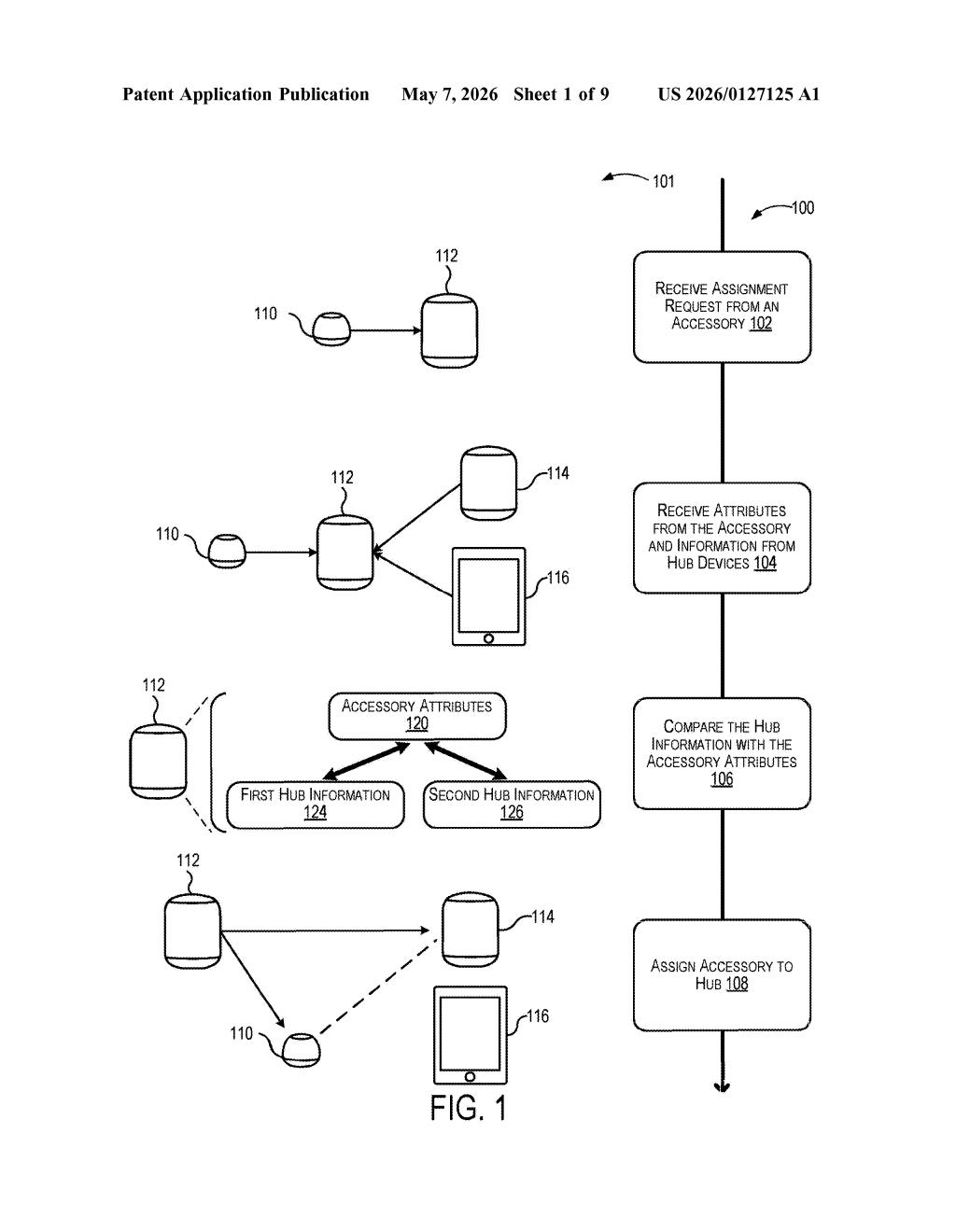
What Apple's hub assignment scoring system actually does
Imagine you have several smart home accessories — a door lock, some light sensors, a thermostat — all trying to connect to a hub (think HomePod or Apple TV). Right now, that assignment process can be clunky. Apple's patent describes a smarter way to handle it.
A leader device — like your iPhone — acts as a coordinator. When an accessory asks to connect, the leader collects a kind of report card from every available hub device, comparing each hub's capabilities against what the accessory actually needs. The hub with the highest connection score wins the assignment.
There's also a fallback system. If the current leader device needs to hand off its coordinator role — say, you leave the house — the system can transfer hub leadership to a different device based on a set of conditions. It's essentially an automatic failover, so your smart home keeps running smoothly even when your devices change.
How Apple scores hubs and transfers leadership between devices
The patent describes a two-part system: accessory assignment and leadership transfer.
For assignment, a user device acting as leader collects hub attributes (capabilities, availability, load) from each hub device and accessory traits (what the accessory needs to function well) from each accessory requesting a connection. It then runs a comparison to generate a connection score for each hub and assigns the accessory to the highest-scoring hub. This is essentially a lightweight matchmaking algorithm run locally on the leader device.
The leadership transfer mechanism — the focus of the first independent claim — handles what happens when the current leader can no longer serve in that role. The system evaluates two distinct sets of criteria:
- If the first set of criteria is met, leadership transfers to a specific third device.
- If the second set of criteria is met instead, leadership goes to a fourth device.
This conditional branching means the system can pick the most appropriate new leader based on context — not just whoever happens to be available. The patent doesn't spell out exactly what those criteria are, leaving room for implementation-specific logic like proximity, battery level, or network quality.
What this means for Apple's smart home and HomeKit ecosystem
Apple's smart home stack — HomeKit, HomePod, and Apple TV — relies on hub devices to keep accessories responsive even when your iPhone isn't home. The problem is that as households add more accessories, load on any single hub grows uneven. A scoring-based assignment system could make that distribution automatic and intelligent rather than static.
The leadership transfer piece is arguably more interesting. It suggests Apple is thinking seriously about resilience: what happens when the device running the show goes offline or leaves range? A graceful handoff mechanism could reduce the frustrating "accessories not responding" errors that still plague smart home setups today. For power users managing dozens of HomeKit devices, that reliability improvement would be genuinely noticeable.
This is solid infrastructure work — not flashy, but exactly the kind of thing that makes a platform feel mature. Apple's smart home reputation has historically suffered from reliability hiccups, and a principled load-balancing and leader-election system addresses a real pain point. Worth watching as HomeKit continues to expand.
There are more where this came from
We read every patent application Big Tech publishes and send you the ones worth knowing. Plain English, free, every week.
Want this weekly breakdown for a company we don't cover? Patentlyze Pro →