
Google Patents a Spatial Audio Format That Keeps 3D Sound Data Codec-Independent
Google is patenting a way to package 3D audio so that the instructions for placing sound in space are stored separately from the compression format — meaning the same audio file could theoretically work across different playback systems without re-encoding.
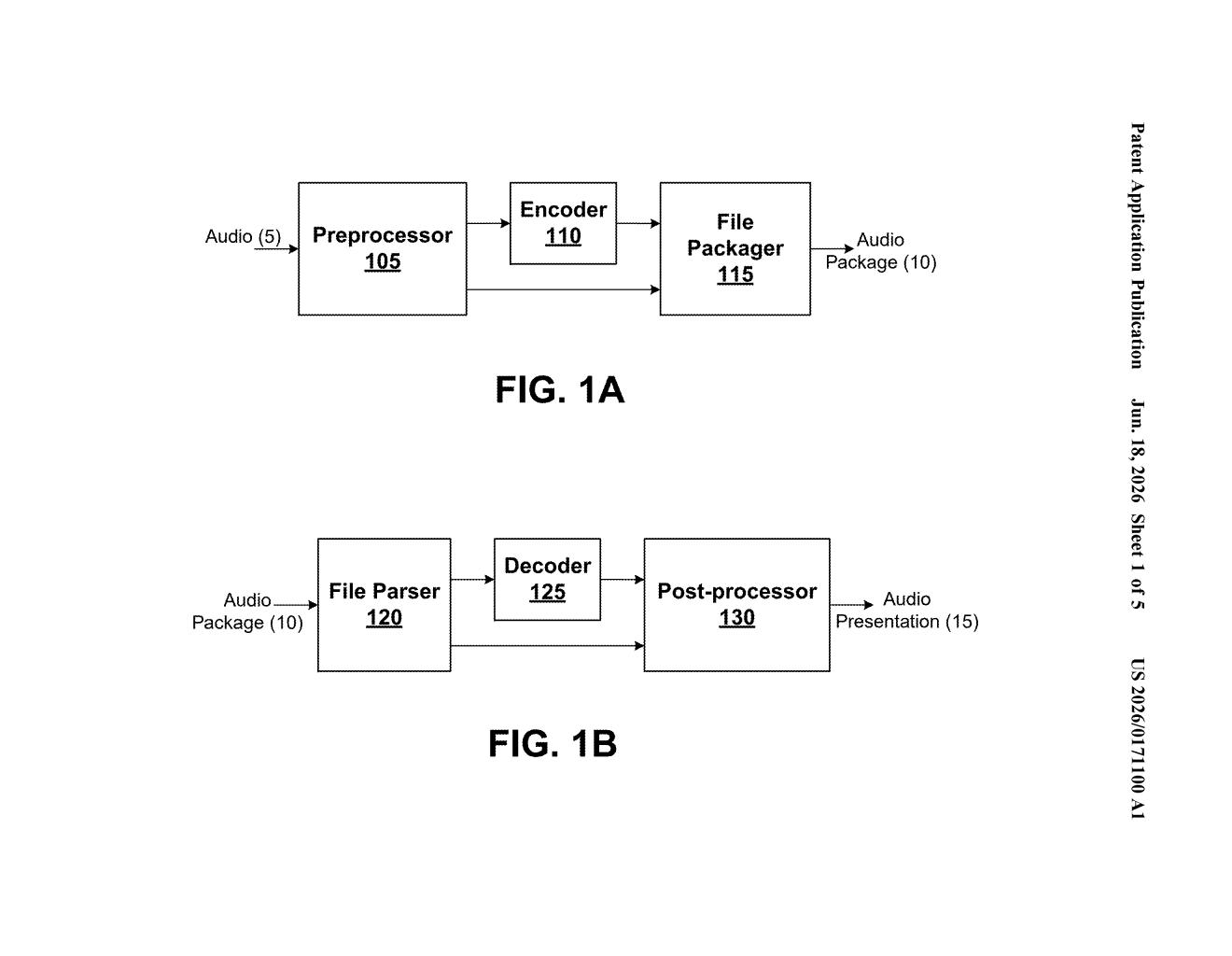
What Google's split audio container actually does
Imagine you're watching a movie in spatial audio — sounds come from behind you, above you, off to the side. Right now, the instructions for where those sounds live in 3D space are often baked into the same technical packaging as the compression format used to shrink the audio file. Change the compression format, and you may have to redo all that spatial work.
Google's patent describes a way to keep those two things separated. One container holds the spatial metadata — where a sound is, how big it feels, how directional or diffuse it is. A second container holds the codec-specific stuff — the technical settings for whatever compression method is being used. Both travel together in a single audio package.
The practical upside is flexibility. If you want to switch from one audio codec to another, you don't have to touch the 3D positioning data. It's a cleaner architecture for anyone building systems that need to deliver spatial audio across different devices or platforms.
How the two-container audio package is structured
The patent describes a three-part audio package: a codec-agnostic container, a codec-dependent container, and the actual compressed audio data.
- Codec-agnostic container: Holds metadata about how to render audio in 3D space — including position, size, directivity (how tightly focused a sound is toward a listener), and diffuseness (how spread-out or ambient it feels). None of this depends on which compression format is used.
- Codec-dependent container: Holds parameters tied to the specific audio codec (a codec is the algorithm used to compress and decompress audio, like Opus or AAC). This is where format-specific technical settings live.
- Compressed audio data: The actual encoded audio payload that gets decoded at playback.
By decoupling the spatial rendering instructions from the compression details, the system allows the same positional metadata to survive a codec swap. The format is designed to handle both audio channels (fixed speaker positions like left/right/center) and audio objects (sounds that move or exist at arbitrary positions in 3D space), which is a distinction important in immersive audio standards like Dolby Atmos or MPEG-H.
What this means for cross-platform spatial audio
Spatial audio is increasingly standard — Apple, Meta, and Google have all been building it into headphones, phones, and VR headsets. But one persistent pain point is interoperability: spatial audio files encoded for one platform often need to be re-processed to work on another, partly because the positional data is tangled up with codec-specific packaging.
If Google's container format gets traction — especially in web or Android contexts where the company has real distribution leverage — it could simplify how developers deliver immersive audio across devices. For you as a listener, that could mean fewer situations where spatial audio just doesn't work when you switch from one app or device to another.
This is a foundational infrastructure patent, not a flashy consumer feature. But the problem it solves is real: spatial audio fragmentation is a genuine headache for developers, and a clean separation between 'where does the sound go' and 'how is the sound compressed' is the kind of architectural decision that makes formats last. If Google pushes this into the WebAudio or Android audio stacks, it's worth paying attention to.
There are more where this came from
We read every patent application Big Tech publishes and send you the ones worth knowing. Plain English, free, every week.
Want this weekly breakdown for a company we don't cover? Patentlyze Pro →