
New Patent Cuts the Cost of Running AI That Handles Many Tasks at Once
Running a large AI model with many specialized sub-networks is expensive, partly because each specialist carries its own full set of parameters. Google's new patent describes a design where those specialists share a common middle layer, cutting the total parameter count without shrinking what the model can do.
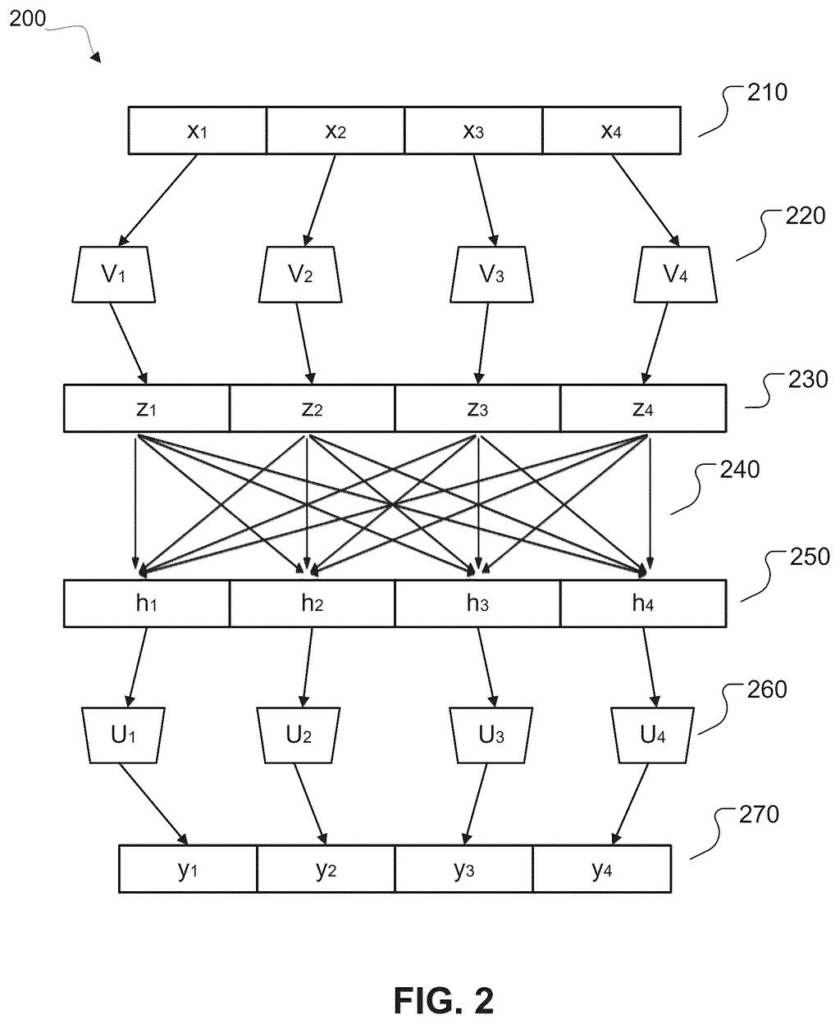
How Google's shared-layer AI network saves memory
Imagine a hospital where every specialist doctor had to memorize the entire medical textbook independently. That's roughly how traditional multi-expert AI models work: each specialist carries a full copy of certain shared knowledge, which wastes memory and compute.
Google's patent proposes a different arrangement. Instead of each AI specialist handling a task entirely on its own, they all hand off their preliminary work to one shared layer that mixes everything together, then each specialist picks up its piece of the result and finishes the job.
The practical effect is that you get the same variety of specialists in the model, but the total number of stored values (parameters) goes down because the middle step is shared rather than duplicated. Fewer parameters means the model is cheaper to run and easier to fit on hardware with limited memory.
partitioning the input tensor into a set of multiple input component tensors; for each respective expert block in the set of multiple expert blocks, processing a corresponding one of the input component tensors using a respective input block of the respective expert block to generate a respective intermediate tensor; …
Translation: The system divides incoming data into separate parts so different expert sections can process them independently.
How the shared mixing layer connects expert blocks
The patent describes a Mixture of Experts (MoE) neural network architecture. In a standard MoE model, a router sends each piece of data to one or more specialist sub-networks called experts. Each expert processes its slice independently. The problem is that experts often end up storing similar information, which inflates the model's total size.
Google's design adds a shared mixing layer sitting between an input stage and an output stage inside each expert block. Here is how data flows:
- The incoming data tensor (a structured grid of numbers representing the input) is split into equal partitions, one per expert.
- Each expert's input block processes its partition and produces an intermediate result.
- All intermediate results are combined and passed through the single shared mixing layer that every expert uses jointly.
- The mixed result is re-split, and each expert's output block processes its slice to produce a final chunk.
- The chunks are concatenated back into one output tensor.
Because the mixing layer is shared rather than replicated per expert, the total parameter count stays low while the model still benefits from specialist processing at the input and output stages.
Methods, systems, and apparatus, including computer programs encoded on a computer storage medium, for performing a machine learning task using a neural network that includes a Mixture of Experts (MoE) subnetwork configured to process an input tensor to generate an output tensor.
Translation: This technology covers the software and hardware setup used to run a specialized AI network efficiently.
What this means for the cost of deploying large AI models
Large AI models are increasingly bottlenecked not by raw capability but by the cost of storing and running them. A design that keeps expert diversity while shrinking parameter counts could make it practical to deploy more powerful models on the same hardware budget, or fit larger models into data centers without proportionally higher bills.
For Google specifically, this matters across products from Google Search to Gemini, where inference costs are enormous at scale. If this architecture makes it into production training pipelines, even a modest reduction in parameters per model translates into significant savings when you multiply across billions of daily queries.
This is a real architectural contribution to a well-known problem in AI scaling, not a defensive or incremental filing. The shared-mixing-layer idea is specific enough to be meaningful, and the efficiency angle is exactly what the industry is focused on right now. Whether it beats existing MoE variants in practice depends on benchmarks Google hasn't published here, but the design logic is sound.
There are more where this came from
We read every patent application Big Tech publishes and send you the ones worth knowing. Plain English, free, every week.
The drawings
5 drawing sheets from US 2026/0228495 A1 · click any drawing to enlarge


Want this weekly breakdown for a company we don't cover? Patentlyze Pro →
Be the first to weigh in