
Google Patents a Parking System That Finds Open Spots Using Sound and Vibration
Google has filed a patent for a parking detection system that doesn't need cameras or per-space sensors — instead, it listens. A network of long-range acoustic and vibration sensors triangulates where every car is and builds a real-time map of which spots are open.
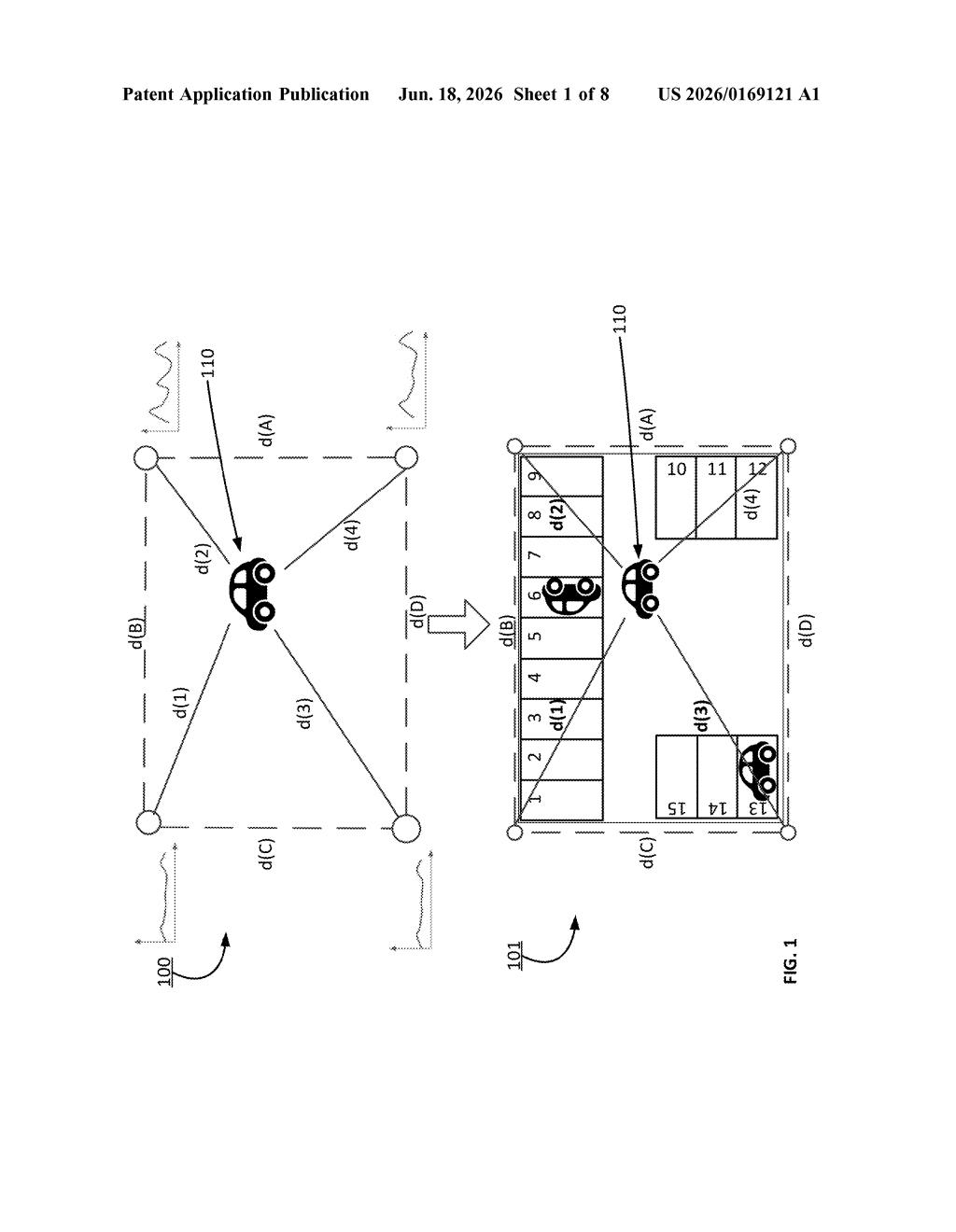
How Google's vibration-based parking tracker works
Imagine a parking garage that always knows exactly which spots are taken — not because every space has its own sensor buried in the pavement, but because a handful of microphones and vibration detectors spread around the building are constantly listening.
That's the core idea in this Google patent. A small network of sensors picks up the sounds and vibrations a car makes as it moves through a parking area. By measuring how far the car is from each sensor, the system can calculate the vehicle's position — the same basic math GPS uses, but with sound instead of satellites. The result is an up-to-date map showing how many cars are in the facility and where each one is parked.
The patent also describes the sensors talking to each other using those same acoustic signals to build an accurate map of the physical space. That means the system could theoretically set itself up without anyone measuring the garage by hand.
How the sensors triangulate each car's position
The system deploys a set of long-range sensors — devices tuned to pick up vibration or acoustic signals — at fixed points around a parking facility. As a vehicle moves or parks, it generates low-frequency sound and physical vibration. Each sensor logs its distance to the vehicle based on how those signals arrive.
With readings from at least two sensors, the system's processor performs a technique called trilateration (the same principle behind GPS: if you know your distance from three known points, you can pinpoint your location). The intersection of those distance measurements pins down the vehicle's position inside the garage.
Using those calculated positions, the system builds a parking availability map — a real-time picture of which areas are occupied and which are free. The map updates as vehicles arrive and depart.
- Sensors also communicate with each other via acoustic signals to measure inter-sensor distances
- That peer-to-peer measurement lets the system auto-generate a layout map of the facility
- The whole approach avoids the need for per-space hardware (like the puck-shaped sensors often installed in each individual bay)
What this means for parking apps and smart garages
Parking guidance systems today usually rely on either in-ground sensors per space (expensive to install and maintain) or overhead cameras (which raise privacy concerns and need heavy image-processing). A sparse network of acoustic sensors could cover an entire garage with far fewer devices and no video footage of drivers or license plates.
For parking operators, that's a potentially cheaper and less invasive deployment. For drivers, the downstream benefit is familiar: a navigation app that shows you a real-time count of open spaces before you even pull in. Google already operates Google Maps parking data features, so a proprietary sensing back-end fits that strategy cleanly.
This is a practical, quietly clever piece of infrastructure work. The idea of using vibration and sound to triangulate vehicles rather than wiring up every individual parking space is genuinely cost-efficient, and the self-mapping feature — sensors measuring their own layout acoustically — is an elegant touch. It's not flashy enough to make headlines on its own, but it fits neatly into Google Maps' existing parking-availability ambitions.
There are more where this came from
We read every patent application Big Tech publishes and send you the ones worth knowing. Plain English, free, every week.
Want this weekly breakdown for a company we don't cover? Patentlyze Pro →