
Google Patents an AI That Pulls a Single Sound Out of a Recording Using Plain-Text Descriptions
Imagine typing 'the guitar' into a search box and having an AI instantly hand you just the guitar track, cleanly separated from the vocals, drums, and crowd noise in a messy live recording. That's the core idea in Google's latest audio patent.
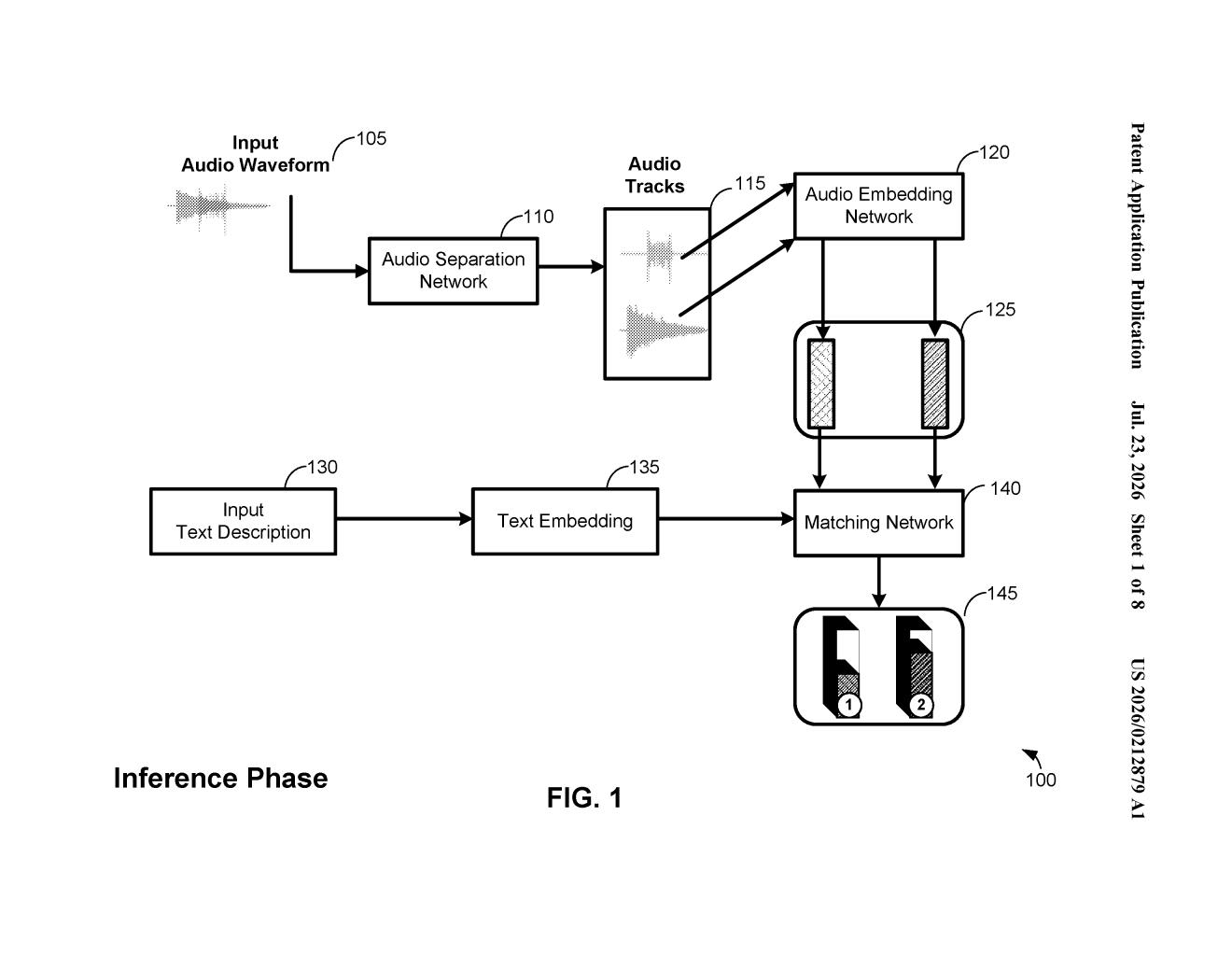
What Google's text-driven audio separation actually does
Picture a home video from a birthday party: there's a song playing, people talking, and kids laughing all at once. Right now, pulling out just the song takes expensive software and a trained audio engineer. Google's patent describes an AI that does this automatically.
You give the system two things: the original recording and a short text description of what you want, like "the piano" or "the person speaking English." The AI splits the recording into individual sound layers, checks which one matches your description, and hands you that layer on its own.
The result shows up in an interactive interface, so you can play it back, download it, or keep editing. No sliders, no frequency charts, no technical know-how required. Just describe what you're after and let the AI find it.
How the neural network matches text to separated audio tracks
The patent describes a system built around a neural network (a type of AI trained on large amounts of audio data) that performs two jobs at once.
First, it runs audio source separation on whatever recording you feed it. Source separation is the computational process of untangling overlapping sounds into distinct tracks, similar to how your brain instinctively focuses on one conversation in a noisy room. The AI produces several candidate tracks from a single mixed input.
Second, it performs text-audio matching: it reads the text description you typed and figures out which of those separated tracks best corresponds to what you described. This cross-modal matching (connecting language to sound) is what makes the system feel like a search engine for audio layers.
Once there's a confident match, the system routes that specific track to a user interface, where it can be previewed or used downstream. The patent doesn't lock in one specific neural network architecture, which suggests the inventors designed this as a general framework rather than a narrow single-use tool.
What this means for audio editing and content tools
Audio editing has always been a specialist skill. Tools that automatically separate instruments or voices exist, but they still require you to listen through every output and pick the right one by ear. Adding a text query layer means anyone can describe what they want in plain language, which is a meaningful shift for content creators, journalists, and accessibility tools that need to isolate speech from background noise.
For Google specifically, this sits naturally alongside products like YouTube Studio, Google Podcasts infrastructure, and its broader AI audio research (Google has published heavily on audio separation models). A feature that lets a YouTube creator type "remove the background music" and get a clean voice track would be a practical, immediate application of exactly this patent.
This is a genuinely useful idea with obvious commercial applications in video editing, podcast production, and accessibility. Google's audio AI research team (several inventors here are known for the Cocktail Party Problem work in deep learning) is not just filing for the sake of filing. The text-query angle is the real differentiator: it's the difference between a professional tool and one a non-expert would actually use.
There are more where this came from
We read every patent application Big Tech publishes and send you the ones worth knowing. Plain English, free, every week.
The drawings
8 drawing sheets from US 2026/0212879 A1 · click any drawing to enlarge


Want this weekly breakdown for a company we don't cover? Patentlyze Pro →
Be the first to weigh in