
AMD's New Patent Wants to Strip a Memory Chip Out of Every Graphics Card
AMD is exploring a way to strip a small but ever-present memory chip out of graphics cards entirely — letting the CPU's driver software do the job that chip used to do. It's a quiet but potentially cost-relevant engineering shift.
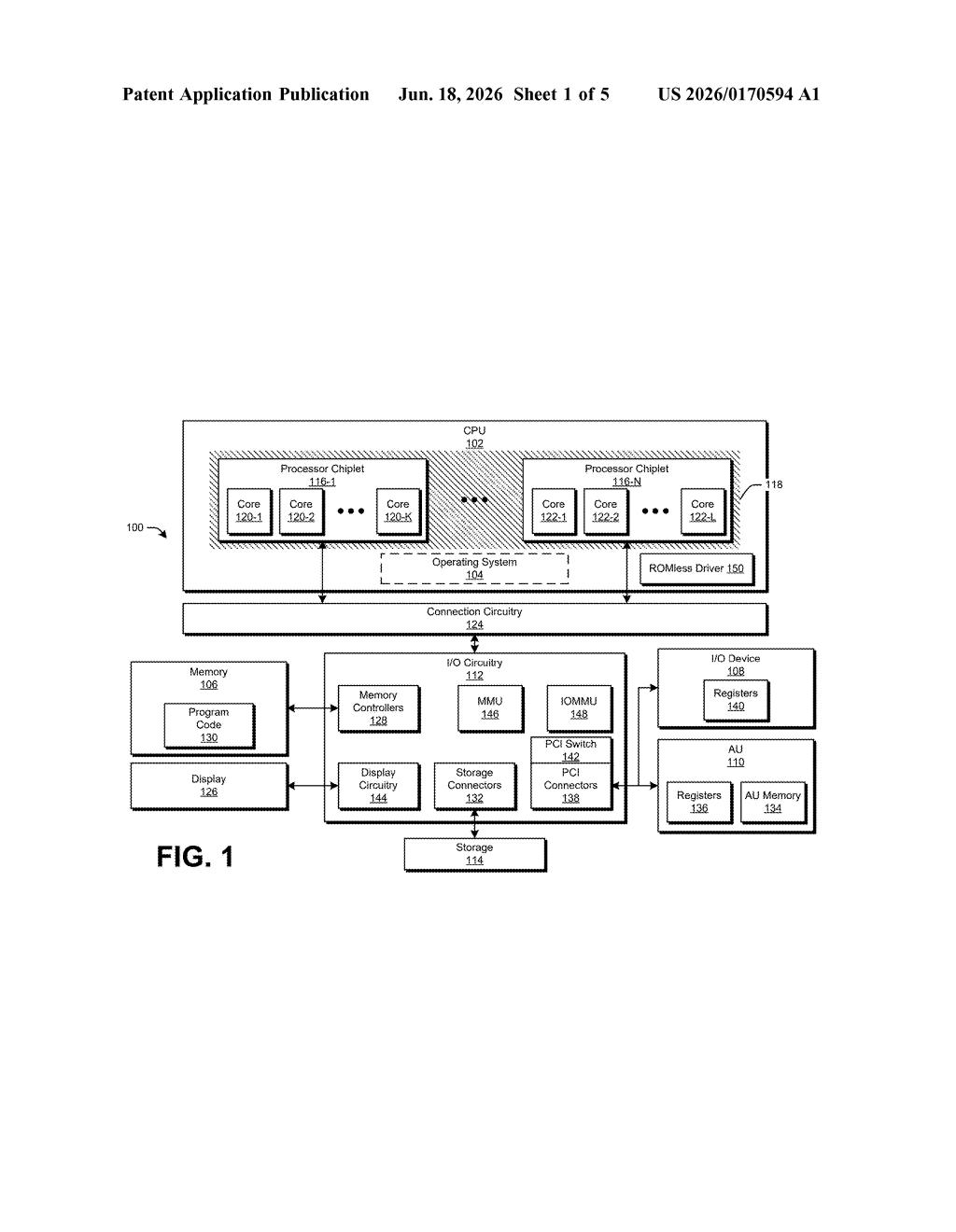
What AMD's ROMless GPU approach actually does
Every graphics card today carries a tiny dedicated memory chip — think of it like the GPU's own personal sticky note — that holds the startup instructions the card needs to get running. AMD's patent describes getting rid of that chip entirely.
Instead of the GPU reading its own startup firmware from an onboard chip, the CPU's graphics driver would store that firmware and beam it directly to the GPU each time the system boots. The driver is already talking to the GPU constantly, so AMD is essentially asking: why not have it handle this step too?
The driver is built to support multiple GPU generations at once, so it can send the right set of instructions for whatever graphics card is actually installed. From your perspective as a user, nothing changes — but on the inside, there's one fewer physical component on the card.
How the CPU driver delivers firmware to a chipless GPU
Modern GPUs rely on a non-volatile memory (NVM) chip — typically a small ROM or flash chip soldered onto the graphics card — to store the firmware the GPU needs when it first powers on. AMD's patent describes removing that chip and relocating the firmware storage into the CPU-side graphics driver.
The driver contains firmware images (complete packages of startup instructions) for multiple GPU architectures. Each firmware image also bundles assembly logic blocks (small architecture-specific code segments that handle CPU-to-GPU communication) for multiple CPU types, so the same driver package works across different hardware combinations.
At boot time, the CPU driver:
- Detects which GPU architecture is installed
- Selects the matching firmware image from its internal library
- Establishes a communication interface using the appropriate assembly logic for the CPU it's running on
- Transmits the firmware image to the GPU for execution
The GPU itself becomes "ROMless" — it has no onboard storage for its own firmware and depends entirely on the host system to supply it at startup. This is similar in spirit to how some network cards can PXE-boot without local storage, but applied to GPU firmware delivery.
What this means for GPU design and manufacturing costs
Removing the ROM chip lowers component count on a GPU board, which matters for manufacturing cost and board complexity — especially as AMD pushes into tighter form factors and lower-cost GPU tiers. It also means firmware updates could be handled entirely through driver software updates, since the firmware lives on the CPU side rather than being burned into a physical chip on the card.
For enterprise and data-center deployments, centralized firmware management through the driver could simplify how large fleets of GPU systems are maintained. There's a practical trade-off too: a ROMless GPU is more dependent on the host driver ecosystem, which raises questions about compatibility and recovery if something goes wrong at boot — but those are engineering problems AMD would address in implementation.
This is a genuinely interesting cost and maintenance play, not a performance story. Eliminating a physical chip is real money at scale, and moving firmware into the driver makes GPU cards simpler to manufacture and easier to update. It's the kind of unglamorous infrastructure patent that tends to quietly show up in shipping silicon a few years later.
There are more where this came from
We read every patent application Big Tech publishes and send you the ones worth knowing. Plain English, free, every week.
Want this weekly breakdown for a company we don't cover? Patentlyze Pro →