
AMD's New Patent Stops a Single Broken Chip Sensor from Faking a Clean Bill of Health
A single broken sensor quietly giving wrong answers is one of hardware security's oldest problems. Xilinx's new patent tackles it by making sure no single checker ever has the final word.
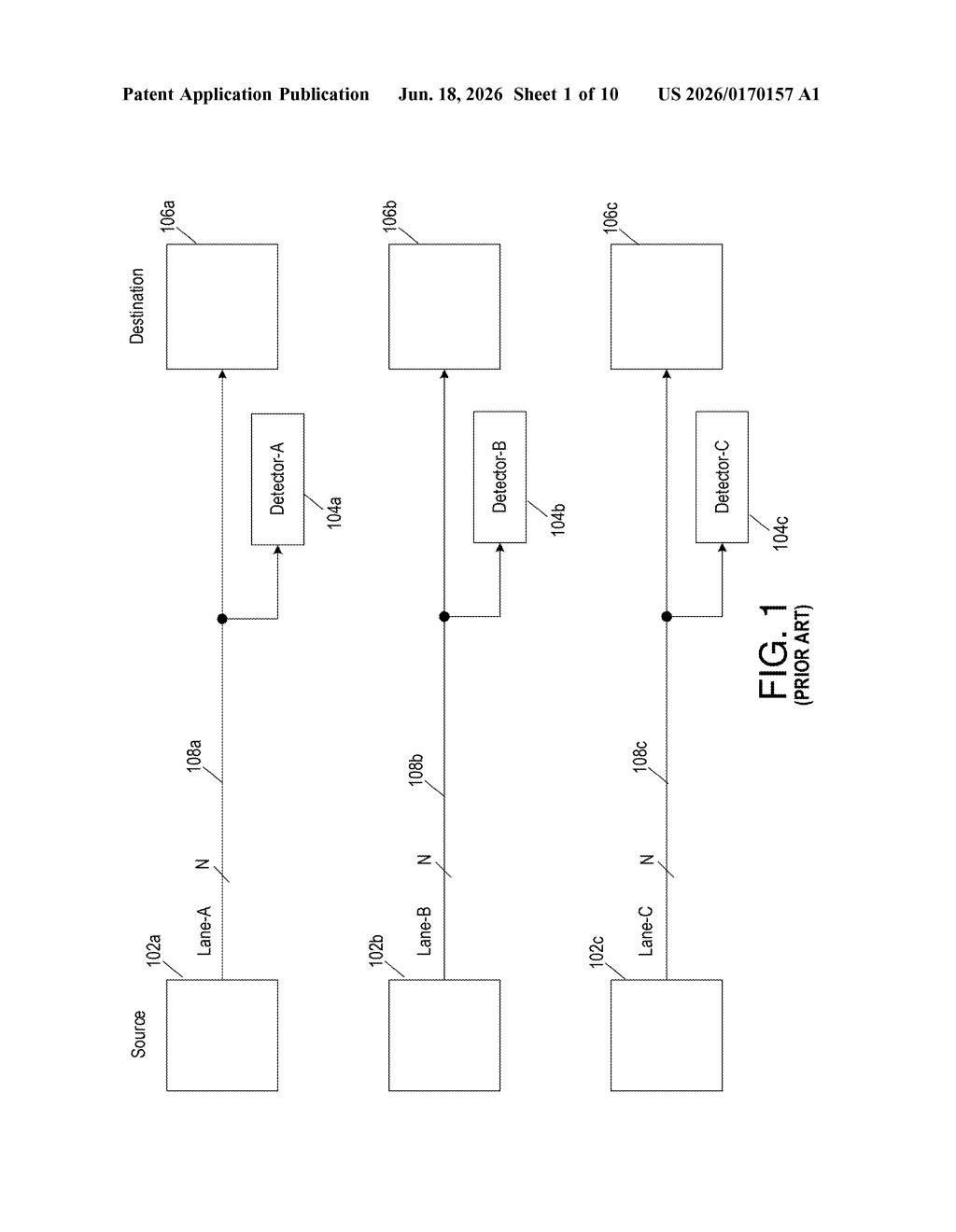
What Xilinx's rotating detector system actually does
Imagine a security guard checking IDs at a door — but if that one guard is secretly asleep or broken, everyone gets waved through without a real check. That's roughly the problem this patent is solving, but inside a computer chip.
Xilinx describes a system where multiple "data detectors" take turns checking each chunk of data moving across a chip. Instead of one detector always being in charge of the same data lane, the job rotates — a different detector handles each new byte that comes through. The system is looking for a specific pattern in that data: a security key code embedded in the bits.
By spreading the work across many detectors in rotation (the patent calls this "data spray"), a single faulty or defective detector can't cause the whole system to reach the wrong conclusion about whether a security key is present. It's a safety-net approach: if one detector is wrong, the others will have independently checked the same stream and can flag the error.
How data spray assigns detectors across byte transfers
The patent describes a method for detecting security key codes hidden in streams of data bytes moving between a source and a destination on a chip — for example, from memory to a processor. A security key code is identified by finding a specific logic state (essentially a particular pattern of 1s and 0s) in at least one bit of a passing byte.
The core technique is called data spray. Rather than assigning one detector permanently to one data lane, the system cycles through a pool of data detectors, assigning a different detector to each successive byte transfer. Every bit in every byte is still examined — nothing is skipped — but the examiner changes with each transfer.
The key security benefit is statistical: if one detector is defective and consistently returns wrong results, it only influences a fraction of the checks, not all of them. The claim explicitly requires that the detector used for one byte must be different from the detector used for the immediately preceding byte on the same lane.
When any detector spots the target logic state, the system raises an indicator flag — signaling that the security key code has been found. The design is aimed at fault-resistant detection, reducing the chance that a hardware defect produces a false "all clear."
What this means for chip-level security reliability
This is fundamentally a hardware reliability problem dressed in security clothing. Chips used in data centers, FPGAs, and secure embedded systems need to verify security keys during data transfers — and a single broken detector quietly passing bad data could open a real vulnerability. Rotating detectors is a straightforward engineering answer, but the fact that Xilinx is patenting the specific implementation suggests it's non-obvious enough to be worth protecting in silicon designs.
For your everyday world, this kind of fault-tolerant security logic is what underpins the reliability of hardware used in cloud infrastructure, automotive chips, and industrial controllers — places where a subtle hardware fault causing a wrong security verdict could have serious downstream consequences. It won't show up as a named feature in any product, but it's the unglamorous work that keeps secure systems trustworthy.
This is a narrow, infrastructure-level patent — not the kind of thing that ships as a consumer feature. But for anyone building or buying hardware that needs to verify cryptographic key material in high-reliability environments, a formally described fault-tolerant detection scheme is genuinely useful. It's not exciting reading, but it's the kind of careful engineering that matters when a chip defect could silently compromise security.
There are more where this came from
We read every patent application Big Tech publishes and send you the ones worth knowing. Plain English, free, every week.
Want this weekly breakdown for a company we don't cover? Patentlyze Pro →