
Real-Time Voice Translation Patent Preserves Each Speaker's Tone
Samsung is working on a translator that doesn't just convert words from one language to another. It also tries to carry over the way you sound when it does it.
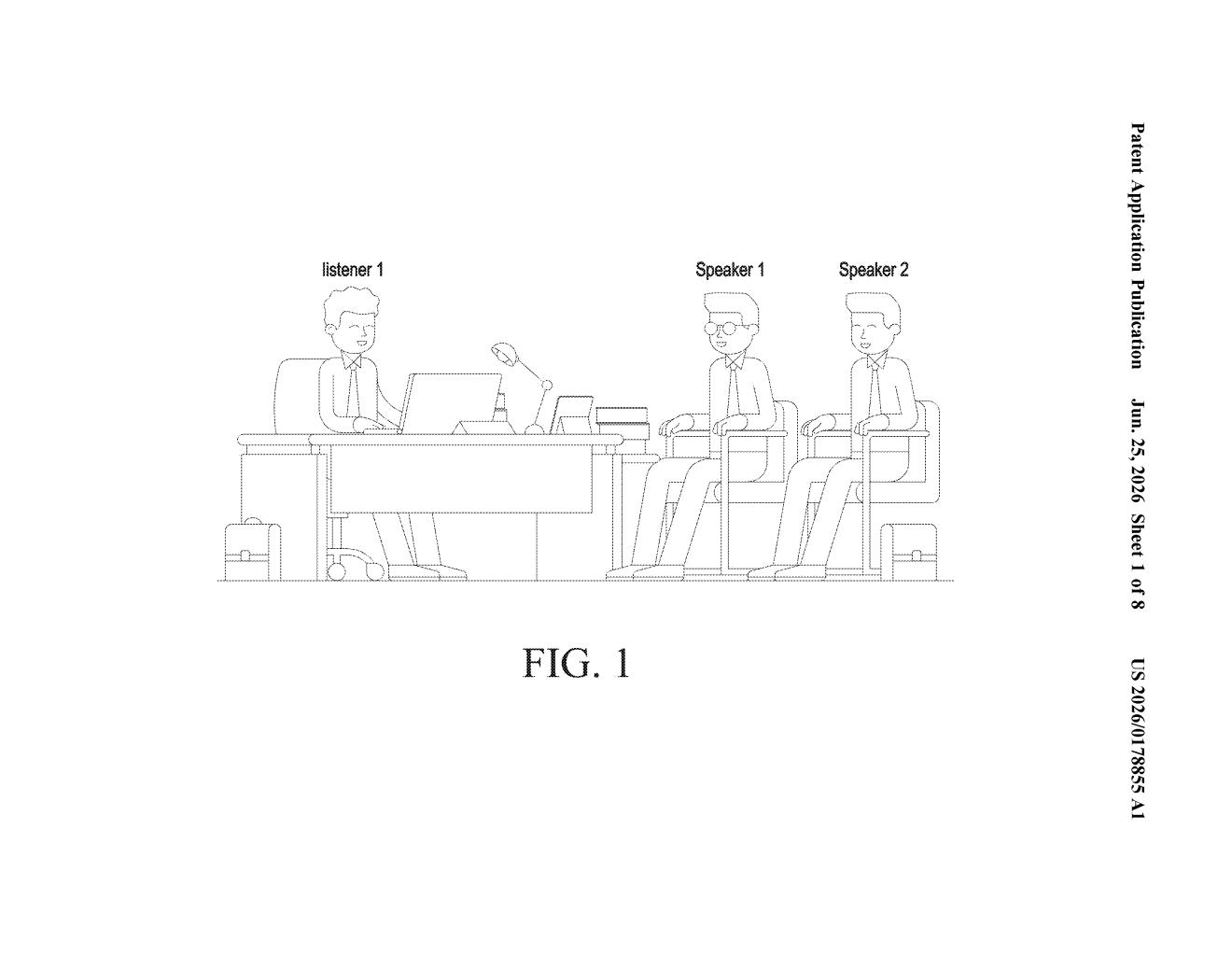
What Samsung's multi-speaker voice translator actually does
Imagine you're in a meeting with colleagues who speak three different languages, all talking at once. Today's translation tools tend to stumble: they flatten everyone into the same robotic voice, lose track of who said what, and sometimes give up when two people speak simultaneously.
Samsung's patent describes a system built to handle that chaos. It listens to everyone at once, figures out who is speaking and in which language, then translates each person's words into a shared target language. The translated audio isn't just technically accurate, it also tries to recreate your speaking style, so the output sounds like you, just in a different language.
The key piece is what Samsung calls a "conversation manager," a coordinating layer that keeps track of multiple speakers and their languages at the same time, rather than processing one speaker's full sentence before moving on. That's what makes the real-time part plausible.
How the system separates speakers, languages, and vocal tone
The system centers on a conversation manager module that orchestrates several steps at once rather than in a simple queue.
First, it takes in audio from multiple users simultaneously and runs speech-to-text conversion on each speaker's utterance independently. It then performs language recognition using both the transcribed text and the raw acoustic features of the audio (things like pitch, rhythm, and phoneme patterns) to identify which language each speaker is using, even mid-conversation.
Next, it segments the text into translation-ready chunks based partly on language boundaries. This matters because sentence structure differs so much across languages that translating word-by-word produces nonsense; segmenting intelligently produces cleaner output. A language processing model (a large translation model) then converts each segment into the target language.
The part that sets this apart from basic translation is the tone style embedding step. The system retrieves a stored vocal profile that matches the original speaker's style, then uses it when generating the final audio output. The goal is that the translated speech doesn't just carry the meaning of what you said; it also reflects how you said it.
What this means for Galaxy devices and live translation
Samsung already ships a Live Translate feature on Galaxy phones, and a version of real-time translation is baked into Galaxy AI. This patent points toward a meaningful upgrade to that capability: handling group conversations, not just two-person exchanges, and preserving individual vocal identity in the output.
For users, the practical difference is the jump from "this tool translates my words" to "this tool translates my voice." In a business call or a travel scenario, hearing a translation that still sounds like the original speaker talking to you is considerably less disorienting than a uniform synthesized voice reading everyone's lines.
This is a genuinely interesting engineering challenge, and Samsung's approach of combining speaker separation, multilingual detection, and tone preservation in one coordinated pipeline is worth watching. Whether the tone-style embedding actually sounds convincing in practice is the hard question the patent doesn't answer, but the problem it's solving is real and the framing is specific enough to take seriously.
There are more where this came from
We read every patent application Big Tech publishes and send you the ones worth knowing. Plain English, free, every week.
Want this weekly breakdown for a company we don't cover? Patentlyze Pro →