
Google's New Patent Stops Its Smart Speakers From Talking to Themselves
If you've ever watched a Google Nest speaker respond to something it just said out loud, you've found the bug this patent is trying to fix. Google is patenting a way to watermark its own audio playback so its microphones know to ignore it.
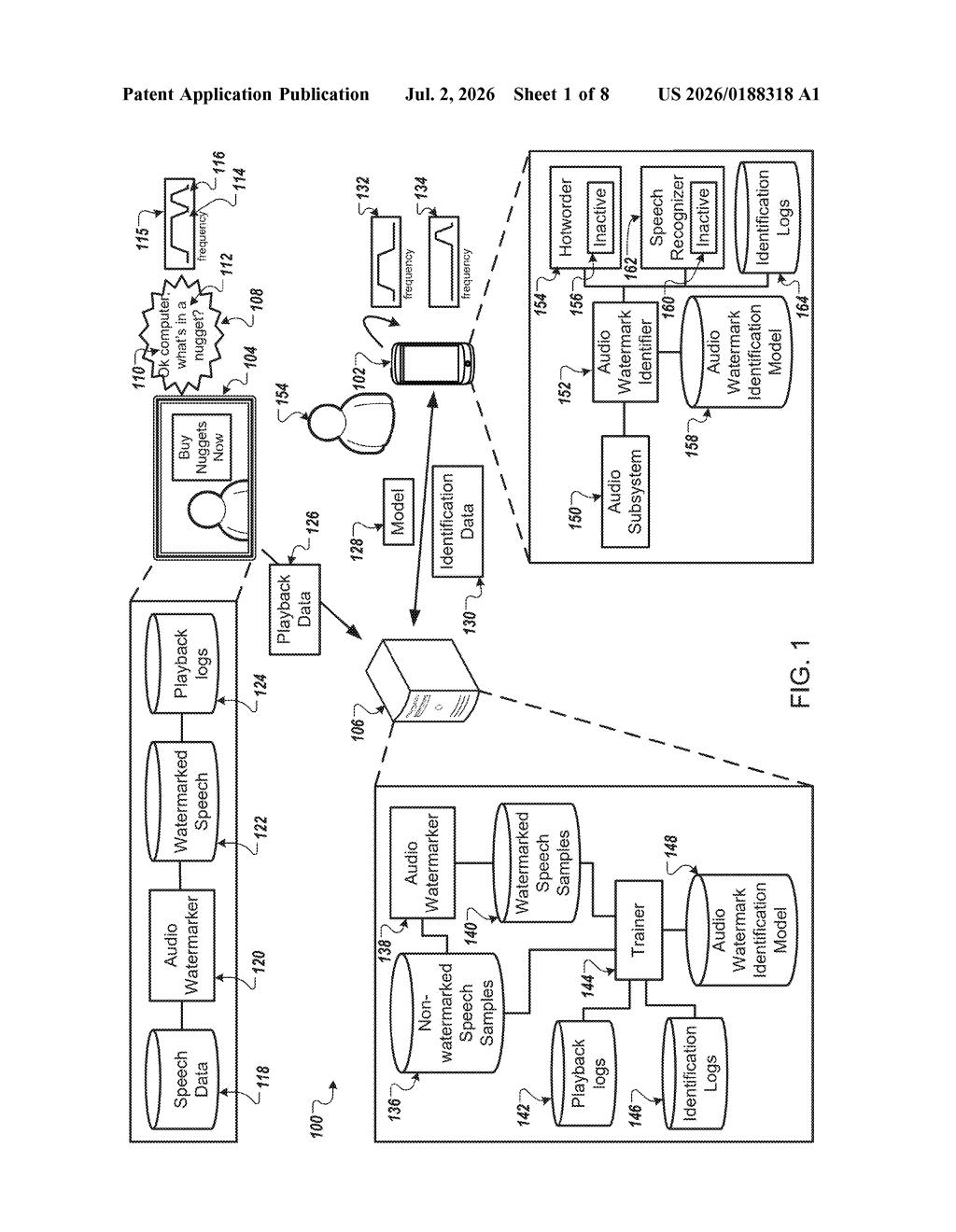
Why Google speakers sometimes talk to themselves
Imagine your Google Nest speaker plays a notification that begins with "Hey Google" and then accidentally triggers itself, launching into a loop of half-finished responses. It's a real problem, and it happens because the microphone can't tell the difference between your voice and the speaker's own output.
Google's solution is to tag the audio the speaker plays with an invisible audio watermark, a hidden signal baked into the sound that doesn't change how it sounds to you. When the microphone picks up that audio, a second system recognizes the watermark and tells the speaker: don't act on this, it came from you.
The patent also describes a neural network that can detect non-linguistic audio features in a recording, basically anything that isn't a real human speaking a real command, and use that as a signal to stop processing. Both approaches point at the same goal: making sure your assistant only responds to you, not to itself.
How audio watermarks tell the microphone to stand down
The patent covers two related but distinct mechanisms for preventing a voice-enabled device from acting on audio it generated itself.
The first approach is audio watermarking: before a device plays back speech containing a hotword (like "Hey Google"), it embeds a hidden marker in the audio signal. A receiving device, which could be the same unit or a nearby one, is trained to detect this marker and immediately stop processing the audio rather than treating it as a user command.
The second approach, described in the first independent claim, uses a neural network confidence score. The model analyzes incoming audio and assigns a probability that the audio contains a "non-linguistic audio feature" (meaning audio characteristics that differ from natural human speech, such as the telltale artifacts of synthesized or speaker-played sound). If that confidence score clears a threshold, the system halts processing before the speech recognition model ever runs.
- Watermark is added at playback time by the originating device
- Receiving device checks for the watermark before acting
- Separately, a neural net scores audio for non-human speech artifacts
- Either signal is enough to block command execution
The two methods can work together or independently, giving the system redundancy against false triggers.
What this means for Google Home and Nest devices
The problem this solves, called self-activation or echo-triggered wakeup, is one of the more annoying quirks of smart speakers. It tends to surface when a device reads out a message, plays content from a podcast, or speaks a response that happens to contain a trigger phrase. The result ranges from harmless (a confused "I didn't catch that") to genuinely problematic if the device executes an unintended command.
For Google, which sells the Nest Audio, Nest Mini, and Nest Hub line of home devices, fixing this cleanly matters both for user experience and for privacy optics. A speaker that reliably ignores its own voice is easier to trust. The watermarking approach is also interesting because it could scale across multiple devices in a home: one Google speaker could watermark audio that other Google speakers in earshot would then ignore.
This is unglamorous but genuinely useful engineering. Self-triggering assistants are one of those small daily irritations that erode trust in voice products over time, and the watermarking approach is a clean architectural fix rather than a band-aid. The neural network confidence-scoring path is particularly worth watching because it works even without a watermark, which means it could catch edge cases like a TV commercial or a YouTube video triggering a nearby speaker.
Get our take in your Top Stories
Liked this breakdown? Add Patentlyze as a preferred source on Google, and our plain-English take shows up more often in your Top Stories the next time Google patent news breaks.
There are more where this came from
We read every patent application Big Tech publishes and send you the ones worth knowing. Plain English, free, every week.
Want this weekly breakdown for a company we don't cover? Patentlyze Pro →