
Google Patent Turns Browser History Into Purpose-Specific AI Text Summaries
Google is patenting a system that reads your browser history and produces multiple AI-written summaries of your recent activity, each one shaped for a different use. Think of it as your web history translated into several different 'reports,' each written for a specific audience or purpose.
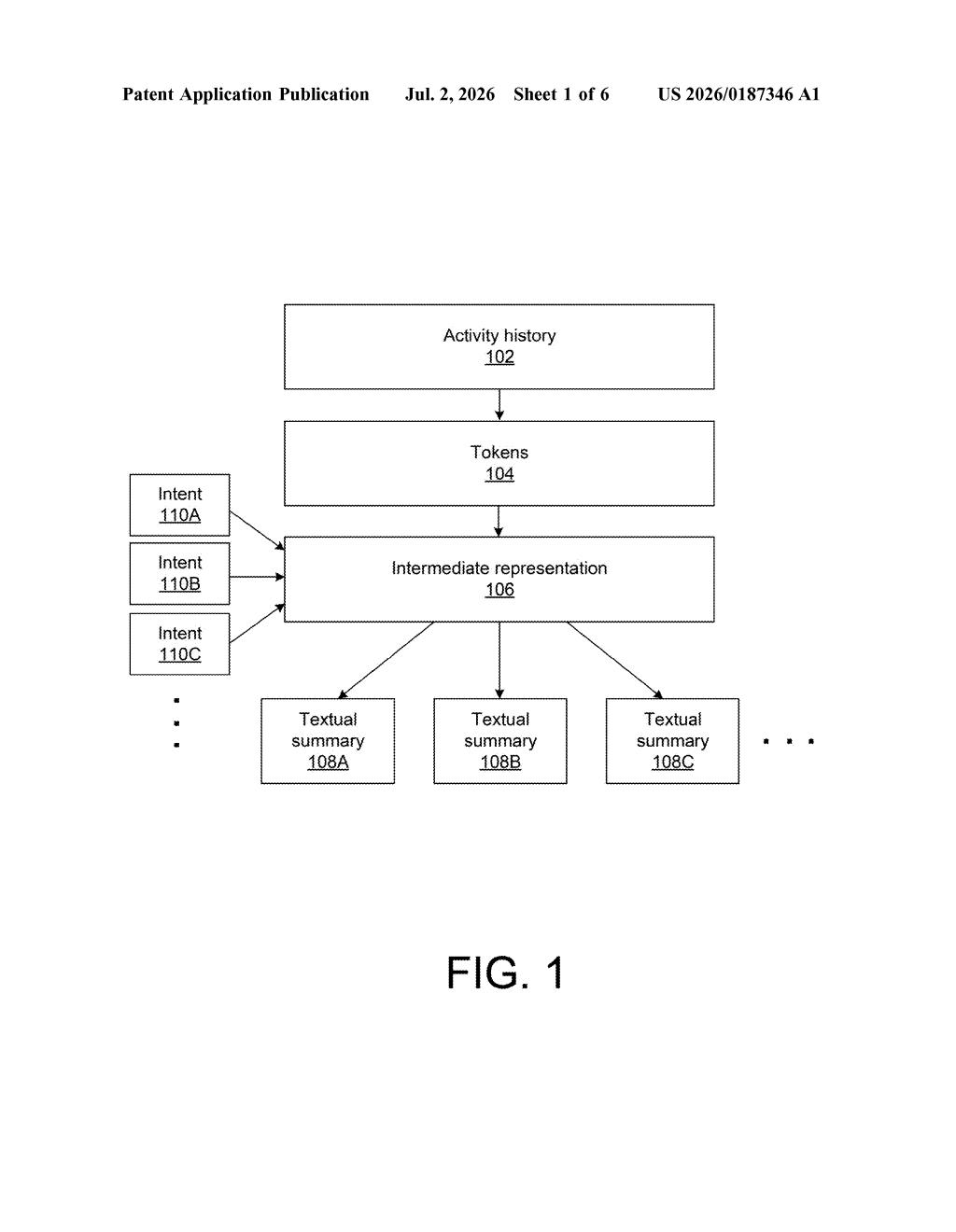
What Google's browsing-history summarizer actually does
Imagine someone skimming everything you've searched for and every page you've visited over the past few weeks, then writing a short report about you. Now imagine that same person writing several different versions of that report depending on who's asking: one version for a shopping assistant, another for a news recommender, another for an ad system. That's the core idea in this Google patent.
The system uses an AI language model to first build a kind of internal 'notes page' from your browser activity. It then uses those notes to generate multiple distinct written summaries, each aimed at a different goal. When something needs to know about you, it gets the version of the summary that fits best.
You don't see any of this directly. It runs in the background, attached to your Google account, and feeds whichever system is serving you content at that moment.
How the intermediate representation feeds multiple summaries
The patent describes a three-step pipeline built around a language model (an AI system like the kind that powers chatbots).
Step one: the intermediate representation. The system takes your browser history (the actions you've performed in a browser linked to a Google account) and asks the language model to compress it into a structured internal summary. This is the 'intermediate representation' (think of it as a condensed set of notes that captures the key patterns in your activity, without yet deciding what those notes are for).
Step two: multiple intent-specific summaries. From those notes, the system generates several separate plain-text summaries. Each one is written with a different 'intent' in mind, meaning a different downstream use case. One summary might describe you as a shopper; another might frame you as a news reader; another might focus on your research habits.
Step three: on-demand selection. When a Google service requests information about you, it specifies what it needs. The system picks the matching summary and uses it to shape the content you receive.
The key efficiency claim is that the intermediate representation is built once and then reused to generate many summaries, rather than re-reading your entire history every time.
What this means for Google's ads and AI assistant plans
Google's core business is showing you things it thinks you want, whether those are ads, search results, or recommendations in products like Discover or YouTube. A system that maintains several up-to-date written profiles of you, each optimized for a specific context, would give Google's AI products a much richer picture to work from than raw click data alone.
For you, the more immediate question is privacy. Your browser activity already feeds Google's ad targeting, but converting that history into explicit natural-language summaries attached to your account is a qualitatively different kind of record. It's the difference between a log of your actions and a written description of who you are as a user. How those summaries are stored, shared across products, or surfaced to you will matter a lot.
This is a meaningful filing. Google is essentially describing a persistent, AI-written user profile built from browser behavior, with multiple flavors tuned for different products. That has real implications for how Google's AI assistant and ad systems get personalized, and it's the kind of infrastructure work that shapes what you see across all of Google's products.
Get our take in your Top Stories
Liked this breakdown? Add Patentlyze as a preferred source on Google, and our plain-English take shows up more often in your Top Stories the next time Google patent news breaks.
There are more where this came from
We read every patent application Big Tech publishes and send you the ones worth knowing. Plain English, free, every week.
Want this weekly breakdown for a company we don't cover? Patentlyze Pro →