
Nvidia Patent: A Self-Correcting AI Layer That Keeps Machine Control Predictions Accurate
Nvidia has filed a patent for a system where a machine learning model sits on top of a robot's control brain, watches it make mistakes, and patches the underlying physics model before the next move. It's essentially a spell-checker for robots.
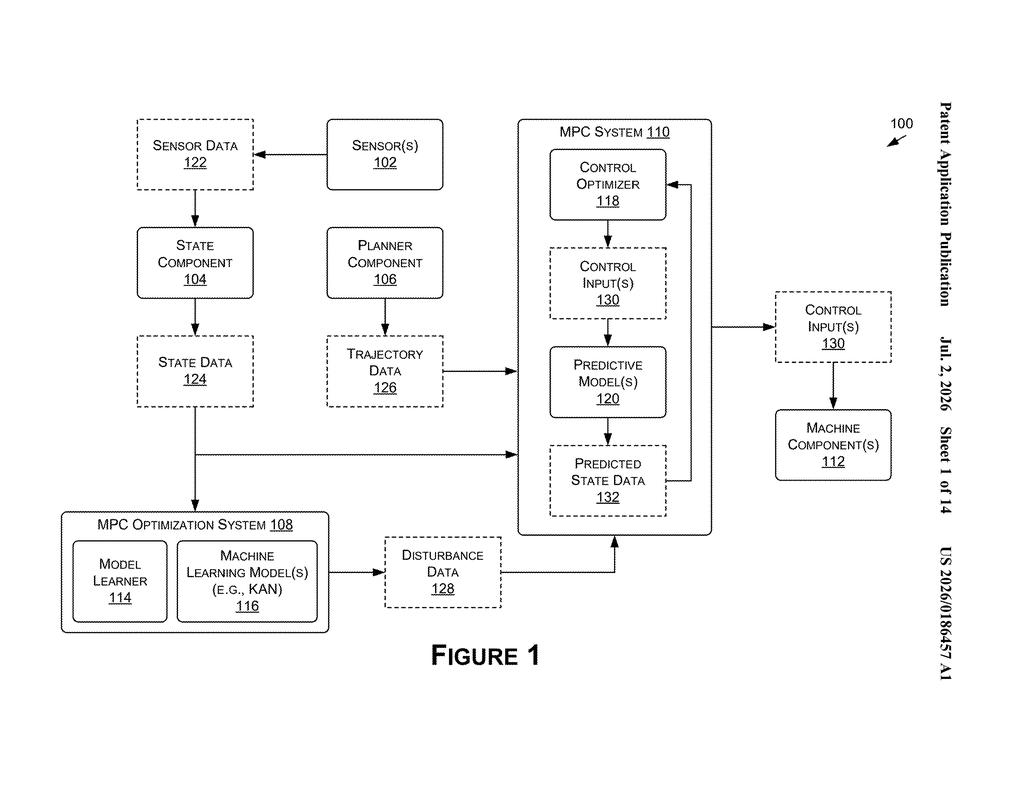
How Nvidia's self-correcting robot control loop works
Imagine teaching a dog to catch a ball. The dog builds a rough mental model of how the ball travels through the air, but wind, spin, and uneven grass keep throwing it off. Now imagine a second process watching the dog's predictions, comparing them to what actually happens, and tweaking that mental model on the fly.
That's roughly what Nvidia's patent describes, but for robots and autonomous machines. At the heart of every modern robot is a system called model predictive control, which uses a built-in physics model to plan future moves. The problem is those models are never perfectly accurate. Nvidia's idea is to wrap that control system with a separate AI that spots the gaps between what the model predicted would happen and what actually happened, then corrects the model before the next action.
If the errors get too large, the AI retrains itself on fresh data so it can keep up with new conditions, like different terrain, a payload change, or equipment wear. The robot doesn't stop. It just gets better while running.
How the KAN layer patches the predictive model mid-operation
The patent describes a two-layer architecture sitting inside a machine's control pipeline. The inner layer is the existing model predictive control (MPC) system, a standard engineering approach where a machine runs a fast internal simulation to plan its next several actions at once, choosing whichever plan looks best. The outer layer is a new Kolmogorov-Arnold Network (KAN), a type of machine learning model that is particularly good at learning smooth, structured mathematical functions.
The KAN's job is to predict the error between the MPC's internal physics model and reality. Specifically:
- The system feeds the KAN real sensor readings from the machine.
- The KAN predicts how much the MPC's simulated state will differ from the true measured state.
- Those predicted error values are used to update the parameters inside the MPC's model, tightening the gap between simulation and reality.
- The corrected MPC then generates updated control commands.
If the predicted errors grow beyond a set threshold, the system flags that conditions have changed enough to warrant a full retraining of the KAN using the latest data. This keeps the correction layer itself from drifting out of date. The whole loop is designed to run in real time, meaning the machine doesn't need to pause, reset, or be manually recalibrated.
What this means for robots and autonomous machines in the real world
Robot control systems fail in the field because the model they were built on stops matching reality: a motor wears down, the ground changes, a payload shifts. Right now, fixing that usually means stopping the machine and recalibrating it by hand, or accepting degraded performance. Nvidia's approach keeps the model accurate continuously, which is a meaningful practical difference for anything running in an uncontrolled environment.
This fits squarely into Nvidia's push into robotics and autonomous systems through its Isaac platform. A self-correcting control layer would make robots shipped with imperfect or simplified physics models far more reliable over time, without human intervention. For industrial robots, drones, or autonomous vehicles, that kind of adaptability translates directly into fewer failures and cheaper operation.
This is genuinely useful engineering, not a flashy demo patent. The specific choice of Kolmogorov-Arnold Networks is notable because KANs are a relatively new architecture that trades the brute-force scale of standard neural nets for something more interpretable and efficient at learning structured functions, which is exactly what you want when you're patching a physics model. This is a well-targeted application of a new tool.
Get our take in your Top Stories
Liked this breakdown? Add Patentlyze as a preferred source on Google, and our plain-English take shows up more often in your Top Stories the next time Nvidia patent news breaks.
There are more where this came from
We read every patent application Big Tech publishes and send you the ones worth knowing. Plain English, free, every week.
Want this weekly breakdown for a company we don't cover? Patentlyze Pro →