
Samsung Patents Technology That Colors 3D Images by Tracking How Light Hits Each Tiny Cube of Space
Samsung is patenting a structured way to calculate how light hits a point in a 3D scene and what color that point should appear from your viewing angle. It's a foundational piece of the ray-tracing puzzle, described here in careful technical detail.
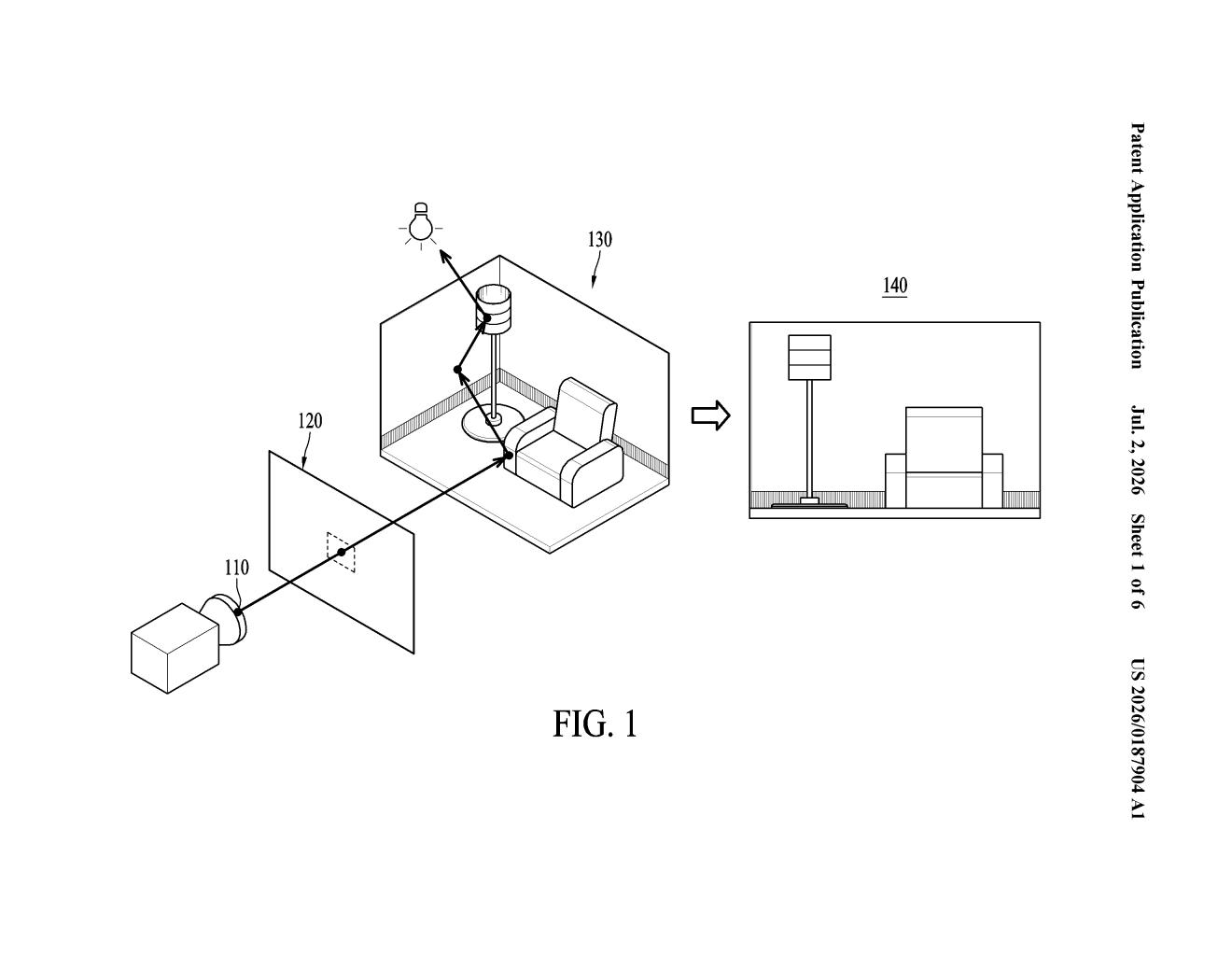
How Samsung figures out the color of a 3D scene pixel
Imagine a 3D video game or a virtual reality scene. Every pixel you see on screen has a color, and figuring out that color is surprisingly hard work. The engine needs to trace an imaginary ray from your eye through the screen toward whatever object you're looking at, then figure out how much light is arriving at that spot from every direction.
Samsung's patent describes a method for doing that calculation using a grid of 3D blocks called voxels (think of them like tiny cubes that divide up a 3D space). Instead of recalculating lighting from scratch for every pixel, the system stores pre-organized light information in each voxel, broken into mathematical building blocks called bases. When you look at a point in the scene, it reads those stored values and quickly works out exactly how bright and what color that point should appear from your angle.
The goal is faster, more accurate color in rendered 3D images without doing the full physics calculation every single time. That kind of efficiency matters for things like augmented reality headsets, 3D content on phones, and game streaming.
How the voxel radiance lookup and basis decomposition work
The patent describes a rendering pipeline step focused on view-dependent radiance, meaning the color a point in a 3D scene shows depends on where you're looking from.
Here's the sequence the method follows:
- A virtual ray is cast from the viewer's position (the viewpoint) through a target pixel on the 2D image plane into the 3D scene.
- The system identifies the target voxel, the small 3D cube in the scene grid that contains the point where the ray lands.
- It records the incident direction, the angle at which the ray arrives at that point.
- It retrieves radiance information stored per voxel, organized across multiple mathematical bases (basis decomposition is a technique that breaks a complex function, like how light bounces, into simpler components that are cheaper to store and evaluate).
- It combines the incident direction with those stored basis values to produce the final radiance, the color and brightness value assigned to that pixel.
This approach is closely related to Neural Radiance Fields (NeRF) and similar volumetric scene representations, where 3D space is encoded as a grid of light-data-laden voxels rather than traditional polygon meshes. Using pre-computed basis representations per voxel speeds up the color lookup compared to running a full neural network query for every pixel.
What this means for real-time 3D rendering on Samsung devices
Real-time 3D rendering is a bottleneck for augmented reality, spatial computing, and high-fidelity mobile games. The more cheaply you can resolve pixel color in a scene, the smoother and more power-efficient the experience. A voxel-plus-basis approach like this one could help Samsung's XR hardware or its GPU-equipped chips handle complex lighting without draining a battery in minutes.
This is also the kind of foundational rendering patent that tends to show up before a product launch. Samsung has been developing its own XR headset hardware and continues to build out its Exynos chip line. A faster, more structured 3D color method fits cleanly into both roadmaps.
This is a solid but specialized rendering-pipeline patent, not a splashy consumer feature. It matters because efficient voxel-based radiance lookup is exactly the kind of under-the-hood work that separates a smooth AR experience from a choppy one. If Samsung ships an XR device in the next few years, patents like this are the plumbing.
Get our take in your Top Stories
Liked this breakdown? Add Patentlyze as a preferred source on Google, and our plain-English take shows up more often in your Top Stories the next time Samsung patent news breaks.
There are more where this came from
We read every patent application Big Tech publishes and send you the ones worth knowing. Plain English, free, every week.
Want this weekly breakdown for a company we don't cover? Patentlyze Pro →