
Intel Patents a Chip That Locks Your Data While Still Running Calculations on It
Imagine sending your bank a locked box and having it count your money without ever opening it. That's the promise of fully homomorphic encryption, and Intel just filed a patent for chip hardware designed to make it practical.
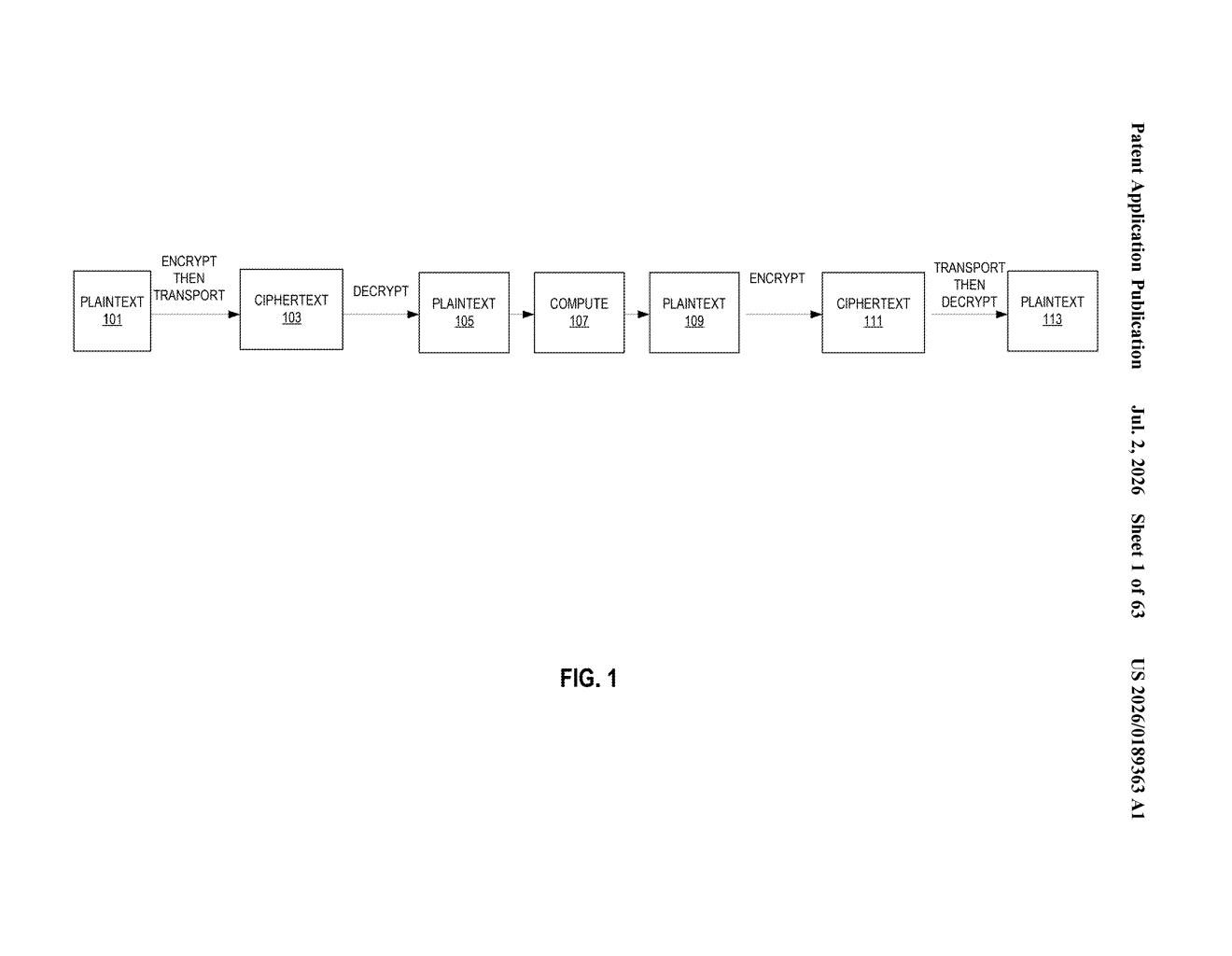
What Intel's encrypted-computing chip circuit actually does
Most encryption works like this: you lock your data, send it somewhere, the other party unlocks it to do their work, then locks it again. Every unlock is a moment of exposure. Fully homomorphic encryption (FHE) skips the unlock step entirely, letting a computer crunch numbers on data that stays scrambled the whole time.
The catch is that FHE is extraordinarily slow on regular hardware, often thousands of times slower than working on unencrypted data. Intel's patent describes a dedicated hardware circuit, essentially a specialized corner of a chip, built from the ground up to run FHE math fast. It handles the specific kind of heavy arithmetic that FHE requires, using a single instruction to trigger what would otherwise take many steps.
This is infrastructure work, not a consumer product. But if Intel can make FHE fast enough to use in practice, it changes what's possible for private cloud computing, where a company could, for example, let an AI service analyze sensitive health records without those records ever being readable by the service doing the analysis.
How the butterfly circuit handles polynomial math on ciphertext
FHE works by turning ordinary numbers into large mathematical objects called polynomials (think of them as very long lists of numbers that follow specific rules), then doing arithmetic on those polynomials instead of the original data. The results, when properly decoded with a private key, match what you'd get if you'd done the math on the plain data directly.
The core of Intel's patent is a piece of circuitry called a butterfly compute unit. The "butterfly" name comes from the shape of the data-flow diagram used in fast Fourier transforms, a well-known algorithm for speeding up polynomial math. Intel's version is designed to execute a single chip instruction that triggers a full polynomial integer multiplication, pulling two input values from a register file (a bank of on-chip storage) and writing the result back, all in one go.
The circuit also handles modular arithmetic, which means all the math is kept within a fixed numerical range by wrapping around at a set boundary (like clock arithmetic, where 13:00 becomes 1:00 PM). FHE requires this constantly, and doing it in dedicated silicon is far faster than doing it in software on a general-purpose CPU.
- Register file stores the large polynomial operands on-chip
- Single instruction triggers the full multiplication, reducing overhead
- Modular arithmetic support keeps FHE's number-wrapping operations efficient
What this means for private cloud computing and AI
The practical blocker for FHE today is speed. It's mathematically sound and cryptographically strong, but running it in software on a standard processor makes even simple operations take seconds or minutes. A chip-level accelerator is the most direct path to making FHE usable in real-world systems like cloud AI inference, medical data analysis, or financial computation, where the organization doing the work should never see the underlying data.
Intel filing this suggests the company sees FHE hardware as a near-term product category, not a research curiosity. If Intel builds this into future server chips or discrete accelerators, it could give cloud providers a concrete way to offer privacy guarantees that go well beyond current encryption standards, which is a real competitive differentiator as data-privacy regulations tighten globally.
This is a narrow but important patent. FHE has been a cryptographer's dream for decades, and the only thing standing between it and widespread use is raw hardware speed. Intel targeting that bottleneck at the instruction-set and circuit level is exactly the right approach. Whether this becomes a shipping product or gets buried in Intel's IP portfolio is the real question.
Get our take in your Top Stories
Liked this breakdown? Add Patentlyze as a preferred source on Google, and our plain-English take shows up more often in your Top Stories the next time Intel patent news breaks.
There are more where this came from
We read every patent application Big Tech publishes and send you the ones worth knowing. Plain English, free, every week.
Want this weekly breakdown for a company we don't cover? Patentlyze Pro →