
Patent Targets Hidden Flaws That Cause Quantum Computers to Produce Wrong Answers
Quantum computers are only as good as the accuracy of their operations, and right now microscopic material defects are one of the biggest reasons those operations go wrong. Google has filed a patent for a system that predicts exactly when and how those defects will cause trouble, then tunes the hardware to avoid them.
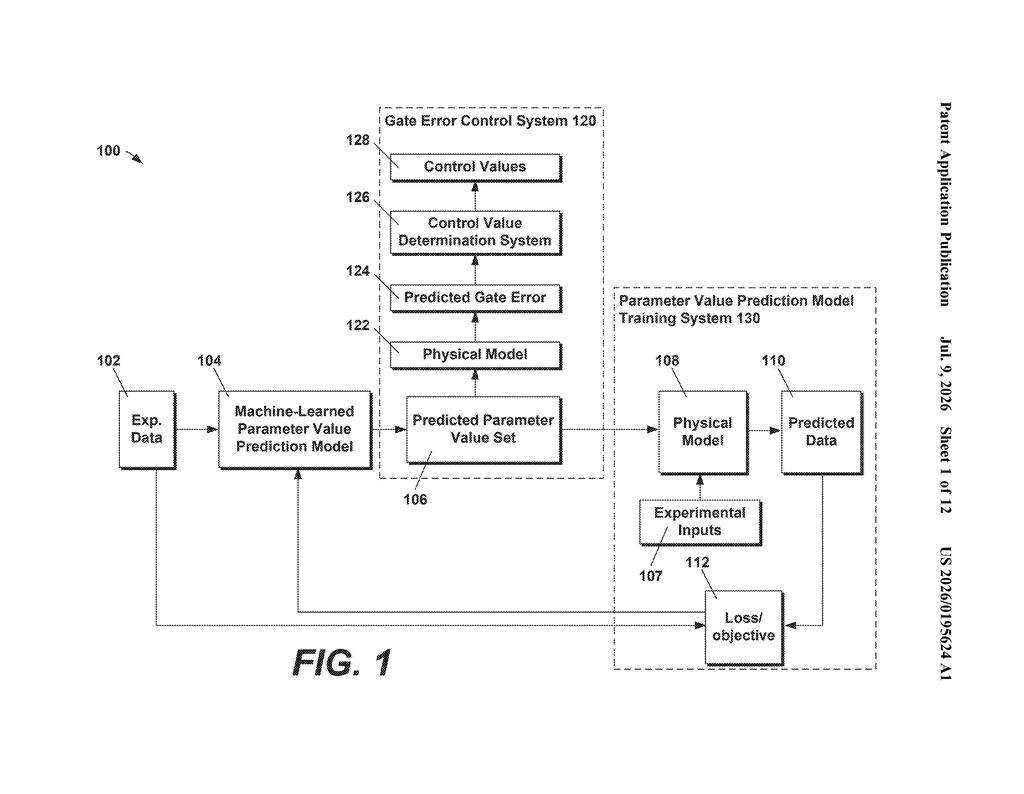
What Google's quantum gate fidelity system actually does
Imagine trying to do precise arithmetic, but your calculator randomly flips numbers because of tiny scratches on its circuit board. That's roughly the problem facing quantum computers today. The microscopic materials used to build them contain small imperfections, and those imperfections interfere with calculations in ways that are hard to predict or fix.
Google's patent describes a system that builds a detailed mathematical picture of how those defects behave during a quantum operation. It uses that picture to predict how accurate a given operation will be, then automatically adjusts the operating frequency of the quantum gate (think of a gate as one step in a calculation) to steer clear of the worst interference.
The goal is to give quantum computers a way to self-tune around their own flaws, improving reliability without requiring engineers to physically redesign the hardware every time a new defect shows up.
How swap spectroscopy models quantum defect interference
The patent centers on a technique called swap spectroscopy, which is a way of probing a quantum processor to find hidden defects. Specifically, it looks for two-level-system (TLS) defects, tiny impurities or structural irregularities in the materials that make up a quantum chip. These defects behave like miniature quantum objects themselves, and they can absorb energy from the qubits (the basic units of a quantum computer) in ways that scramble calculations.
What makes this especially tricky is that the interference is non-Markovian (meaning the defect's past behavior affects its current behavior, rather than each moment being independent). Standard error-correction models often assume the noise is simpler than that, so they underperform against this kind of defect.
Google's system builds a physical model of these interactions and uses it to predict gate fidelity (a measure of how accurately a quantum gate performs its intended operation) at different operating frequencies. The key steps are:
- Run swap spectroscopy experiments to identify where TLS defects are located in frequency space
- Feed that data into the physical model to predict fidelity at any given operating frequency
- Select the frequency where predicted fidelity is highest
- Control the quantum gate to operate at that frequency
This is essentially a closed-loop tuning system: measure the problem, model it, find the best workaround, apply it.
What this means for the future of practical quantum computing
Quantum computers are currently in what researchers call the NISQ era (noisy intermediate-scale quantum), meaning errors are common and limiting. TLS defects are one of the leading causes of those errors in superconducting quantum processors, which is the technology Google uses in its Sycamore chips. A system that can automatically identify and work around these defects would directly improve the reliability of every calculation the machine runs.
For you as an end user, this matters because it moves quantum computing closer to being practically useful for things like drug discovery, materials science, or financial modeling. Better gate fidelity means fewer errors per operation, which means you need fewer redundant calculations to get a trustworthy answer.
This is genuinely important infrastructure work, not a flashy announcement. TLS defects are a well-known bottleneck in superconducting quantum hardware, and a principled, automated way to characterize and avoid them addresses a real engineering problem. It won't make headlines the way a new qubit count record does, but this kind of fidelity engineering is what separates a research novelty from a machine that can actually do useful work.
Get our take in your Top Stories
Liked this breakdown? Add Patentlyze as a preferred source on Google, and our plain-English take shows up more often in your Top Stories the next time Google patent news breaks.
There are more where this came from
We read every patent application Big Tech publishes and send you the ones worth knowing. Plain English, free, every week.
Want this weekly breakdown for a company we don't cover? Patentlyze Pro →