
Microsoft Patents a Per-Customer Early Warning System for Cloud Slowdowns
Most cloud monitoring watches the whole network at once, which means small problems affecting specific customers get buried in the noise. Microsoft's new patent flips that around, building a personal baseline for every single customer and flagging trouble before it shows up in the aggregate numbers.
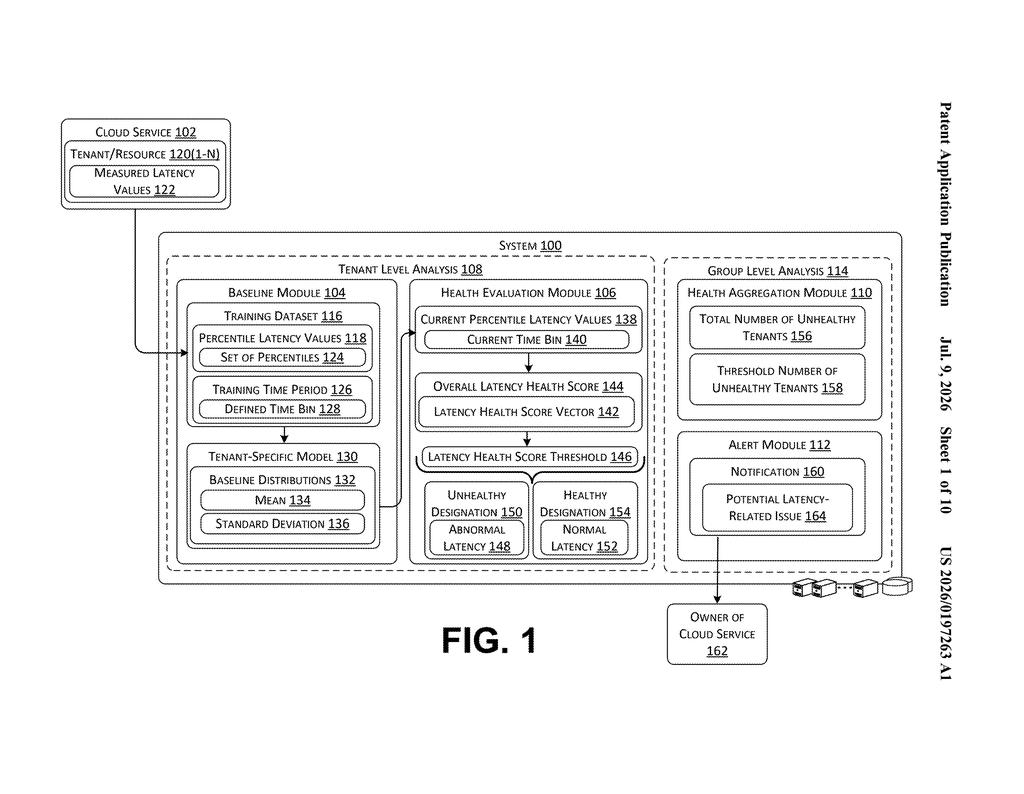
How Microsoft tracks cloud speed problems customer by customer
Imagine a coffee shop that only notices the espresso machine is broken when every customer starts complaining at once. A smarter approach would be to track each regular's usual wait time and flag the moment their order takes longer than normal, well before the line backs up.
That's the logic behind this Microsoft patent. When you use a cloud service like Microsoft 365 or Azure, your traffic has a predictable rhythm. Requests tend to arrive and respond in a pattern specific to your organization. This system learns that pattern for each customer individually, then watches for the moment your experience drifts away from your own normal.
Once enough individual customers are flagged as "unhealthy," the system sends an alert to the team running that service. The idea is to catch real slowdowns faster and with fewer false alarms, because the signal comes from many customers each deviating from their own baseline, not from a single noisy average.
How the tenant health score and alert threshold work together
The patent describes a multi-stage detection pipeline built around what it calls tenant-specific models. A "tenant" in cloud-service terms is a single customer organization, the way a company renting one floor of an office building is a tenant.
For each tenant, the system:
- Analyzes historical latency data over a training window to build a statistical distribution (a profile of "normal" response times for that customer)
- Continuously compares incoming latency readings against that distribution to produce a latency health score
- Labels the tenant "unhealthy" if the score drops below a threshold, meaning their experience is deviating significantly from their own historical norm
Once binary healthy/unhealthy labels exist for all tenants, the system counts how many are currently unhealthy. If that count crosses a second, predefined threshold, the service's owner receives an automated alert about a potential platform-wide latency problem.
The two-stage design matters. A single customer having a bad day could mean anything: a misconfigured app, a local network issue, a spike in their own usage. But many customers simultaneously deviating from their individual baselines points to something wrong with the shared infrastructure itself.
What this means for Azure reliability and enterprise customers
For enterprise customers running critical workloads on Azure or Microsoft 365, slow incident detection translates directly into downtime costs. A system that spots trouble at the individual-customer level before it registers on broad platform monitors could shrink the gap between "something is wrong" and "engineers are paging in."
For Microsoft, faster and more accurate alerting also means fewer false positives that burn out on-call engineers. The patent's per-tenant approach is particularly well suited to cloud platforms where customers have wildly different usage volumes and the same absolute latency number means something very different to a small startup versus a Fortune 500 company running millions of requests per hour.
This is solid, practical infrastructure engineering, not a flashy AI story. Per-customer baselines are a genuinely better approach to anomaly detection in multi-tenant cloud systems than platform-wide averages, and the two-threshold design (individual score, then aggregate count) is a clean way to separate noise from real incidents. It won't make headlines, but the kind of operations teams who manage Azure reliability will recognize the problem it solves immediately.
There are more where this came from
We read every patent application Big Tech publishes and send you the ones worth knowing. Plain English, free, every week.
Want this weekly breakdown for a company we don't cover? Patentlyze Pro →
Be the first to weigh in