Microsoft
Microsoft · AI / ML · Filed Dec 30, 2024 · USPTO published Jul 2, 2026 · Jul 2 release
Microsoft Patent Targets Cross-Agent Memory Sharing in Multi-Agent AI Systems
When you ask an AI assistant to do something complicated, it often forgets what a different part of itself already figured out. Microsoft has filed a patent for a system that fixes exactly that, by giving AI agents a shared, searchable memory they can draw from when helping each other.
- Publication number
- US 2026/0186828 A1(US20260186828A1)
- Applicant
- Microsoft Technology Licensing, LLC
- Filed · Published
- Dec 30, 2024 · Jul 2, 2026
- Inventors
- Juan Pablo Bottaro, Gokulraj Mohanasundaram, Keren Baruch, Kevin Arcara, Amol Chandla, Vivek Katarya, Christopher Ng, David Nicolas Racca, Santhosh Sachindran, Jeffrey Wang
- Status when we published
- Examiner raised objections; the company can respond
- Document
- 20 claims
- US classification
- 718/102
- Examiner
- HUARACHA, WILLY W (Art Unit 2197)
How Microsoft's AI agents pass context to each other
Imagine asking an AI assistant to plan a work trip. One part of the AI handles your calendar, another handles travel bookings, and a third manages your budget preferences. The problem is that each of those parts often starts from scratch, with no idea what the others already know about you.
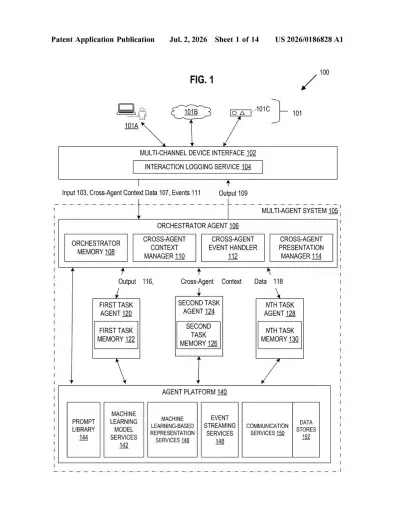
Microsoft's patent describes a coordinator AI (called an orchestrator) that, before handing a task off to a specialized AI agent, searches a shared memory layer for relevant context from past interactions. So if the travel-booking agent already knows you prefer window seats and avoid red-eye flights, that information gets passed along automatically to the calendar agent too.
The memory itself works in two layers: one stores the raw conversation history, and another stores compressed, learned representations of what those conversations meant. The orchestrator searches the second layer to find the most relevant context, then bundles it with the task before sending it to whichever agent needs to act.
How the orchestrator searches and routes shared memory
The patent describes a multi-agent application system where a central orchestrator agent manages a team of specialized task agents. When a user sends a request, the orchestrator doesn't just assign the task and move on. It first runs a search against a multi-layer memory store to pull in relevant background before any agent starts working.
The memory has two distinct layers:
- Layer one stores raw conversation logs between the orchestrator and the various task agents, essentially a transcript of past work sessions.
- Layer two stores machine learning-based representations of those interactions (think of them as compressed summaries that capture meaning, not just words), which makes searching for relevant context much faster and more accurate.
When a task comes in, the orchestrator formulates a search query using both the user's input and the identified task type, then queries layer two. The results, called cross-agent context data, are extracted and bundled with the task before being routed to the appropriate agent. That agent then uses this shared context to generate its response.
The key detail is that this context can originate from a different agent than the one receiving it. One agent's prior work informs another agent's current task, without either agent needing to communicate directly in real time.
What this means for AI assistants handling complex jobs
Most AI agent systems today are either stateless (each session starts fresh) or share context only within a single conversation thread. Microsoft's approach builds a persistent, cross-agent memory that survives across sessions and across agent boundaries. For anyone using an AI platform to handle multi-step workflows (think enterprise tools, coding assistants, or customer service bots), this could mean far less repetition and fewer errors caused by one agent not knowing what another already established.
From a product strategy angle, this fits Microsoft's heavy investment in Copilot and agent-based AI across its Microsoft 365 and Azure platforms. A system like this would make those agents considerably more coherent over time, which is a key complaint users have with today's AI tools.
Source: US 2026/0186828 A1 at the USPTO (PDF). Full patent text and figures are in the official publication.
Get our take in your Top Stories
Liked this breakdown? Add Patentlyze as a preferred source on Google, and our plain-English take shows up more often in your Top Stories the next time Microsoft patent news breaks.
Add Patentlyze on Google
One click.
There are more where this came from
We read the new patents from Big Tech, carmakers and more and send you the ones worth knowing. Plain English, free, every week.
More from Microsoft
All 681 Microsoft patents →
More in AI assistant & agent
All 436 AI assistant & agent patents →
Google
Google Patents a Multi-Agent System That Merges Conflicting AI Prompts
IBM
IBM Patents a Shared-Layer System for Running Multiple Fine-Tuned AI Models at Once
IBM
IBM Patents a Self-Organizing System That Stops LLMs From Confusing Their Own Tools
IBM