
Samsung Patents a Wearable That Lets You Feel the Weight of Virtual Objects
Picking up a virtual sword and actually feeling it pull on your hand sounds like science fiction. Samsung just filed a patent describing exactly that, using tiny magnetic particles pumped into a wearable glove.
What Samsung's magnetic-particle VR glove actually does
Imagine grabbing a heavy box in a VR meeting room and feeling your hand strain under the weight, even though nothing is actually there. Right now, VR headsets can show you that box in vivid detail, but your hand feels nothing. Samsung wants to fix that.
The idea is a wearable device, think a glove or sleeve, filled with nano-magnetic particles: microscopic bits of magnetic material that can be moved around by a magnetic field. When your VR avatar picks up an object, the system calculates where that object's center of gravity is and how your hand would naturally grip it, then shifts those particles to the right spots on your real hand to mimic the pressure and weight.
The result, if it works as described, is that you would feel a heavy virtual book pressing differently on your palm than a light pen would. It is aimed squarely at virtual meetings and social VR spaces, where actually feeling a handshake or a shared object could make the experience feel far more real.
How nano-magnetic particles simulate grip and weight
The patent describes a full pipeline that connects what happens in the virtual world to what your hand physically feels.
- Interaction detection: VR circuitry monitors your avatar's hands in real time. The moment your avatar grabs, pushes, or even shakes hands with another avatar, the system flags it as a physical action.
- Magnitude measurement: The system calculates the physical properties of the virtual object, including its mass, center of mass (the point where its weight is balanced), and the exact contact points between the avatar's hand and the object's surface.
- Particle routing: Based on those calculations, the wearable device redirects nano-magnetic particles into specific regions of the user's real hand. A top-heavy virtual object would concentrate more particle pressure toward the fingertips; a balanced one would spread it more evenly across the palm.
- Emulation in real time: The wearable activates and adjusts continuously as the avatar moves the object, so shifting the virtual item from one hand to the other would change the pressure distribution accordingly.
The claim is broad enough to cover not just object weight but any physical avatar interaction, including collisions between avatars, which suggests Samsung envisions this for social VR scenarios like handshakes or high-fives, not just object manipulation.
What this means for the future of VR touch
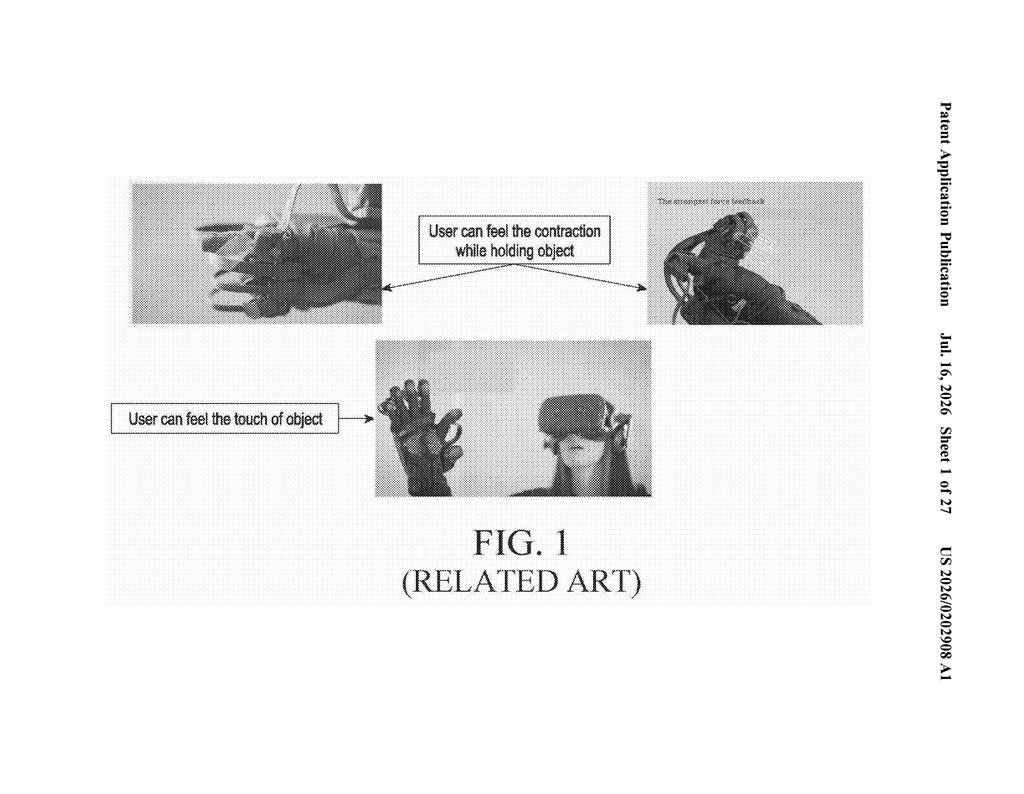
The biggest complaint about VR today is that it is only visual and auditory. You see and hear a virtual world, but touch is completely absent, which constantly breaks the illusion. A system that delivers even a rough approximation of weight and pressure would be a meaningful step toward VR feeling genuinely physical.
Samsung is clearly positioning this for virtual collaboration and social VR, markets where Meta and Apple are also spending heavily. If this kind of haptic feedback ever makes it into a consumer product, it would change what you expect from a VR meeting or a virtual game. The magnetic-particle approach is unusual compared to the vibration motors most current haptic gloves use, and it could theoretically simulate sustained pressure rather than just quick buzzes.
This is a genuinely interesting approach to a real problem in VR. Most haptic patents describe vibration patterns; using reconfigurable magnetic particles to simulate distributed weight and grip pressure is a different and more ambitious idea. The gap between 'filed a patent' and 'ships in a consumer glove' is enormous here, but the underlying concept is worth tracking.
There are more where this came from
We read every patent application Big Tech publishes and send you the ones worth knowing. Plain English, free, every week.
Want this weekly breakdown for a company we don't cover? Patentlyze Pro →
Be the first to weigh in