
Samsung
Samsung · AR / VR · Filed Mar 12, 2026 · USPTO published Jul 16, 2026 · Jul 16 release
Samsung Patents a Wearable That Lets You Feel the Weight of Virtual Objects
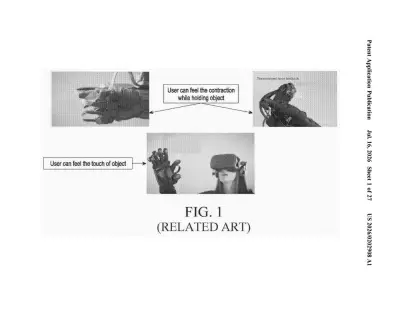
Picking up a virtual sword and actually feeling it pull on your hand sounds like science fiction. Samsung just filed a patent describing exactly that, using tiny magnetic particles pumped into a wearable glove.
- Publication number
- US 2026/0202908 A1(US20260202908A1)
- Applicant
- Samsung Electronics Co., Ltd.
- Filed · Published
- Mar 12, 2026 · Jul 16, 2026
- Inventors
- Dewanshu HASWANI, Vijay Narayan TIWARI, Anupam AGGARWAL
- Status when we published
- Waiting for an examiner
- Document
- 20 claims
- US classification
- 345/156
- Parent application
- Continuation of PCT/KR2024/096180 (filed Sep 19, 2024)(PCTKR2024096180)
What Samsung's magnetic-particle VR glove actually does
Imagine grabbing a heavy box in a VR meeting room and feeling your hand strain under the weight, even though nothing is actually there. Right now, VR headsets can show you that box in vivid detail, but your hand feels nothing. Samsung wants to fix that.
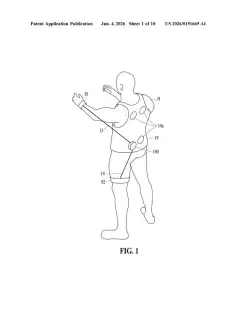
The idea is a wearable device, think a glove or sleeve, filled with nano-magnetic particles: microscopic bits of magnetic material that can be moved around by a magnetic field. When your VR avatar picks up an object, the system calculates where that object's center of gravity is and how your hand would naturally grip it, then shifts those particles to the right spots on your real hand to mimic the pressure and weight.
The result, if it works as described, is that you would feel a heavy virtual book pressing differently on your palm than a light pen would. It is aimed squarely at virtual meetings and social VR spaces, where actually feeling a handshake or a shared object could make the experience feel far more real.
How nano-magnetic particles simulate grip and weight
The patent describes a full pipeline that connects what happens in the virtual world to what your hand physically feels.
- Interaction detection: VR circuitry monitors your avatar's hands in real time. The moment your avatar grabs, pushes, or even shakes hands with another avatar, the system flags it as a physical action.
- Magnitude measurement: The system calculates the physical properties of the virtual object, including its mass, center of mass (the point where its weight is balanced), and the exact contact points between the avatar's hand and the object's surface.
- Particle routing: Based on those calculations, the wearable device redirects nano-magnetic particles into specific regions of the user's real hand. A top-heavy virtual object would concentrate more particle pressure toward the fingertips; a balanced one would spread it more evenly across the palm.
- Emulation in real time: The wearable activates and adjusts continuously as the avatar moves the object, so shifting the virtual item from one hand to the other would change the pressure distribution accordingly.
The claim is broad enough to cover not just object weight but any physical avatar interaction, including collisions between avatars, which suggests Samsung envisions this for social VR scenarios like handshakes or high-fives, not just object manipulation.
What this means for the future of VR touch
The biggest complaint about VR today is that it is only visual and auditory. You see and hear a virtual world, but touch is completely absent, which constantly breaks the illusion. A system that delivers even a rough approximation of weight and pressure would be a meaningful step toward VR feeling genuinely physical.
Samsung is clearly positioning this for virtual collaboration and social VR, markets where Meta and Apple are also spending heavily. If this kind of haptic feedback ever makes it into a consumer product, it would change what you expect from a VR meeting or a virtual game. The magnetic-particle approach is unusual compared to the vibration motors most current haptic gloves use, and it could theoretically simulate sustained pressure rather than just quick buzzes.
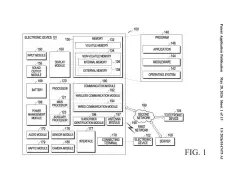
Source: US 2026/0202908 A1 at the USPTO (PDF). Full patent text and figures are in the official publication.
Get our take in your Top Stories
Liked this breakdown? Add Patentlyze as a preferred source on Google, and our plain-English take shows up more often in your Top Stories the next time Samsung patent news breaks.
Add Patentlyze on Google
One click.
There are more where this came from
We read the new patents from Big Tech, carmakers and more and send you the ones worth knowing. Plain English, free, every week.
More from Samsung
All 1,662 Samsung patents →
More in AR / VR
All 718 AR / VR patents →
Sony
Sony Patents Real-Time Environmental Reflections for AR Virtual Objects
Apple
Apple Patents a Way to Flip Virtual Windows from Walls to Tabletops in 3D Space
Apple
Apple Patents a Virtual Store Where You Can Swap Accessories and Try On Products
Samsung