
Samsung Patents a Way to Start Wi-Fi Device Pairing Over Bluetooth
Samsung is working on a method that lets two devices find each other over Bluetooth and then switch to a direct Wi-Fi link, without needing a router in the middle. It's a small protocol tweak with some real-world convenience implications.
How Samsung's Bluetooth-to-Wi-Fi handoff actually works
Imagine you want to share a file directly from your phone to a friend's phone, no internet or router required. Right now, getting two devices to discover each other and agree on a direct Wi-Fi connection involves some awkward timing and coordination steps behind the scenes.
Samsung's patent describes a process where your device first sends out a short Bluetooth signal to announce itself, then quickly negotiates a direct Wi-Fi session with the other device using a standard called Wi-Fi Aware (also called NAN, or Neighbor Awareness Networking). Think of it like tapping someone on the shoulder with Bluetooth, then having the full conversation over Wi-Fi.
The practical upside is that devices could find and connect to each other faster and more reliably, without waiting around for the usual Wi-Fi discovery windows that Wi-Fi Aware normally requires.
How BLE ads carry the NAN sync frame to bootstrap a connection
Wi-Fi Aware is a standard that lets devices talk directly to each other over Wi-Fi without a router, but its normal discovery process requires devices to wake up on synchronized schedules to listen for each other. That can introduce delays.
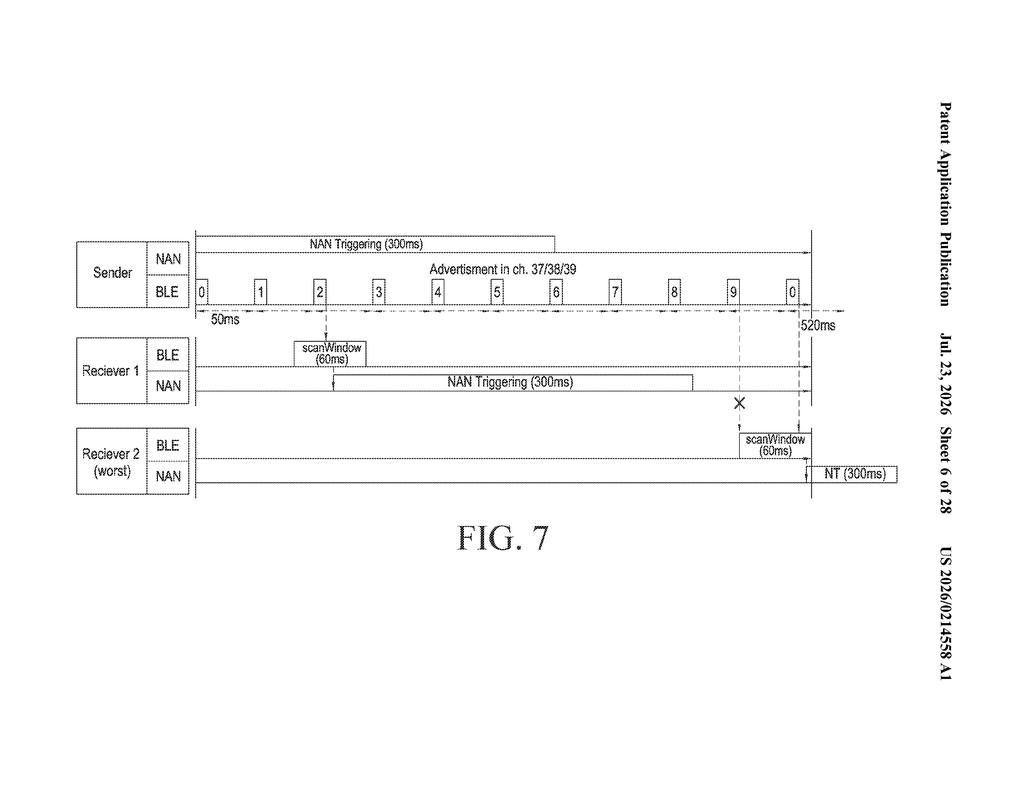
This patent describes a shortcut: the first device broadcasts a Bluetooth Low Energy (BLE) advertisement, a tiny, low-power radio signal, that contains a NAN synchronization frame (the timing and identification data normally carried over Wi-Fi). This means the second device can pick up the sync information it needs over Bluetooth instead of waiting for the next Wi-Fi discovery window.
Once that handshake is done, the two devices exchange Service Discovery Frames (SDFs), which are Wi-Fi Aware messages that say, in effect, 'here's what I offer' and 'here's what I need.' After those messages match, the devices establish a full NAN (Neighbor Awareness Networking) connection over Wi-Fi.
The core claim is the use of BLE as an out-of-band channel to carry Wi-Fi Aware synchronization data, which could reduce the time-to-connect compared to relying on Wi-Fi discovery alone.
What this means for device-to-device Wi-Fi in Samsung products
For end users, faster and more reliable direct device connections matter any time you're sharing files, streaming content, or syncing data phone-to-phone. Samsung's Galaxy phones and tablets already support Wi-Fi Aware in some scenarios, so a protocol improvement like this could show up in how Quick Share or similar features behave.
More broadly, any time a device-to-device feature feels slow or flaky to start, protocol-layer fixes like this are usually the reason it eventually gets better. This is the kind of unglamorous engineering that makes everyday wireless features feel more polished.
This is a narrow, standards-adjacent patent covering a specific protocol optimization rather than a big product idea. It matters if you care about how Samsung's direct-sharing features perform at a technical level, but it's not a headline-grabbing invention. Wireless engineers will find it interesting; most readers can safely move on.
There are more where this came from
We read every patent application Big Tech publishes and send you the ones worth knowing. Plain English, free, every week.
The drawings
28 drawing sheets from US 2026/0214558 A1 · click any drawing to enlarge


Want this weekly breakdown for a company we don't cover? Patentlyze Pro →
Be the first to weigh in