
Intel Patents a Bluetooth Broadcast That Hides Private Messages Inside Public Signals
Bluetooth is usually an all-or-nothing deal: one device broadcasts, everyone nearby receives the same thing. Intel's new patent describes a way to slip a private, device-specific message into that public broadcast stream, without switching to a separate connection.
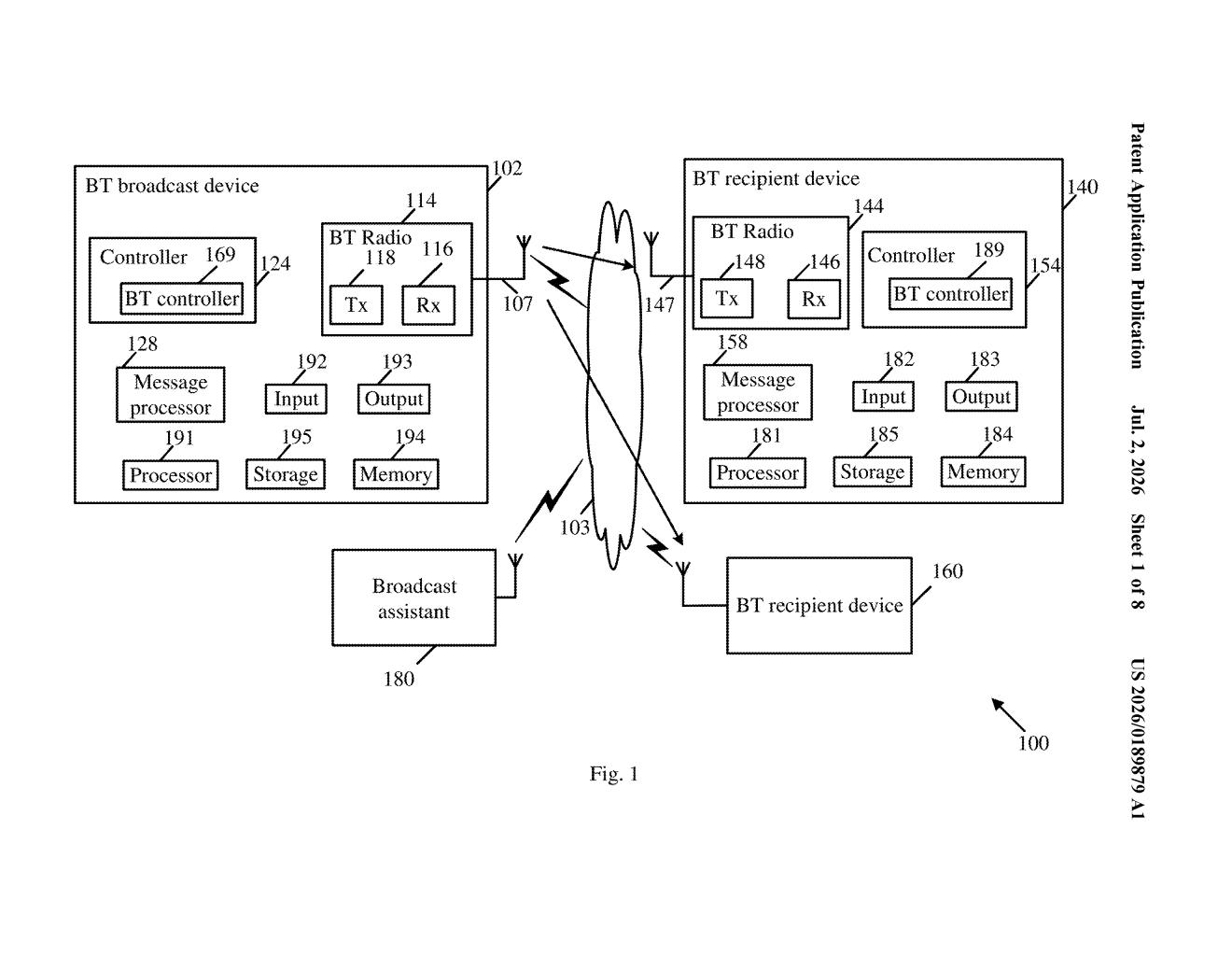
How Intel tucks targeted data inside a Bluetooth broadcast
Imagine a sports stadium playing the same audio feed over Bluetooth to thousands of fans. Every phone hears the same thing. Now imagine the venue also needs to tell certain staff phones to switch channels, or tell a specific scoreboard display to update its configuration. Today, that would require a separate, one-to-one connection for each device.
Intel's patent describes a method where a Bluetooth transmitter sends its normal broadcast to everyone, then immediately follows it with a special control message. That control message carries a marker saying "this part is only for certain recipients," along with the actual targeted instructions embedded inside.
Devices that aren't on the list simply ignore the control message. Devices that are targeted can read their specific instructions, all without the transmitter having to set up individual connections to each one. It keeps the efficiency of broadcasting while adding a layer of selective delivery.
How the control PDU tags specific recipients in a broadcast stream
Standard Bluetooth broadcast (also called isochronous or periodic advertising) is a one-to-many channel: one transmitter, many passive listeners, no back-and-forth handshake required. That efficiency is great for audio, location beacons, and sensor data, but it means every listener gets identical data.
Intel's system adds a second packet called a broadcast control PDU (PDU stands for Protocol Data Unit, basically a formatted chunk of data) that travels immediately after the regular broadcast data packets. This control PDU has two key fields:
- Opcode field: a predefined code that tells any listening device "what follows is targeted, not universal."
- Control data field: the actual payload, which contains instructions or data addressed to one or more specific recipient devices.
A receiving device checks the opcode, recognizes the targeted type, then looks inside the control data to see whether it is one of the intended recipients. If it is not, it discards the packet with minimal processing. If it is, it acts on the instructions. The transmitter never needs to open a dedicated unicast connection (a private, two-way Bluetooth link) to reach those specific devices, which saves both time and radio overhead.
What this means for Bluetooth in arenas, transit, and IoT
For consumer Bluetooth audio, this is mostly invisible plumbing. But for large-scale deployments, the difference is real. Think of a transit system pushing configuration updates to hundreds of passenger-facing displays, or an industrial floor where a controller needs to reconfigure a subset of sensors without interrupting the data feed to all the others. Today those scenarios either require unicast connections to each device or a full system redesign. Intel's approach keeps the broadcast lane open while adding a lightweight targeting layer on top.
It also matters for Bluetooth LE Audio, the newer broadcast standard already rolling out in hearing aids, assistive listening systems, and public audio venues. Adding targeted control messages to that infrastructure could let venue operators manage individual device classes, like updating one brand of hearing aids but not another, without breaking the shared audio stream everyone else is receiving.
This is quiet but useful work. It solves a real limitation in Bluetooth broadcast without requiring a fundamental protocol overhaul, and the IoT and public audio deployment cases are genuinely compelling. It won't make headlines at a product launch, but engineers running large Bluetooth networks will recognize the problem immediately.
There are more where this came from
We read every patent application Big Tech publishes and send you the ones worth knowing. Plain English, free, every week.
Want this weekly breakdown for a company we don't cover? Patentlyze Pro →
Be the first to weigh in