
Meta Patent: Silent Wrist Gesture Activates AI Assistant Through Smart Glasses
No 'Hey Meta,' no tap, no voice at all. Meta is patenting a way to call up an AI assistant just by flexing your wrist muscles, letting your glasses do the looking and your watch do the talking.
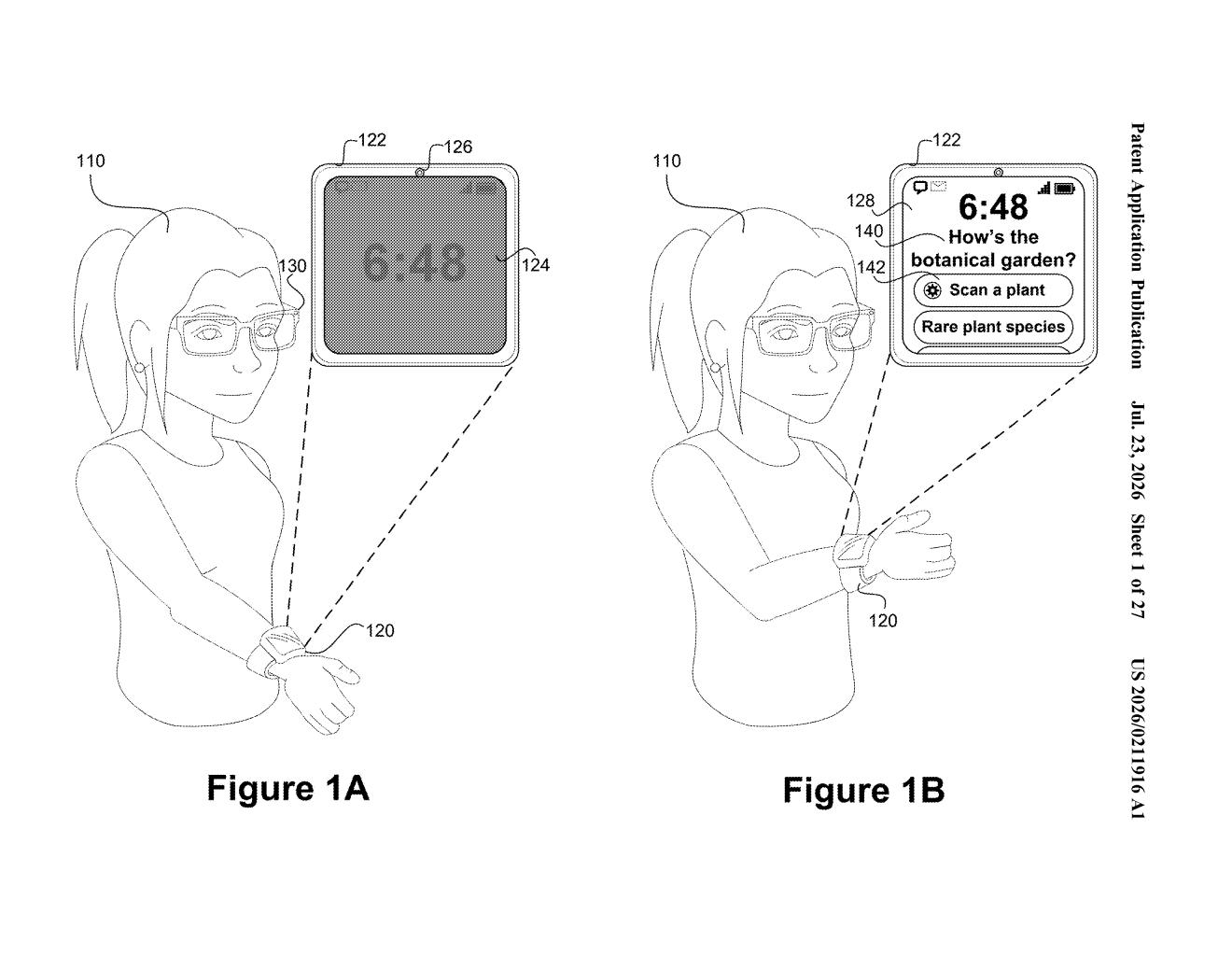
How Meta's glasses-and-watch AI duo actually works
Imagine you're browsing a grocery store and you want to know if a wine bottle fits your preferences. Instead of pulling out your phone or saying anything out loud, you make a tiny, invisible wrist gesture. Your glasses take a photo of the bottle, an AI figures out what it's looking at, and your watch shows you a personalized note, maybe whether it's a grape variety you like or a price point you've set as a limit.
That's the idea behind this Meta patent. The system combines muscle-reading sensors on a wristband, cameras on a pair of glasses (the kind with no screen, like Meta's Ray-Ban collab), and a watch display to create a hands-free, voice-free AI assistant loop. The trigger isn't a button or a voice command; it's a neuromuscular signal, meaning the sensors detect the faint electrical activity in your wrist muscles when you make a specific gesture.
What's interesting is that the AI doesn't give you a generic answer. It pulls from your own saved preferences for whatever type of object it recognizes. So the response you get about a wine bottle is different from the one you'd get pointing at a restaurant menu, and both are tailored to you.
How muscle signals, cameras, and user prefs connect
The patent describes a three-device pipeline: a wristband with biopotential sensors (electrodes that detect the electrical signals your muscles produce when you move), a displayless head-wearable device (essentially camera-equipped glasses with no built-in screen), and a smartwatch that handles the visual output.
Here's how a single interaction flows:
- You make a specific wrist gesture. The biopotential sensors pick up the neuromuscular signal and interpret it as an AI invocation command.
- The glasses automatically capture an image of whatever is in front of you.
- That image goes to the AI agent, which identifies the object type (a food item, a product, a piece of text, etc.).
- The AI cross-references the object type against a stored set of user-specific preferences tied to that category, then generates a tailored response.
- Your watch displays both a thumbnail of the object and the AI's message.
The patent also covers doing this twice in a row with two different objects, and critically, the system swaps out the preference set automatically based on what the second object is. So the AI isn't just carrying the same filter across every lookup; it's contextually reconfiguring for each object type.
This matters because it means the system can be genuinely useful across very different situations, reading a food label versus scanning a product barcode versus looking at a restaurant sign, without you having to manually switch modes.
What this means for Meta's Ray-Ban glasses ambitions
Meta's Ray-Ban smart glasses already have cameras and a built-in AI assistant, but today you have to speak to activate it. A voice-free, gesture-based trigger is a meaningful step for situations where speaking out loud is awkward or impossible, a crowded store, a quiet office, a social gathering. This patent suggests Meta is actively working on making the glasses-plus-wristband combo feel less like a tech demo and more like a natural extension of how you'd actually behave in the world.
The preference-matching layer is the part that could genuinely change daily behavior. An AI that already knows your dietary restrictions, budget limits, or brand preferences before you even ask a question is more useful than one you have to re-brief every time. If Meta can execute this across its existing hardware lineup, the combination of EMG wristband, Ray-Ban glasses, and a future Meta watch becomes a coherent platform, not just a collection of gadgets.
This is one of the more coherent AR-ecosystem patents Meta has filed. The muscle-signal trigger is the headline feature, but the real signal here is the preference-matching architecture, Meta is designing an AI that adapts to object context automatically, which is exactly what makes the difference between a neat demo and something people actually use. The hardware stack it describes (EMG wristband plus displayless glasses plus watch) maps cleanly onto Meta's publicly announced product roadmap, so this isn't a moonshot patent sitting in a drawer.
Get our take in your Top Stories
Liked this breakdown? Add Patentlyze as a preferred source on Google, and our plain-English take shows up more often in your Top Stories the next time Meta patent news breaks.
There are more where this came from
We read every patent application Big Tech publishes and send you the ones worth knowing. Plain English, free, every week.
The drawings
27 drawing sheets from US 2026/0211916 A1 · click any drawing to enlarge


Show the other 19 sheets


Want this weekly breakdown for a company we don't cover? Patentlyze Pro →