
Nvidia Patents a Way to Make Different AI Models Share Information Directly
Most AI systems today are islands: each model speaks its own internal language, and getting two of them to cooperate means a lot of awkward conversion work at the edges. Nvidia is patenting a way to build a dedicated translator that sits between AI models and lets them share information directly.
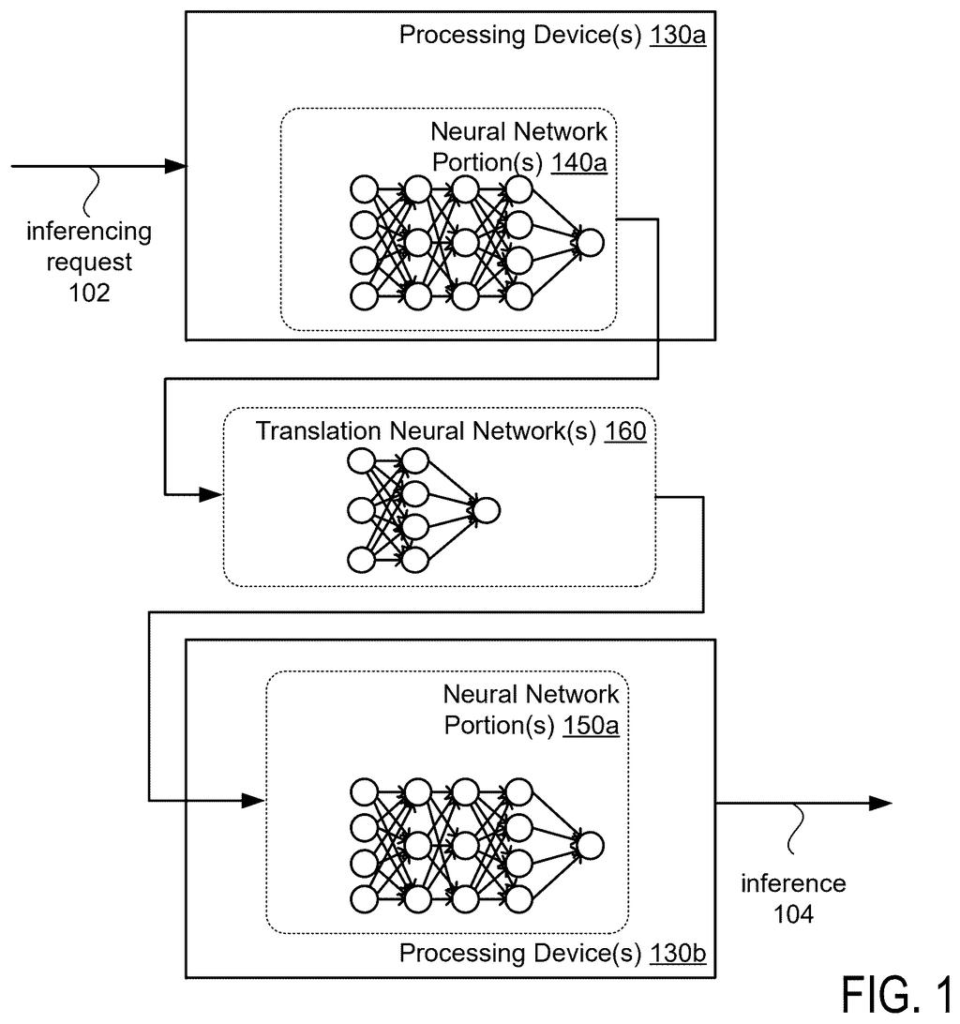
How Nvidia's AI-to-AI translation layer works
Imagine you hired two expert contractors who each speak a different language. Right now, everything they need to share has to be converted to plain text first, handed off, then converted back. It works, but a lot gets lost in translation and it takes extra time.
Nvidia is filing a patent for a system that places a small, dedicated AI in between two larger AI models. That in-between AI acts as an interpreter, converting the internal signals from one model into a form the other model can actually use, without forcing everything to pass through a slow, lossy intermediate format.
The idea is to let different AI models cooperate more tightly, even if they were trained separately and have completely different internal structures. Instead of bolting models together at the output stage, this approach connects them deeper inside.
How the translation network bridges two model internals
Most AI inference pipelines today take the output of one neural network (say, a vision model that identifies objects in a frame) and feed it as a plain numeric result into a second network. That hand-off point is a bottleneck: the first model's rich internal state gets compressed down to a final answer before the second model ever sees it.
Nvidia's patent describes translation neural networks, small purpose-built models whose only job is to convert the intermediate representations (the internal activations and feature maps, not just the final output) of one neural network into a format that a second, different neural network can process directly. The translating model learns what the two networks' internal languages have in common and maps between them.
The key claim is broad: one or more circuits use one or more translation networks to pass information between portions of two or more different neural networks. "Portions" is significant because it means the handoff can happen at any layer inside the models, not just at their outputs.
- Model A produces an internal feature map mid-inference
- The translation network converts that into the equivalent internal representation for Model B
- Model B resumes inference from that translated state rather than starting from scratch
This is essentially a learned adapter layer, but one that is itself a neural network and can be trained end-to-end.
What this means for running multiple AI models together
For Nvidia, whose chips run the majority of the world's AI inference workloads, making multi-model pipelines faster and more efficient is a direct business interest. If two specialized models can share internal states rather than passing fully decoded outputs back and forth, the overall computation shrinks and the results can be more accurate because less information is discarded at each handoff.
From a practical standpoint, this kind of technology could let companies mix and match AI components (a vision encoder from one vendor, a reasoning model from another) without retraining everything from scratch. That matters a lot as AI deployments grow more modular and organizations build systems out of pre-trained pieces rather than single end-to-end models.
This is a foundational infrastructure patent, not a flashy product announcement, but it addresses a real and growing problem. As AI pipelines get more complex and organizations stack specialized models together, the inefficiency at model boundaries adds up. A learned translation layer is a cleaner solution than the manual feature engineering that's common today, and Nvidia patenting it early signals they plan to bake it into their inference stack.
There are more where this came from
We read every patent application Big Tech publishes and send you the ones worth knowing. Plain English, free, every week.
The drawings
27 drawing sheets from US 2026/0220434 A1 · click any drawing to enlarge


Want this weekly breakdown for a company we don't cover? Patentlyze Pro →
Be the first to weigh in