
Qualcomm Patents a Way to Keep Objects Tagged While Building a 3D Map
Building a 3D map of the world is hard enough. Keeping track of which blob of pixels belongs to which chair, person, or car as the camera moves is a whole other problem. Qualcomm's new patent tackles both at once.
How Qualcomm's object-aware 3D mapping actually works
Imagine you're wearing AR glasses that need to know exactly where your coffee cup is sitting on the table, not just roughly where the table is. To do that, the device has to build a 3D model of the room and label every object in it, all in real time, as you move your head around.
The tricky part is keeping those labels consistent. When you tilt your head, the camera angle changes, and the software can lose track of which blob of pixels it already identified as "the cup." Qualcomm's patent describes a system that cross-references what the camera sees right now with what it already knows from its existing 3D model, then reassigns labels so nothing gets confused or duplicated.
The result is a 3D scene where every object stays properly identified across frames, even as the viewpoint shifts. That kind of stable, object-level understanding is exactly what AR glasses, robots, and autonomous cameras need to interact meaningfully with the world around them.
How instance maps and depth data update the 3D point cloud
The system works by running two parallel processes on each incoming camera frame and then reconciling them.
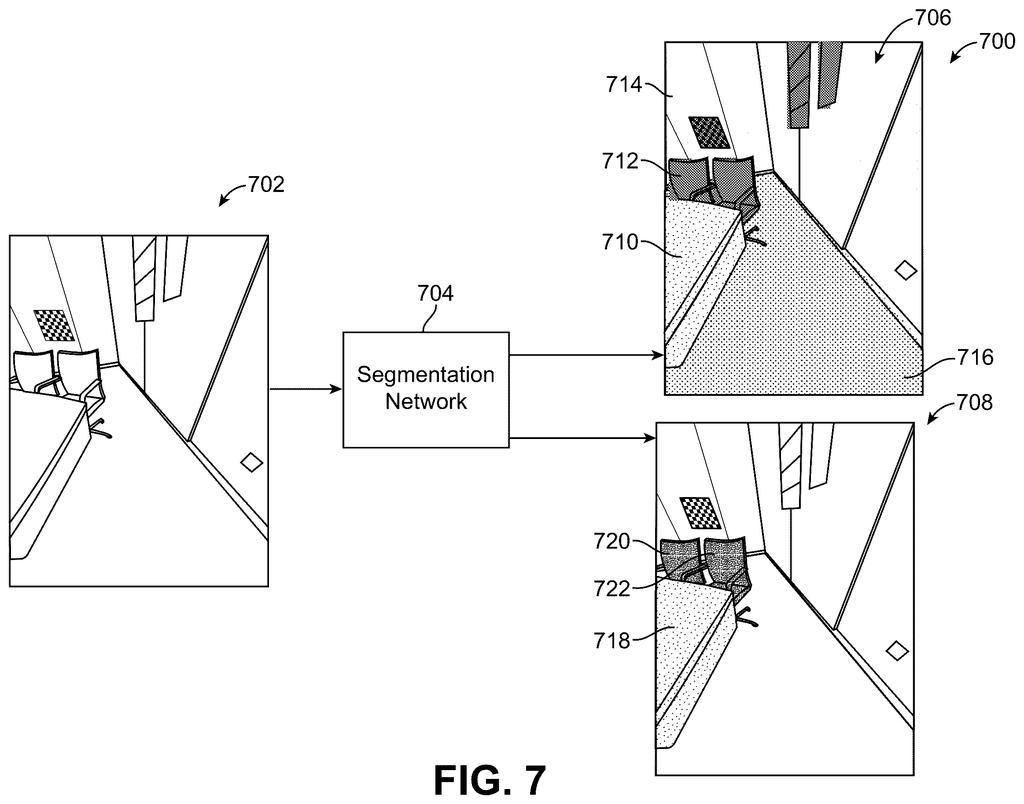
Step one: instance segmentation. The processor analyzes the image and produces an "instance map," a pixel-by-pixel label sheet that says "these pixels are object A, those pixels are object B." This is standard computer-vision work, but it's done fresh for every frame, so object IDs can drift or reset.
Step two: projecting the existing 3D model. The system takes the 3D point cloud it has already built (think of it as a dense scatter of labeled dots floating in space) and mathematically "projects" those dots back onto the flat image plane, accounting for the camera's current position and angle (its pose). This creates a second map showing where the already-known objects should appear in this frame.
Step three: reconciliation. The fresh instance map and the projected map are compared. The system reassigns pixel labels from the fresh map to match the stable IDs already in the 3D model, preventing the same object from getting two different names.
Step four: updating the 3D model. A depth map (per-pixel distance data, like what a LiDAR or stereo camera provides) is used to refresh the 3D point cloud with new geometry, and any newly identified object regions are added with their corrected labels.
What this means for AR headsets and autonomous devices
For AR headsets, robotics, and autonomous cameras, stable object identity is a foundational requirement. If a robot's 3D map keeps relabeling the same chair as a new object every few frames, it can't plan a path around it reliably. Qualcomm makes the chips (Snapdragon) that power many of these devices, so a patent like this points directly at on-device processing capabilities it wants to bake into future silicon.
The approach described here is designed to run efficiently on a single device without a cloud connection, which matters for anything that needs low-latency spatial awareness, like a headset tracking your hands or a drone avoiding obstacles. If this ends up in a Snapdragon XR chip, developers building spatial apps would get object-level scene understanding essentially for free.
This is solid, practical computer-vision infrastructure work. It doesn't invent a new sensing modality or model architecture, but it does address a real and annoying consistency problem that plagues real-time 3D reconstruction. For Qualcomm, whose business depends on making AR and robotics workloads run well on its chips, owning this kind of pipeline patent is strategically sensible.
There are more where this came from
We read every patent application Big Tech publishes and send you the ones worth knowing. Plain English, free, every week.
The drawings
16 drawing sheets from US 2026/0220879 A1 · click any drawing to enlarge


Want this weekly breakdown for a company we don't cover? Patentlyze Pro →
Be the first to weigh in