
Samsung Patents a Tri-Fold Phone That Uses Shifting Magnets to Hold Its Shape
Folding a phone once is tricky engineering. Folding it twice, and keeping all three panels locked exactly where you want them, is a whole other problem. Samsung's latest patent tackles that with a magnet that physically moves.
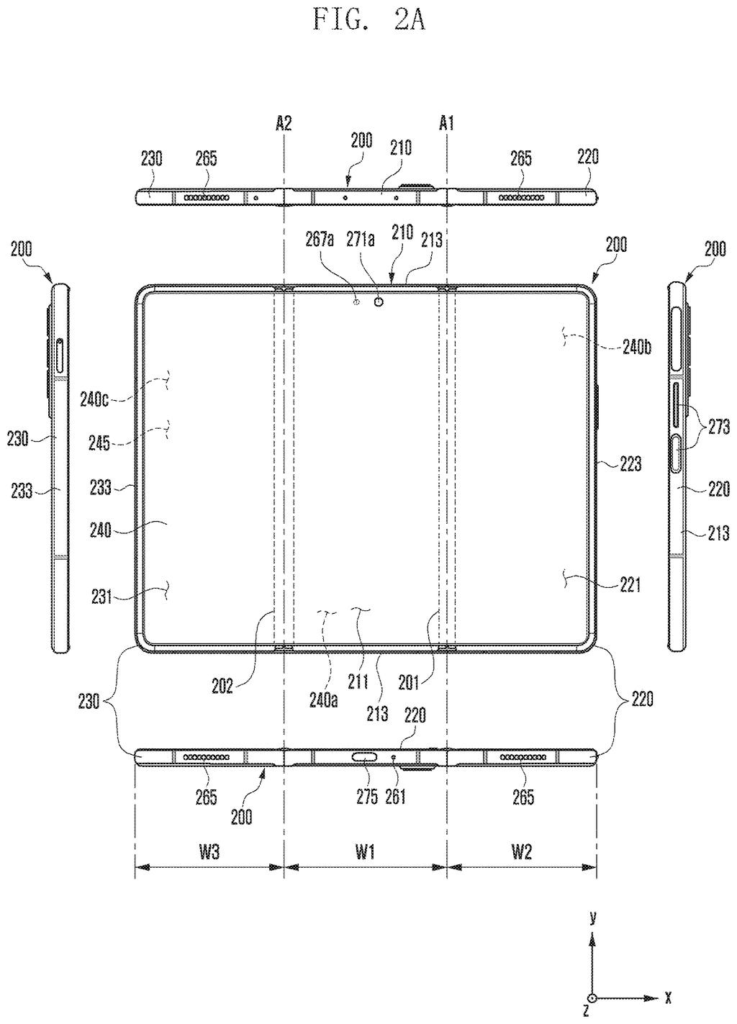
What Samsung's sliding magnet system does in a tri-fold
Imagine a phone that folds in two places, like a letter folded into thirds. When you open it all the way, the three panels need to stay put without flopping around. Samsung's idea is to put a magnet inside the middle panel that can slide between two different spots depending on how open the device is.
When the phone is in one position, the sliding magnet sits in one spot and stays out of the way. When you open it further, that magnet shifts to a new position, where it ends up facing a second magnet in the left panel. Here's the clever part: both magnets are set to the same polarity, so they repel each other. That repulsion acts like a little invisible spring, pushing the panels apart and holding them open at the right angle.
It's the same principle as holding two fridge magnets with the same side facing each other, they push away from each other. Samsung is using that push to keep a tri-fold screen locked in place.
How the first magnet assembly moves between two positions
The patent describes a tri-fold device with three housings (panels). The middle panel is the anchor, and one outer panel folds off each side via separate hinge structures.
Inside the middle panel is a first magnet assembly that can physically slide between two positions. The left panel contains a second magnet assembly that is fixed. When the angle between the middle and right panels reaches a specific threshold (the "first angle"), the sliding magnet stays in its default position. When that angle reaches a second, wider threshold, a mechanical trigger causes the sliding magnet to move into its second position.
At the second position, the two magnet assemblies face each other with the same magnetic polarity. Same-polarity magnets repel, so the system generates a controlled outward force between the middle and left panels. This does two things:
- Keeps the left panel from collapsing back on its own
- Provides a defined, tactile "open" state the user can feel snap into place
The movement of the first magnet assembly is tied to the angle of a different hinge (the one on the right side), making the two hinges mechanically interdependent. One fold's position directly influences the magnetic behavior on the other side.
What this means for Samsung's tri-fold phone ambitions
Tri-fold phones are one of the more credible next steps in foldable hardware, and Samsung has already shown prototype-level interest in the format. The biggest engineering headache with any multi-fold design is keeping panels at stable, consistent angles without adding thick mechanical locks or bulky hinges. A magnet that repositions itself based on the device's fold state is a compact, passive solution to that problem, and passive means no extra battery drain or motors.
For you as a buyer, this kind of system is what separates a premium foldable that feels solid from one that feels wobbly. If Samsung ships something like this, it would show up as a firmer, more deliberate "click" when you fully open the device.
This is tidy, functional engineering, not a flashy concept. The idea of using same-polarity repulsion as a passive positional lock is genuinely clever because it adds stability without motors or extra sensors. Samsung has been the most serious player in foldable hardware, and patents like this suggest their tri-fold work is moving into detailed mechanical design rather than staying at the concept stage.
There are more where this came from
We read every patent application Big Tech publishes and send you the ones worth knowing. Plain English, free, every week.
The drawings
46 drawing sheets from US 2026/0222477 A1 · click any drawing to enlarge


Want this weekly breakdown for a company we don't cover? Patentlyze Pro →
Be the first to weigh in