
Intel Patents a Chip That Prepares AI Data for Calculations Without Slowing the Processor
Intel has filed a patent for a dedicated hardware engine that handles the messy work of unpacking and converting compressed AI data entirely on-chip, without slowing down the main processor or clogging up the instruction pipeline.
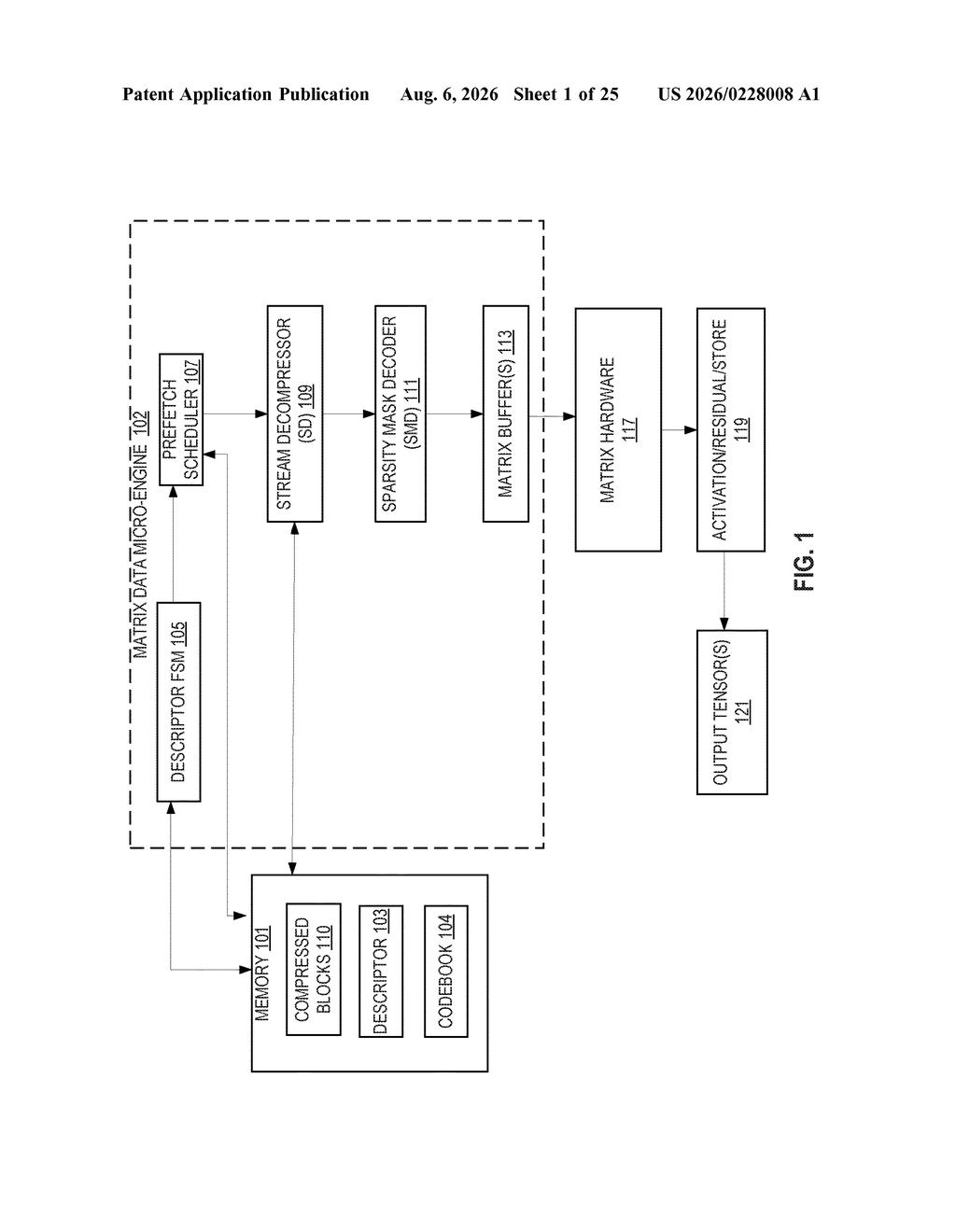
What Intel's on-chip decompression engine actually does
Imagine a warehouse where every box arriving on the loading dock needs to be unpacked, re-labeled, and sorted before it reaches the factory floor. Right now, the factory foreman has to stop what he's doing and personally handle every box. Intel's patent describes a dedicated loading-dock crew that does all that prep work automatically, so the foreman never has to stop.
In chip terms: AI workloads feed enormous tables of numbers (called matrices) into processors constantly. Those numbers are often stored in compressed formats to save space, and the chip has to convert them back to a usable format before any calculation can happen. Normally that conversion work lands on the main processor, stealing time from actual math.
Intel's design adds a small, dedicated engine on the chip that handles all the unpacking and conversion work on its own, triggered by a single instruction. The main processor just says "go" and moves on. The engine handles the rest.
… prefetch packed blocks representing matrix data from memory, decode and/or decompress the packed blocks, generate one or more index/value tokens or dense matrices based on sparsity metadata, and buffer the one or more index/value tokens or dense matrices based on sparsity metadata into a destination.
Translation: The chip fetches raw data, decompresses it, filters out empty values, and loads the results into a buffer.
How the matrix micro-engine decodes packed data blocks
The patent describes what Intel calls a matrix data micro-engine, a small piece of dedicated circuitry that handles data preparation tasks that would otherwise run as software on the main processor pipeline.
The engine is triggered by a single instruction that points to a descriptor (think of a descriptor as a recipe card stored in memory that tells the engine exactly what to do with the incoming data). By reading that descriptor, the engine can chain together several transformation steps in one pass:
- Format conversion (e.g., INT4 to FP16, translating low-precision 4-bit numbers into higher-precision 16-bit floating-point values that math hardware can actually use)
- Sparsity expansion (a "2:4 sparsity" format stores only 2 of every 4 numbers to save space; the engine reconstructs the full matrix by filling in the zeroes)
- Layout transposition (reordering data in memory so it arrives in the order the compute hardware expects)
All of this happens inside a dedicated hardware data path that pulls data from memory in continuous streams, completely separate from the CPU's instruction cache. The result is that the main processor never sees the decompression code at all.
This effectively decouples the memory access patterns from the compute cadence. The use of the descriptor allows for complex, multi-stage data transformations (e.g., INT4 to FP16 conversion, 2:4 sparsity expansion, and layout transposition) to occur strictly within the hardware data path …
Translation: By handling data prep separately, the main processor avoids getting bogged down in formatting tasks.
What this means for AI chip efficiency at scale
AI chips spend a surprising amount of time just preparing data rather than computing with it. Compressed and sparse matrix formats are standard practice in modern AI models because they shrink memory usage and bandwidth, but converting them back for computation is overhead that adds up fast. Intel's approach shifts that overhead out of software and into fixed-function hardware, which is generally faster and more power-efficient.
For data center customers running large language models or neural networks, this kind of low-level efficiency gain compounds across billions of operations per second. It also keeps the CPU pipeline clean for actual work, which matters in systems where every clock cycle is accounted for.
This is unglamorous but genuinely useful chip engineering. Offloading format-conversion work from software to dedicated hardware is exactly the kind of incremental optimization that separates competitive AI accelerators from also-rans. It's not a headline product, but it's the sort of thing that shows up in benchmarks.
There are more where this came from
We read every patent application Big Tech publishes and send you the ones worth knowing. Plain English, free, every week.
The drawings
25 drawing sheets from US 2026/0228008 A1 · click any drawing to enlarge


Want this weekly breakdown for a company we don't cover? Patentlyze Pro →
Be the first to weigh in