
Intel Patents a Chip That Slims Down Software Brains Before Putting Them to Work
Intel wants to shrink AI models right inside the chip that manages server workloads, so they run faster and cheaper on the hardware next door.
What Intel's on-chip AI compression actually does
Imagine you have a massive instruction manual that needs to go through a narrow door. Instead of shoving the whole thing through, someone first trims it down to only the essential pages. That's roughly what this patent describes, but for AI software running in a data center.
AI models are large. Running them on specialized chips (called accelerators) is faster than running them on general-purpose processors, but those accelerators work best with smaller, more efficient versions of the model. Right now, trimming a model down is usually done separately, before deployment. Intel's idea is to build that trimming step directly into the chip that already manages the server's network and storage traffic, called an Infrastructure Processing Unit, or IPU.
The result: the IPU receives a full-size AI model, compresses it on the spot into a leaner version, and hands the compact version to the accelerator for actual use. Less back-and-forth, less wasted compute, and the optimization happens closer to where the work is done.
How the IPU converts a full-size model to a compact one
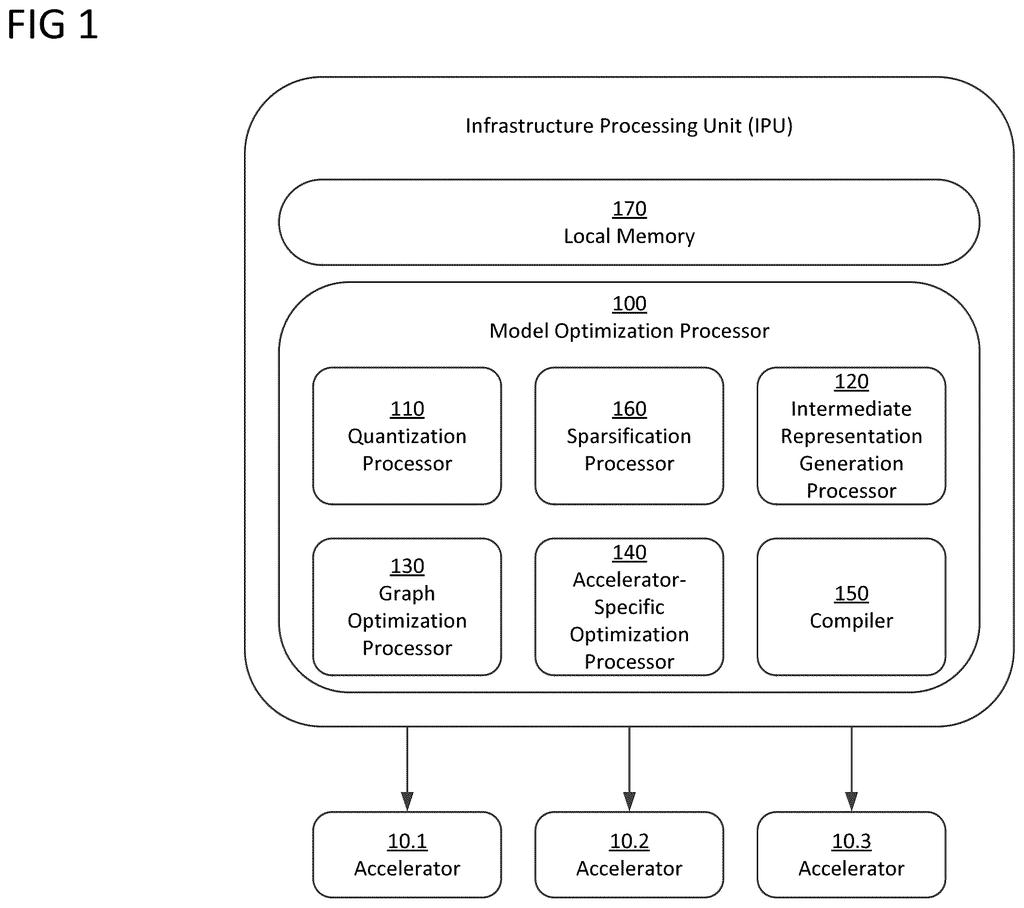
The patent describes an Infrastructure Processing Unit (IPU), a type of chip Intel already sells for offloading data-center networking and storage tasks from the main CPU. This particular design adds a new capability: a dedicated model optimization processor built into the IPU itself.
The core operation is quantization (converting a high-precision AI model, where each number takes up 32 or 16 bits of memory, into a low-precision version where numbers take up only 8 or 4 bits). This shrinks the model's memory footprint and speeds up math operations, often with only a small drop in accuracy. Normally this step is done offline by engineers before deployment. Here, the IPU does it automatically, on-device, as a managed workload step.
The workflow looks like this:
- The IPU receives a full-precision AI model.
- Its on-chip optimization processor quantizes the model into a compact, low-precision version.
- The IPU stores intermediate data about that optimization in its own local memory.
- The optimized model is deployed directly to the accelerator (a GPU or AI chip) that the IPU manages.
Because the IPU already sits between the network and the accelerator in most data-center setups, adding this step doesn't require a separate pass through the CPU or extra round-trips across the server fabric.
What this means for data-center AI costs
Data-center operators are spending enormous amounts on AI inference, which is the step where a trained model actually answers questions or makes predictions. Quantization is one of the most effective ways to cut that cost, but it typically requires engineering work before a model ever reaches production. Moving that step onto the IPU makes it faster to deploy new or updated models and reduces the load on the main CPU.
For you as an end user, this kind of infrastructure efficiency is what keeps cloud AI services from getting more expensive as demand rises. For Intel, it's a way to make its IPU product more appealing against rivals like Nvidia's BlueField and Marvell's OCTEON, which are competing for the same data-center real estate.
This is a narrowly scoped infrastructure patent, not a consumer-facing story. But it's a smart positioning move: Intel is trying to make its IPU more than a network offload chip by giving it an active role in the AI deployment pipeline. Whether it ships as a real product feature or stays on paper, it signals where Intel sees IPU value going.
There are more where this came from
We read every patent application Big Tech publishes and send you the ones worth knowing. Plain English, free, every week.
The drawings
2 drawing sheets from US 2026/0220456 A1 · click any drawing to enlarge


Want this weekly breakdown for a company we don't cover? Patentlyze Pro →