
Nvidia Patent: Selecting Unique Training Data Reduces Neural Network Learning Costs
Training an AI model requires tuning dozens of settings before real learning even begins. Nvidia has filed a patent that tries to make that setup step faster by being picky about which data it looks at first.
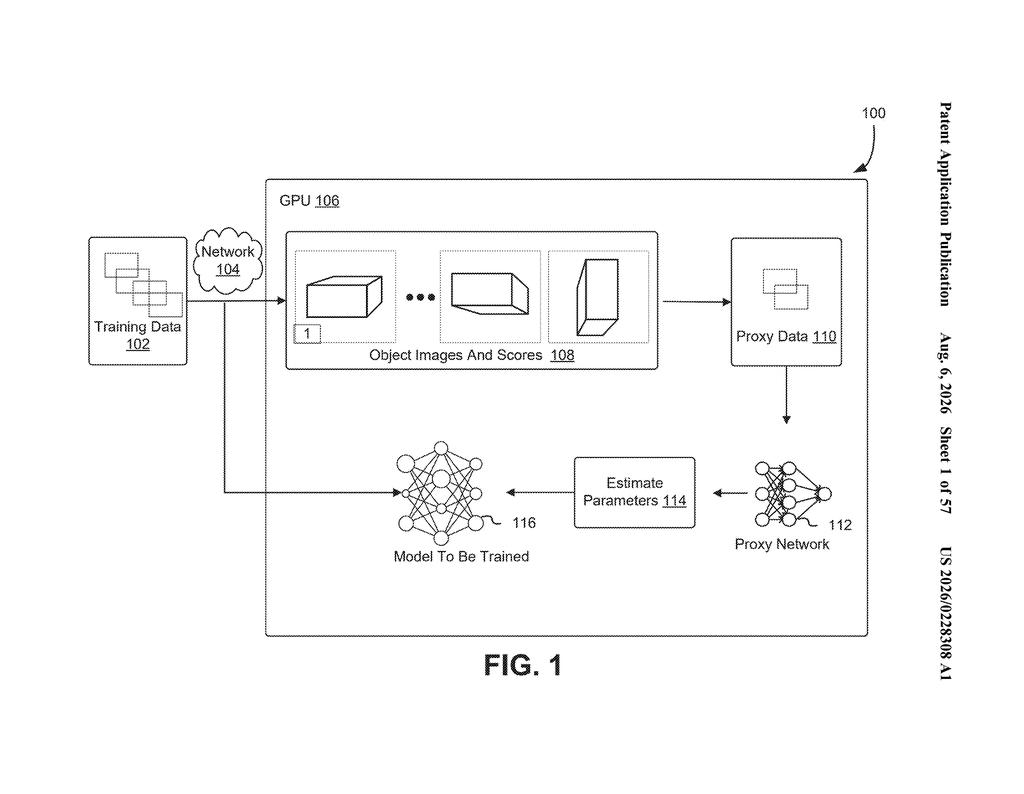
How Nvidia's training-data selection approach works
Imagine you're studying for a big exam, but your textbook has thousands of repetitive practice problems. A good tutor wouldn't make you work through every duplicate, they'd pick the most varied, useful examples so you learn faster. Nvidia's patent applies the same logic to AI training.
When an AI model is being built, engineers have to figure out the right "settings" (called parameters) before the real training run begins. That process normally looks at all available training data, which can be enormous. This patent proposes picking a representative subset of that data instead, focusing on examples that are the most unique and informative.
The idea is that you don't need to read every redundant data point to get a good estimate of the best settings. By filtering down to the most distinct examples, Nvidia's system aims to reach good parameter estimates faster and with less computing power.
Apparatuses, systems, and techniques estimate parameters to train one or more neural networks based on uniqueuss of training data. In at least one embodiment, a subset of training data is selected and used to estimate parameters to train one or more neural networks, based on, for example, uniqueness of training data.
Translation: Nvidia patented a system that trains neural networks using only a distinct subset of training data.
How the system scores data uniqueness to pick subsets
The patent describes a system for parameter estimation during the pre-training phase of neural network development. Before a model actually learns from data, engineers must set hyperparameters (the configuration knobs that control how learning happens). Getting those right usually requires an expensive search over the full dataset.
Nvidia's approach introduces a uniqueness-based selection step: the system scores training data samples by how distinct or novel they are relative to each other, then picks a subset that captures the most informational variety. Think of it like choosing a small group of people to represent a whole population, you'd want people from different backgrounds, not ten copies of the same person.
By working with this curated subset rather than the full dataset, the parameter estimation step becomes:
- Faster, because fewer samples need processing
- More efficient, because redundant data is excluded
- Potentially more accurate, because the selected data better represents the full range of the training distribution
The patent is broadly written to cover one or more neural networks, suggesting the technique could apply across model types and training pipelines rather than being limited to a single architecture.
What this means for AI training efficiency at scale
For companies training large AI models, the pre-training configuration phase can burn significant compute budget before a single useful result appears. A method that trims that step down by working with a smarter data subset could meaningfully reduce costs and iteration time, especially at the scale Nvidia's own data center customers operate at.
The patent is filed under medical imaging classification (USPC 382/128), and several of the inventors are well-known researchers in medical AI, suggesting the technique may be targeted at specialized domains where labeled data is scarce and expensive. In those settings, squeezing the most signal out of a limited dataset is especially valuable.
This is a narrowly scoped, workmanlike patent covering an efficiency improvement in the AI training pipeline. The core idea, that unique data points are more useful than redundant ones for parameter estimation, is intuitive and not dramatically new as a concept. What matters here is whether Nvidia's specific implementation offers a measurable speedup in practice. Given the medical imaging context and the research team behind it, this looks like applied ML infrastructure work, not a foundational shift.
There are more where this came from
We read every patent application Big Tech publishes and send you the ones worth knowing. Plain English, free, every week.
The drawings
57 drawing sheets from US 2026/0228308 A1 · click any drawing to enlarge


Want this weekly breakdown for a company we don't cover? Patentlyze Pro →
Be the first to weigh in