
Sony Patents a Camera Chip That Activates Only When Lighting Conditions Change
Most camera sensors capture every frame at a fixed rate, whether anything interesting is happening or not. Sony's new patent describes a sensor that only responds when the light hitting a pixel actually changes.
How Sony's event-driven sensor skips most frames
Imagine a security camera that records 30 frames per second even when nothing is moving. That's how almost every camera works today: it takes snapshots at a fixed rhythm regardless of whether the scene has changed. Sony's patent describes a different approach, sometimes called an event-driven sensor, where each tiny photo-detector only speaks up when the brightness at its location shifts.
Think of it like a room full of people who stay quiet unless something noteworthy happens, rather than everyone giving a status report every second. Each pixel holds a small electrical charge that tracks how much light it's receiving. When that charge crosses a threshold because the light got brighter or darker, the pixel sends a signal.
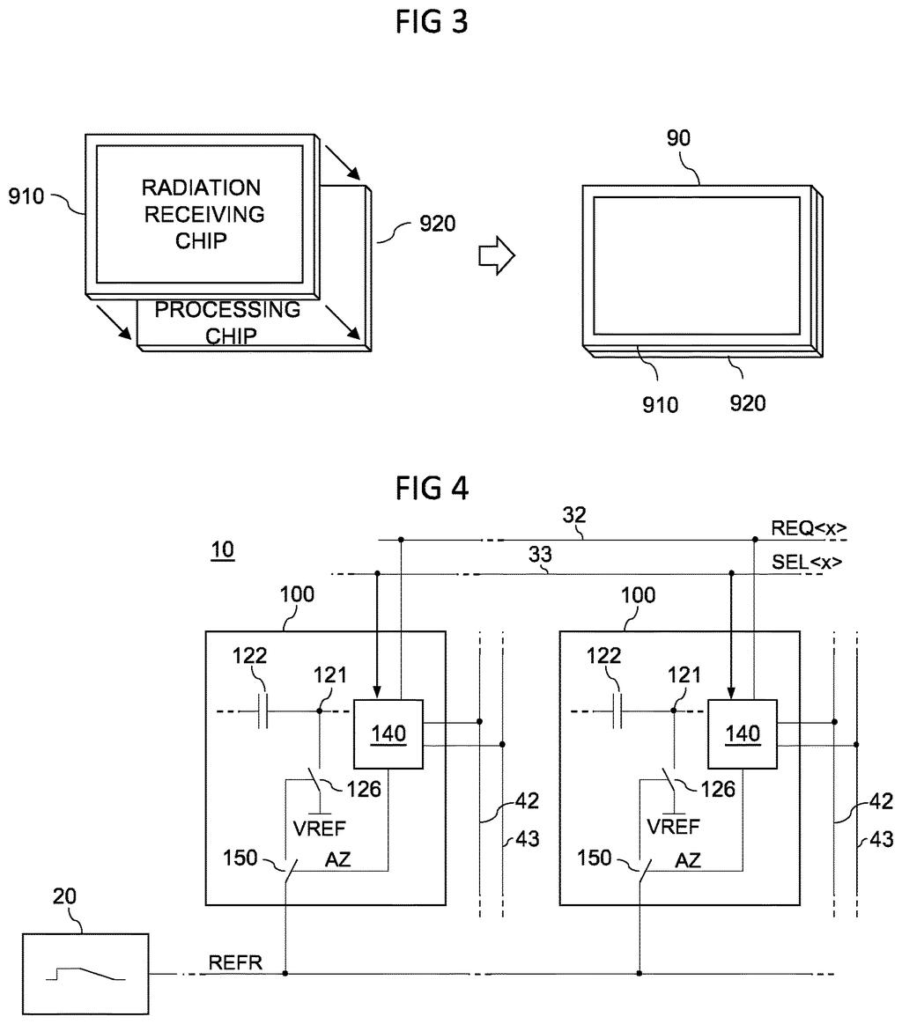
The twist in this particular patent is a ramp reset signal: a smoothly rising voltage that sweeps through groups of pixels to gently reset them to a known starting state, rather than flipping them all at once. That careful reset is what makes the system precise enough to be useful in real cameras.
… each pixel circuit is configured to output a request signal in response to a predefined change in illumination …
Translation: Every pixel decides on its own to wake up when it detects a shift in the lighting.
How the ramp signal resets each pixel's charge store
The sensor is built around a pixel array where each pixel circuit contains a floating node, a small electrical junction that accumulates charge proportional to changes in incoming light. Unlike a standard image sensor that reads every pixel on a fixed clock, each pixel here independently generates a request signal only when the change in illumination crosses a predefined threshold. This is the core idea behind event-based vision, a sensor architecture borrowed from neuroscience that mimics how the human retina works.
The key engineering detail in this patent is the reset ramp signal (REFR). After a pixel fires, it needs to be reset to a known baseline so it can detect the next change. A naive approach would snap every pixel's floating node back to zero voltage instantly, but that can introduce noise and timing errors. Instead, a dedicated ramp signal circuit outputs a gradually rising voltage that sweeps through at least one group of pixels, letting each pixel's reset switch engage at a precise point along the ramp.
The practical result is:
- Pixels reset cleanly and consistently, reducing false events caused by sloppy resets
- Groups of pixels can be reset in coordinated sweeps rather than chaotically all at once
- The sensor stays power-efficient because most pixels are idle most of the time
This architecture is particularly relevant for dynamic vision sensors (DVS), a class of chips already used in robotics and high-speed tracking.
… a floating node configured to temporally store charge as a function of a change of an illumination condition …
Translation: A tiny temporary holding area tracks how much the light has shifted.
What this means for cameras in fast-moving or low-power devices
Event-driven sensors generate far less data than conventional cameras because they only report what changed, not a full frame every 30th of a second. That makes them attractive for applications where power or bandwidth is tight: drones, AR headsets, industrial inspection rigs, or any AI vision system that needs to react in milliseconds rather than frame intervals.
Sony is already one of the world's dominant image sensor suppliers, and this filing signals continued investment in the event-sensor category. The ramp-reset approach they describe is a concrete engineering improvement over simpler reset schemes, the kind of detail that matters when you're trying to mass-produce reliable sensors rather than just demonstrate a lab prototype. Whether this specific circuit ends up in a shipping product is unknowable from a patent alone, but it fits squarely into Sony's broader sensor roadmap.
This is a focused, technically credible filing rather than a high-concept moonshot. Sony is tackling a real and well-known problem in event sensor design: noisy resets that undermine detection accuracy. It won't make headlines the way a flashy consumer product patent does, but for anyone watching the event-vision space, it's exactly the kind of incremental progress that eventually makes a technology reliable enough to ship at scale.
There are more where this came from
We read every patent application Big Tech publishes and send you the ones worth knowing. Plain English, free, every week.
The drawings
19 drawing sheets from US 2026/0230721 A1 · click any drawing to enlarge


Want this weekly breakdown for a company we don't cover? Patentlyze Pro →
Be the first to weigh in