
Nvidia Patents Technology That Keeps AI Calculations Accurate Without Slowing Down Chips
Every AI model lives or dies by matrix multiplication. Nvidia's new patent describes a system that automatically decides, in real time, whether to use faster integer hardware or more precise floating-point hardware for each chunk of math, squeezing out both speed and accuracy at once.
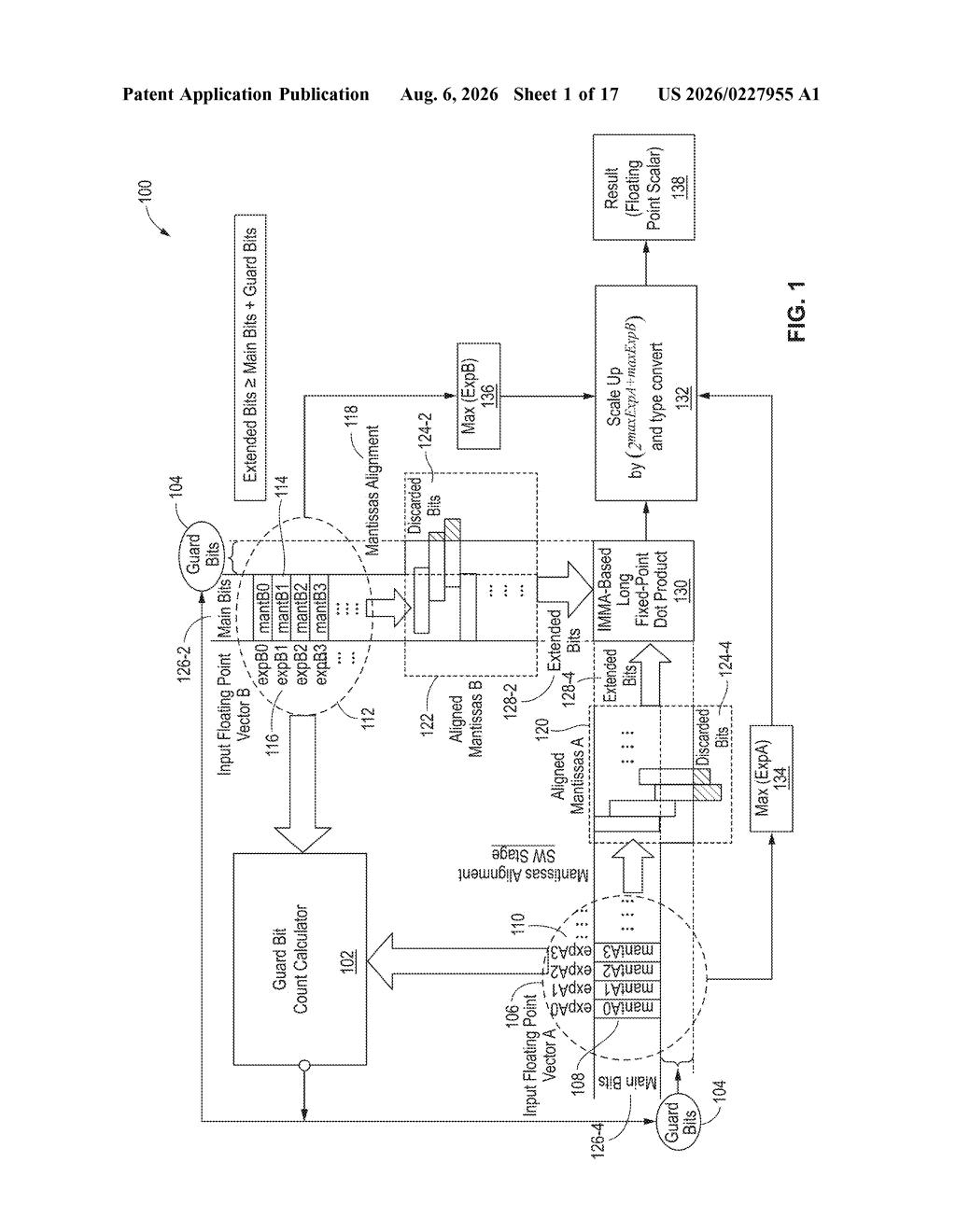
How Nvidia keeps AI math fast without losing accuracy
Imagine you're doing a lot of long multiplication by hand. For some problems, you can use quick mental shortcuts and still get the right answer. For others, you need to work it out carefully on paper. Nvidia's patent describes a chip system that makes that same call automatically, millions of times per second, while running AI software.
At the heart of it is a calculation the patent calls the "Exponent Cancellation Degree." Think of it as a risk score: it measures how much precision you could lose if you take the fast-but-approximate shortcut. If the risk is low, the system uses quicker integer hardware. If the risk is too high, it switches to more careful floating-point hardware.
The goal is to keep AI model training and inference as fast as possible without letting tiny rounding errors accumulate into wrong answers. You never see any of this happening; it all runs automatically inside the GPU.
… calculating an Exponent Cancellation Degree (ECD) value representing a difference between (i) a sum of a first maximum exponent value from the first vector and a second maximum exponent value from the second vector, and (ii) a third maximum exponent value obtained from summing corresponding element exponents across the first vector and the second vector …
Translation: It measures potential math errors by comparing the size of the numbers before and after adding them up.
How the ECD value drives the integer-vs-float decision
The patent describes a method for performing matrix multiplication, the core math operation behind nearly every modern AI model, with dynamic control over precision.
Each matrix is broken into vectors (rows or columns of numbers). For every pair of vectors being multiplied together, the system computes an Exponent Cancellation Degree (ECD) value. This measures how much numerical precision could be lost when converting floating-point numbers (which carry a lot of decimal detail) into integers for faster computation. A higher ECD means more precision is at risk.
Based on the ECD, a "guard bit calculator" determines how many extra precision bits need to be added to protect the result. The system then makes a real-time routing decision:
- If integer hardware (called IMMA, or Integer Matrix Multiply-Accumulate) can handle the job with enough guard bits and still be faster, it uses that.
- If the precision demands are too high, it falls back to dedicated floating-point hardware.
The patent also covers optimizations like processing multiple matrix tiles in a uniform format for compatibility with SIMD (Single Instruction Multiple Data, meaning one instruction operates on many numbers simultaneously) pipelines, and a two-stage approximation method so the ECD estimate itself doesn't become a bottleneck.
A specialized sign-magnitude integer format may enable the repurposing of half-precision matrix multiply-accumulate hardware for integer operations with dynamically determined precision.
Translation: A custom number format lets standard AI chip circuits handle fast integer math without losing accuracy.
What this means for AI training speed and GPU efficiency
AI training and inference are dominated by matrix math, and GPUs currently make a hard tradeoff: use fast integer units and accept some precision loss, or use slower floating-point units and get more accurate results. This patent describes a way to make that choice per operation rather than globally, which could meaningfully improve throughput on large models without degrading output quality.
For Nvidia's data center GPU lineup, where customers pay for every FLOP and every training run costs real money, shaving time off matrix operations at scale adds up quickly. This kind of low-level hardware optimization is also hard for competitors to copy without equivalent silicon, which makes it strategically interesting beyond the raw performance gain.
This is a dense, deep-in-the-stack patent, but it's exactly the kind of work that compounds into meaningful performance advantages over time. Nvidia has been systematically patenting precision-management techniques for years, and this one fits a clear pattern: make the hardware smarter about when to take shortcuts so customers get more throughput for the same power budget. Worth watching.
There are more where this came from
We read every patent application Big Tech publishes and send you the ones worth knowing. Plain English, free, every week.
The drawings
17 drawing sheets from US 2026/0227955 A1 · click any drawing to enlarge


Want this weekly breakdown for a company we don't cover? Patentlyze Pro →
Be the first to weigh in