
Salesforce Patents a Way to Steer AI Responses Using Built-In Logic Rules
Every time an AI generates a response, it's making thousands of tiny guesses about what word comes next. Salesforce has patented a method to intercept those guesses and push them toward logically consistent conclusions, without retraining the whole model.
How Salesforce wants to keep AI on a logical leash
Imagine you ask an AI assistant a question, and midway through answering it contradicts itself or drifts into territory you didn't want. That happens because AI language models are essentially very sophisticated autocomplete systems: they predict one word at a time, and nothing inside them is checking whether the output actually follows logically from the input.
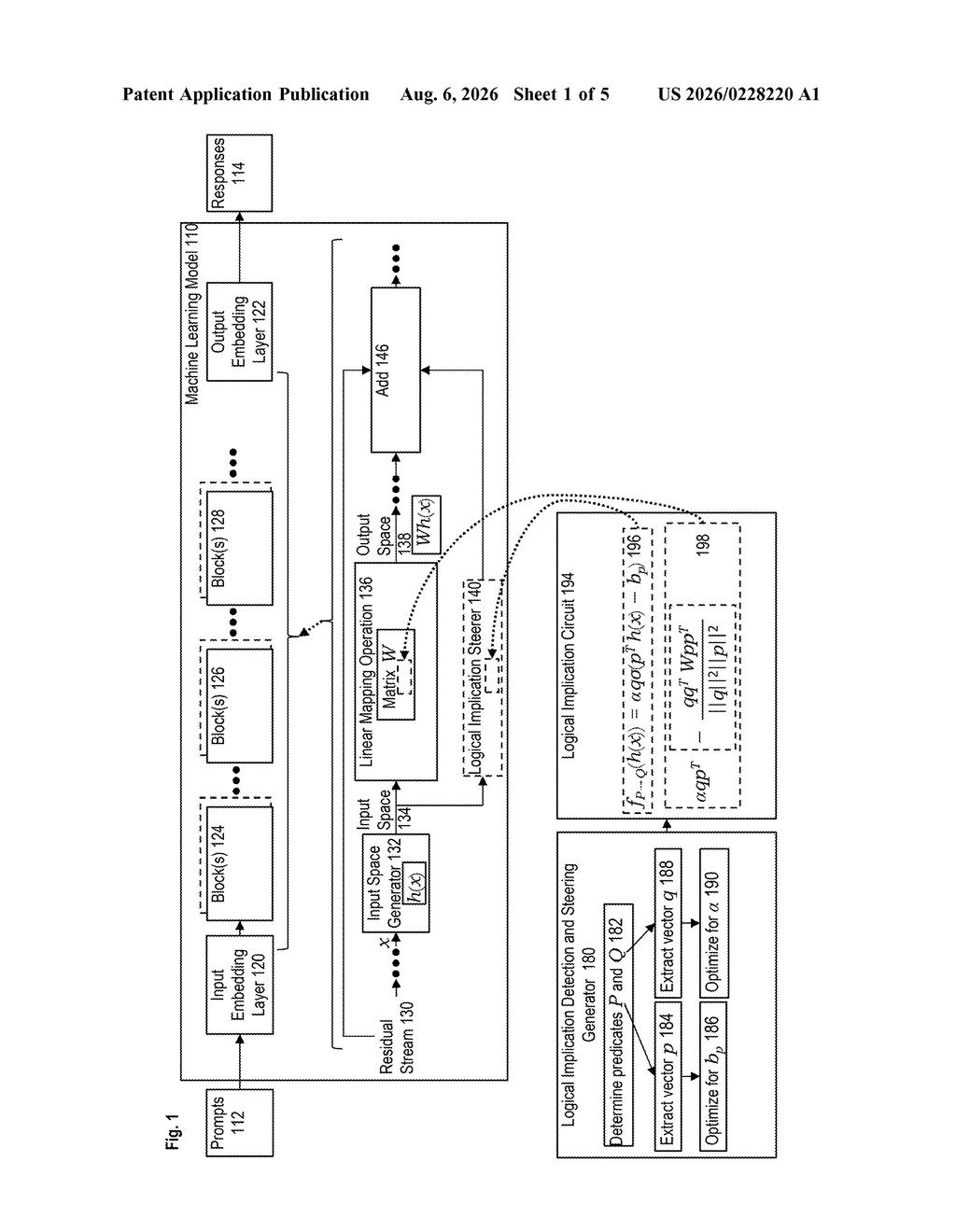
Salesforce's patent describes a kind of logic plug-in, called a logical implication circuit, that sits inside the AI model. When the model's internal state starts looking like a certain concept or topic (think of it as the AI "thinking about" something specific), the circuit nudges the next-word choices toward a related, pre-approved direction. It's like installing a set of if-then rules at the level of the AI's internal math, not just tagging on filters after the fact.
For a business context, this could mean an AI that, whenever a customer service question triggers a certain topic, reliably steers its answer toward the correct policy or response, rather than improvising.
applying the logical implication circuit that, when a first vector is similar to a representation on an input to a linear mapping operation in the machine learning model, steers the generating toward a second vector; …
Translation: The system uses built-in logic rules to redirect the AI's output whenever its internal data matches specific patterns.
How the logical implication circuit redirects token generation
The patent describes installing a logical implication circuit directly into a standard large language model (LLM). Here's how the pieces fit together:
- When a user's prompt arrives, the model breaks it into tokens (small text chunks, roughly words or word fragments) and converts them into numerical vectors (lists of numbers that represent meaning in math-space).
- As the model generates its response, token by token, the logical implication circuit monitors the model's internal activations at a specific layer called a linear mapping operation (a standard matrix multiplication step inside the neural network that transforms one set of numbers into another).
- If the internal representation at that layer is close to a pre-specified first vector (meaning the model's "thinking" resembles a target concept), the circuit intervenes and steers generation toward a pre-specified second vector (a desired direction or topic).
- This happens iteratively, at every token-generation step, throughout the response.
The key difference from simple output filtering is that the steering happens inside the generation process, not after the full text is produced. The model's word choices are redirected in real time rather than edited after the fact.
The text-based version of the prompt is tokenized in an input embedding layer of the machine learning model to generate a token-based version of the prompt.
Translation: The AI breaks down your written question into smaller computer friendly pieces before processing it.
What this means for enterprise AI reliability
For enterprise software, the reliability of AI responses is a practical problem, not a theoretical one. Salesforce builds CRM and customer service tools that companies deploy at scale, and an AI that sometimes wanders off-message or reaches incorrect conclusions is a genuine business liability. This patent points toward AI systems where specific logical relationships (if the customer asks about a refund, always reference the 30-day policy) are enforced at the model level, not just coached through prompt engineering.
The broader implication is that companies could customize how an AI reasons, without paying to retrain it from scratch. That's a meaningful cost and time saving. Whether Salesforce can make this work reliably across diverse real-world inputs is the open question, but the direction is practical and commercially motivated.
This is a focused, credible patent from a company with an obvious commercial reason to care about it. Salesforce doesn't need flashy AI research; it needs AI that does what enterprise customers expect, every time. A mechanism for injecting logical constraints directly into the generation process, rather than layering on post-hoc filters, is exactly the kind of unglamorous but useful infrastructure work that actually ships in products.
There are more where this came from
We read every patent application Big Tech publishes and send you the ones worth knowing. Plain English, free, every week.
The drawings
5 drawing sheets from US 2026/0228220 A1 · click any drawing to enlarge


Want this weekly breakdown for a company we don't cover? Patentlyze Pro →
Be the first to weigh in