
Sony Patents a Digital Ownership Certificate System for Proving Rights to Use Content
Sony is exploring a way to use blockchain tokens not as collectibles, but as verifiable proof that someone actually has permission to use a digital asset, think of it as a tamper-proof receipt that doubles as a door key.
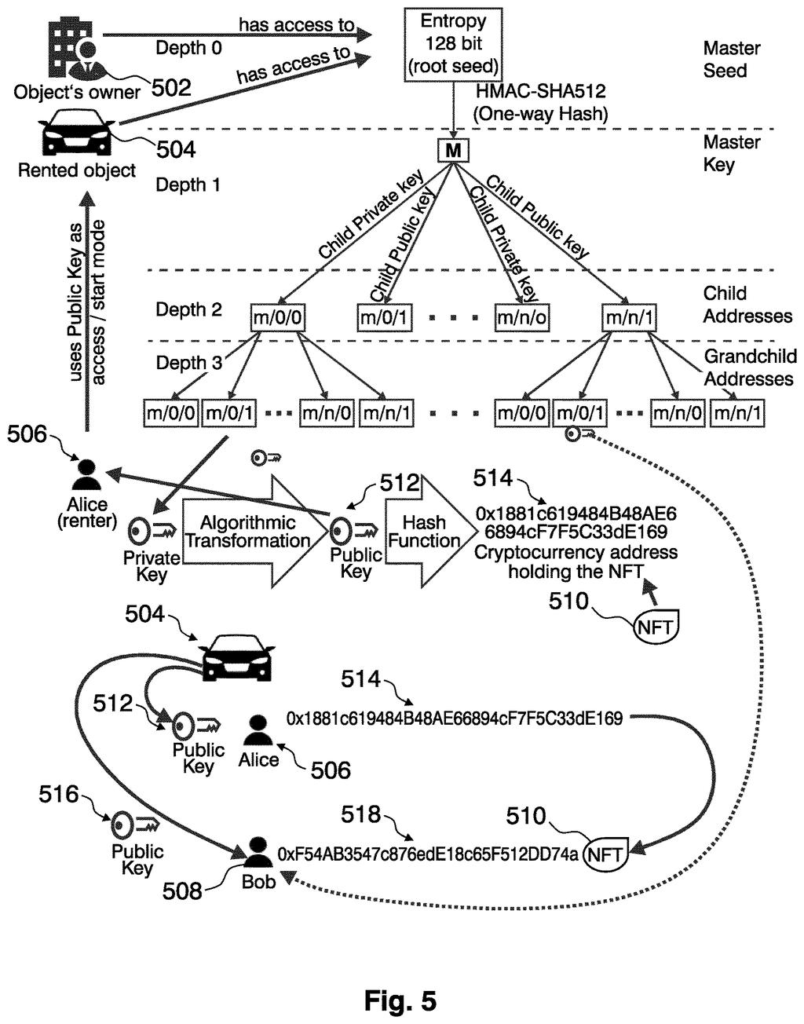
How Sony wants NFTs to work as digital keys
Imagine you buy a license to use a piece of software, a song, or a digital tool. Today, verifying that you actually own that license usually involves usernames, databases, and trust in a central company. Sony's patent proposes a different approach: every digital object gets its own cryptocurrency wallet, and when someone is granted the right to use that object, a blockchain token (NFT) moves into a new slot in that wallet. The new owner gets a digital code (called a public key) tied to that slot.
When someone wants to prove they have the right to use the object, they present that code. Because the blockchain is public and permanent, anyone can confirm the code matches the current token holder, no company database required. It's less about buying a collectible and more about using the blockchain as a tamper-resistant permission slip.
This kind of system could apply to digital media licenses, software access, or even physical objects that have a digital twin. The core idea is that the right to use something becomes trackable and provable without relying on a single company to vouch for it.
transferring an NFT associated with the object from a first cryptocurrency address to a second cryptocurrency address in a cryptocurrency wallet set up for the object …
Translation: Moving a digital token inside a dedicated crypto wallet to assign rights.
How the wallet address swap proves access rights
Sony's patent describes a system where every object (digital or physical with a digital representation) is paired with a dedicated cryptocurrency wallet. That wallet holds an NFT (non-fungible token), which acts as the official marker of who currently holds usage rights.
When a right to use the object is granted to someone, the NFT is transferred from one address in the wallet to another. Cryptocurrency wallets can hold multiple addresses, so this happens within the object's own wallet rather than sending the token to a completely separate wallet. The key steps are:
- An NFT linked to the object is moved from a first address (the current holder) to a second address (the new authorized user's slot).
- The public key tied to that second address is handed to the user. A public key is essentially a unique cryptographic code that proves ownership of a blockchain address without exposing any private credentials.
- To verify the right, a third party checks whether the public key the user presents matches the address currently holding the NFT on-chain.
Because blockchain records are append-only and decentralized, this verification doesn't require trusting Sony or any central server. The ledger itself is the authority.
The right to use the object can be verified based on the public key associated with the second cryptocurrency address.
Translation: A cryptographic key lets users prove they are allowed to use the digital item.
What this means for digital licensing and content access
Digital rights management (DRM) has always been a cat-and-mouse game between content owners and people who circumvent it. Most DRM systems are centralized: if the company's servers go down or the company shuts down, your licenses can vanish. Sony's approach offloads the verification record to a public blockchain, which means the proof of your right to use something persists independently of any single company's infrastructure.
For you as a user, this could eventually mean that a license you bought for a game, film, or software tool is genuinely yours in a verifiable way, not just a row in a database that can be revoked or lost. For Sony, it opens a path to building resale and transfer markets for digital goods where each handoff is cryptographically clean and auditable. Whether this ever ships in a consumer product is a separate question, but the underlying mechanism is more practical than most NFT patents filed in the past few years.
This is one of the more sensible NFT patents to cross the wire in a while. Sony isn't chasing JPEG collectibles, it's proposing a concrete technical mechanism for digital rights that addresses a real problem with existing DRM. Whether blockchain is actually the right tool for this, given its complexity and energy costs, is a fair debate, but at least the problem being solved is real.
There are more where this came from
We read every patent application Big Tech publishes and send you the ones worth knowing. Plain English, free, every week.
The drawings
8 drawing sheets from US 2026/0230324 A1 · click any drawing to enlarge


Want this weekly breakdown for a company we don't cover? Patentlyze Pro →
Be the first to weigh in