
Sony Patents a System That Gives Your Hands a Physical Jolt Between Actions
Most haptic motors just buzz on and then buzz off. Sony's new patent describes a system that adds a deliberate pressure spike, or dip, at the exact moment your physical action changes state, making the feedback feel less like a notification and more like touching something real.
What Sony's pressure-pulse haptic feedback actually does
Every time your game controller rumbles or a VR glove pushes back against your fingers, a tiny motor is deciding how hard to press and for how long. Right now, most of those systems switch bluntly between "pressing" and "not pressing," and your brain notices the abruptness.
Sony's patent describes a control system that watches what you are doing, gripping, releasing, tapping, and matches the physical feedback precisely to each phase of that action. When you move from one phase to the next, the system doesn't just flip a switch. It generates a brief transitional signal that curves the pressure up or down in a deliberate arc before settling at the new level.
The result is that your fingers feel a distinct event at the moment of change, rather than a blurry shift. Think of the difference between a door that snaps shut and one that clicks into place: both close, but only one feels satisfying.
… a third driving signal to apply a third physical stimulus to the user in a transition from the first state to the second state, the third physical stimulus including at least one of an upwardly convex change or a downwardly convex change in an amount of physical stimulus.
Translation: It delivers a distinct physical jolt right when you switch from one action to the next.
How the control unit shapes the transition signal
The patent describes three types of driving signals. A first driving signal runs while the user is in a stable starting state (say, holding an object firmly). A second driving signal runs in the stable end state (object released). Between them, a third driving signal handles the transition.
That third signal is the invention's core idea. It doesn't simply ramp linearly from one intensity to the other. Instead, it can follow an upwardly convex curve (pressure peaks above either stable level and then drops to the target) or a downwardly convex curve (pressure dips below both levels before rising to the target). In plain terms: the signal overshoots or undershoots on purpose, then corrects itself.
A determination apparatus, which could be a sensor array, a camera, or a motion-tracking system, feeds real-time data about the user's action state into the control unit. The control unit then decides which of the three signal types is appropriate at any given moment.
- State 1 signal: steady pressure for the held/active phase
- State 2 signal: steady pressure for the released/idle phase
- Transition signal: a curved pulse that marks the precise moment of change
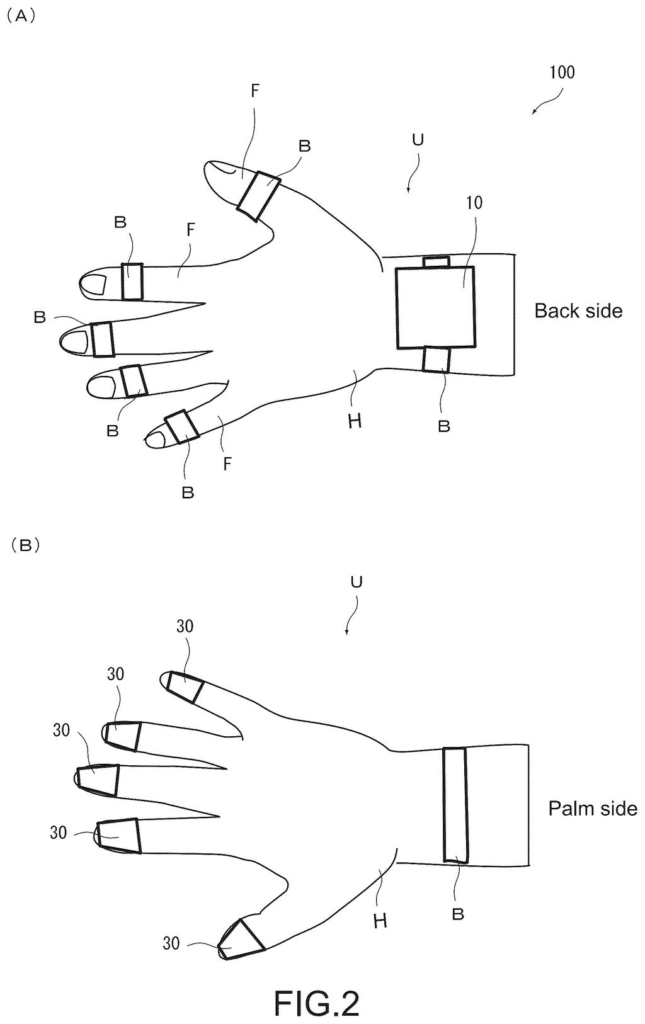
A pressure sensation presentation system according to an embodiment of the present technology includes an output apparatus, a determination apparatus, and a control apparatus.
Translation: The system uses three main parts to track your movements and deliver the right physical feedback.
What sharper haptics mean for VR gloves and game controllers
For anyone wearing VR gloves or using a high-end game controller, this kind of precision would make virtual textures and physical actions feel noticeably more convincing. Your nervous system is very good at detecting change, it's far more sensitive to the moment something shifts than to a constant pressure held over time. A system that deliberately emphasizes that moment exploits the way human touch actually works.
a growing pile of Sony haptic-feedback filings points to a company that sees touch as a serious part of its PlayStation and XR hardware roadmap. Whether this specific approach makes it into a shipping product is an open question, but the engineering direction here aligns with where high-end controllers and mixed-reality headsets are heading.
Sony's 22nd filing we've tracked since May in input and haptics follows earlier ideas like paying for games via controller and a split controller for phones.
The concrete payoff here is small but real: a controller or glove that uses this system would feel more responsive at exactly the moments that matter during gameplay or virtual manipulation. Most people can't articulate why some haptics feel cheap, but this patent identifies one reason: the transition is mushy.
That said, the gap between a lab-grade pressure signal and what a consumer motor can actually produce is wide. The patent describes the signal shape precisely, but haptic actuators in shipping hardware are noisy, imprecise, and battery-constrained. Whether the curved transition survives that translation is a fair question.
Still, this is a specific, testable idea rather than a vague gesture at "better haptics." If Sony can implement it, the person who benefits most is the one who will never read this patent, the player whose controller just feels oddly right.
There are more where this came from
We read every patent application Big Tech publishes and send you the ones worth knowing. Plain English, free, every week.
The drawings
20 drawing sheets from US 2026/0288245 A1 · click any drawing to enlarge


Want this weekly breakdown for a company we don't cover? Patentlyze Pro →
Be the first to weigh in