
Nvidia Patents an AI That Drops Objects Into Photos Without Manual Editing
Adding an object to a photo usually means carefully painting a selection mask by hand. Nvidia's latest patent describes a system that figures out where the object should go, generates it from a text description, and drops it in automatically.
How Nvidia's auto-inpainting skips the manual masking step
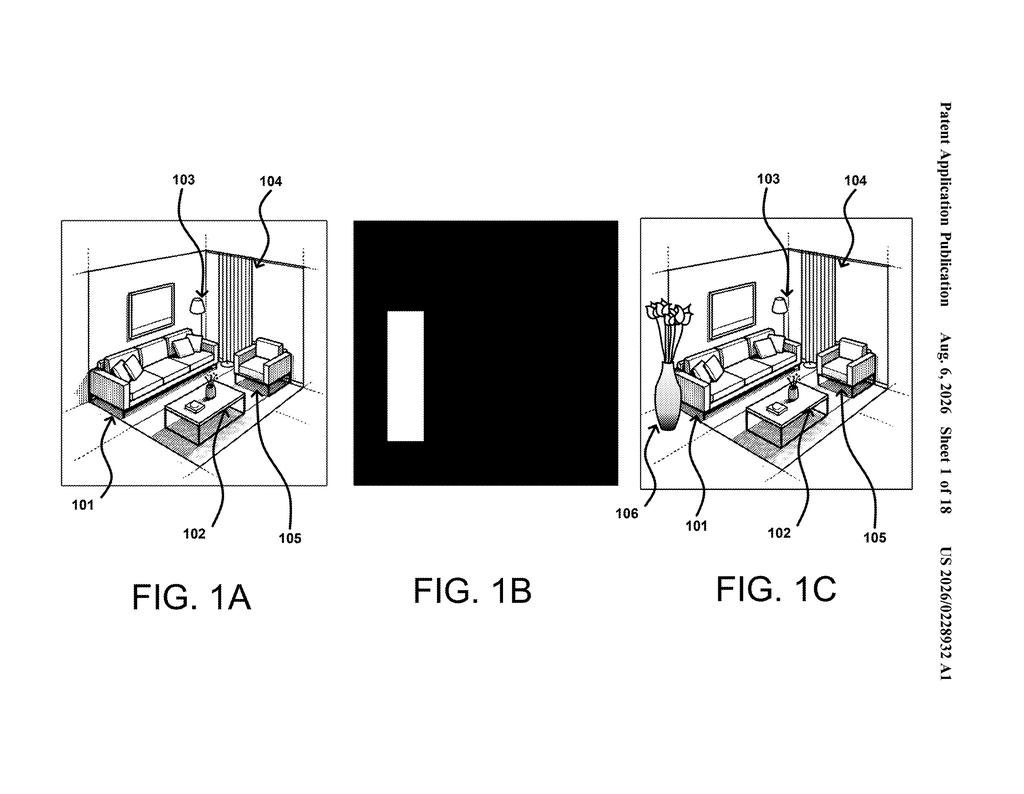
Imagine you have a photo of a living room and you want to see what a particular lamp would look like sitting on the side table. Today, doing that convincingly in a photo editor means manually tracing the area where you want the object to appear. It's tedious, and one wrong stroke makes the result look fake.
Nvidia's patent describes an AI pipeline that skips that step entirely. You type a description of the object you want (say, "a modern floor lamp"), and the system figures out on its own where in the photo that object would realistically belong. It then generates a version of the object, resizes and recolors it to match the scene, and drops it in.
You can get back several different versions showing the object in slightly different positions, and you pick the one that looks best. The goal is to make photo compositing feel less like surgery and more like a prompt.
… generate, using a text-to-image model, one or more object images depicting at least one type of object, the one or more object images generated based in part upon a text prompt, indicating the at least one type of object to be added to the input image …
Translation: It creates a new object using an AI text prompt so it can be added to the picture.
How the segmentation and text-to-image pipeline fits objects in
The system works in two main stages, both driven by machine learning models.
First, a segmentation model (a type of AI that categorizes every part of an image, like labeling one region as "floor," another as "wall," and another as "table surface") scans the input photo and maps out what kinds of surfaces and spaces are available. That map is then used to figure out plausible spots for a new object.
Second, a text-to-image model (the same family of AI that powers tools like DALL-E or Stable Diffusion) generates candidate images of the requested object. Critically, it does this with awareness of the scene context, so the generated object already accounts for the available regions. The segmentation model then runs again on those generated images to cleanly extract just the object itself, cutting away the background.
After the object is placed, the system applies post-processing adjustments:
- Scaling the object to match the perspective of the scene
- Adjusting aspect ratio to fit naturally into the available space
- Matching the color profile of the photo so lighting and tone look consistent
The output is multiple variations of the final image, giving the user options to choose from.
Approaches are described for automatically determining the optimal location to inpaint objects into an image to eliminate the need for manual mask creation.
Translation: The system figures out the best spot to paste a new object without needing anyone to manually draw a mask.
What this means for photo editors and AI image tools
Right now, high-quality object compositing in photos is a skill that takes years to develop in tools like Photoshop. This patent points toward a future where you describe what you want in plain text and an AI handles the placement, sizing, and color matching automatically. That's a meaningful shift for anyone who does product photography, interior design visualization, or social media content without a professional editing background.
For Nvidia, this fits squarely into its push to build AI-powered creative tools. The company already sells infrastructure that runs image-generation models at scale, and owning the patents around context-aware placement could matter as those tools move from the cloud into consumer-facing applications. If you use any AI image editor in the next few years, there's a real chance the "add this to my photo" button is doing something close to what this patent describes.
This is a genuinely practical patent in a space that's currently frustrating for non-experts. The manual masking step is one of the biggest friction points in photo compositing, and automating it well would make AI image tools substantially more useful. Whether Nvidia ships this directly or licenses the approach, it's worth tracking.
There are more where this came from
We read every patent application Big Tech publishes and send you the ones worth knowing. Plain English, free, every week.
The drawings
18 drawing sheets from US 2026/0228932 A1 · click any drawing to enlarge


Want this weekly breakdown for a company we don't cover? Patentlyze Pro →
Be the first to weigh in