Samsung
Samsung · AI / ML · Filed Jul 8, 2025 · USPTO published Jul 2, 2026 · Jul 2 release
Samsung Patents an AI That Grades Photo Quality by Comparing Examples
Most photo-quality tools give you a number and move on. Samsung's new patent describes a system that compares two versions of an image, pulls in similar real-world examples, and generates a reasoned quality verdict, more like a critic than a meter.
- Publication number
- US 2026/0187774 A1(US20260187774A1)
- Applicant
- SAMSUNG ELECTRONICS CO., LTD.
- Filed · Published
- Jul 8, 2025 · Jul 2, 2026
- Inventors
- Sehwan KI, Younghyun JO, Eunhee KANG, Jisoo SON, Hyong Euk LEE
- Status when we published
- Waiting for an examiner
- Document
- 22 claims
- US classification
- 382/112
How Samsung's image-grading AI actually makes its call
Imagine your phone's camera had to explain, in plain terms, why one photo is better than another. Not just "this one scored 87" but something more like "the sharpness is noticeably better, but the color balance is roughly the same." That's the kind of output Samsung is working toward.
The system takes two photos of the same subject at different quality levels, figures out which one is better across several dimensions (sharpness, noise, color, and so on), then looks up similar comparisons it has seen before. Using all of that context, it generates a fuller written or structured assessment of the difference.
For you as a phone user, this kind of technology could power smarter automatic photo selection, more useful editing suggestions, or better quality control in camera apps that process multiple shots before showing you the "best" one.
How the two-modality retrieval pipeline scores images
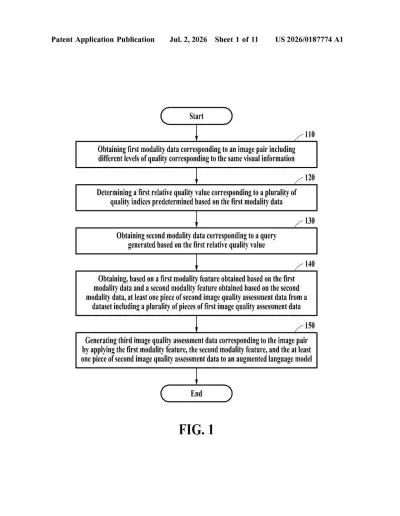
The patent describes a multi-step pipeline for image quality assessment (IQA) that combines visual analysis with a language model.
- Step 1, Pairwise visual encoding: The system takes an image pair (two photos sharing the same scene or subject but at different quality levels) and encodes them into what the patent calls "first modality data", a structured visual representation of both images together.
- Step 2, Relative quality scoring: From that visual data, the system produces a relative quality score across several predetermined quality dimensions (things like sharpness, noise level, or exposure).
- Step 3, Query generation: That score is turned into a text or embedding query ("second modality data"), which is used to search a database of previously labeled image quality assessments for similar examples.
- Step 4, Retrieval-augmented generation: The retrieved examples, along with the original visual and query features, are fed into an augmented language model (a model that can pull in external examples at inference time, rather than relying only on what it learned during training). The model then produces a final quality assessment for the image pair.
The retrieval step is what makes this approach different from a simple scoring model. By pulling in real past examples that are semantically similar to the current query, the language model has concrete context to work from, which tends to produce more calibrated and explainable outputs.
What this means for Samsung camera software
Camera hardware in flagship phones has largely plateaued in raw sensor quality. The next frontier is computational photography software, picking the best frame from a burst, deciding when to apply sharpening, or flagging a low-quality shot before the user even sees it. A system that can reason about quality in nuanced, explainable terms gives Samsung's camera pipeline a more reliable foundation for those decisions.
There's also a broader AI angle. The retrieval-augmented approach described here is the same general architecture being applied across text, code, and now image domains. If Samsung integrates this into Galaxy camera software, it could mean more accurate "Best Photo" picking or on-device feedback explaining why a shot was rejected, the kind of feature that's small but genuinely useful in everyday use.
Source: US 2026/0187774 A1 at the USPTO (PDF). Full patent text and figures are in the official publication.
Get our take in your Top Stories
Liked this breakdown? Add Patentlyze as a preferred source on Google, and our plain-English take shows up more often in your Top Stories the next time Samsung patent news breaks.
Add Patentlyze on Google
One click.
There are more where this came from
We read the new patents from Big Tech, carmakers and more and send you the ones worth knowing. Plain English, free, every week.
More from Samsung
All 1,662 Samsung patents →
More in AI vision
All 352 AI vision patents →
Google
Google Patents an AI That Finishes Cut-Off Objects and Moves Them Anywhere in a Photo
Adobe
Adobe Patents an AI System That Cleans Up Sloppy Object-Removal Edges
Google
Google Patents an AI That Fits Real Objects Into Any Art Style Without Losing Their Details
Adobe