
Nvidia Patent Explores Stacked Virtual Tokens to Transform AI Model Training
Instead of feeding an AI model a plain text instruction, Nvidia's new patent describes a system that builds invisible, stacked 'instruction bundles' learned from multiple data sources at once. It's a more efficient way to specialize a general-purpose AI without retraining the whole thing from scratch.
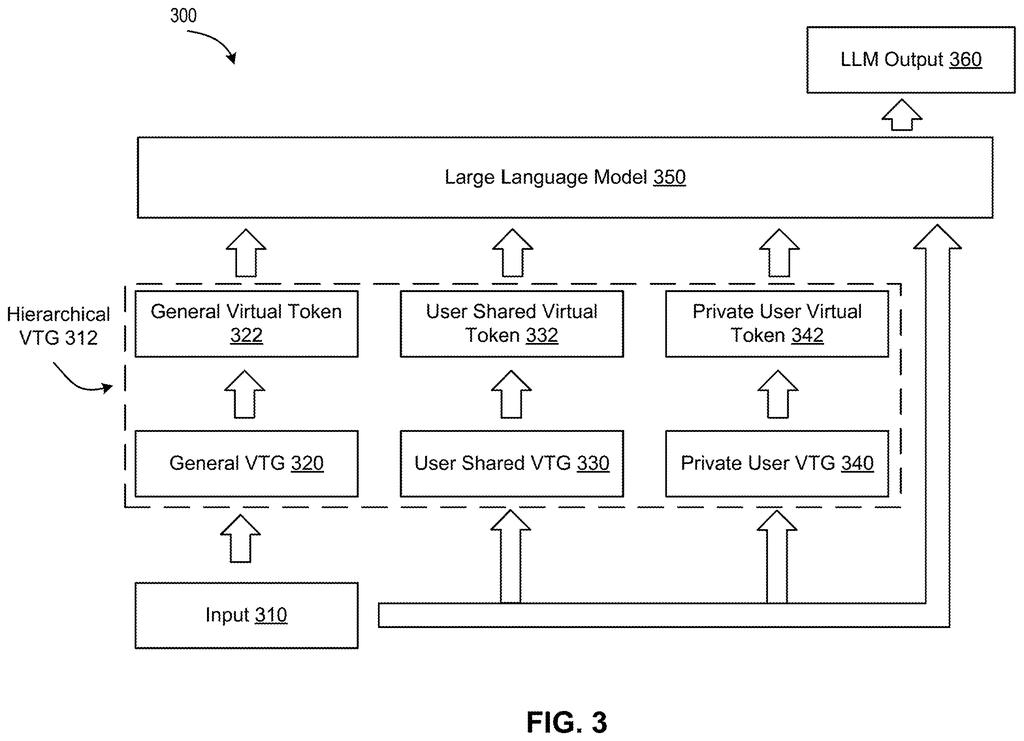
How Nvidia's layered prompt system trains AI chatbots
Imagine you want to teach a general-purpose AI assistant to be good at, say, both customer service and medical Q&A. Normally you'd have to retrain the entire model or write very long, carefully crafted text instructions every time. That's slow and expensive.
Nvidia's patent describes a different approach: instead of writing those instructions in plain words, the system generates compact, invisible 'prompt packets' that the AI reads before it answers anything. These packets are learned automatically from different datasets, one for each specialty you want the AI to have, and then stacked together into a single input.
The result is an AI that can absorb guidance from multiple domains at once without you having to rewrite its core. Think of it like pre-loading multiple personality settings into the AI before it starts talking to you, rather than reprogramming it each time.
train a hierarchical virtual token generator (VTG) model to generate a large language model (LLM) input prompt …
Translation: Build a system that creates custom prompts for artificial intelligence models.
How the hierarchical VTG model stacks token embeddings
The patent centers on a hierarchical virtual token generator (VTG) model. A 'virtual token' is not a word you type; it's a dense numerical representation (called an embedding) that lives in the AI's internal math space and carries meaning the model can act on.
The system trains two or more separate VTGs, each on a different dataset:
- A first VTG learns from one dataset (say, customer support transcripts) and produces a first token embedding.
- A second VTG learns from a different dataset (say, technical documentation) and produces a second token embedding.
- Both embeddings are combined into a single input prompt fed to the large language model (LLM) before any real conversation begins.
The word 'hierarchical' signals that the two generators are not equal peers; one layer builds on or conditions the other, letting the system represent a primary specialty and a secondary one at the same time. The LLM itself does not need to be retrained; only the lightweight VTG layers are trained, which is far cheaper computationally.
… training, based at least on a first dataset, a first VTG to output a first virtual token embedding, and training, based at least on a second dataset different from the first dataset, a second VTG to output a second virtual token embedding …
Translation: Combine different data sources to generate separate token layers for the prompt.
What this means for customizing AI without full retraining
Fine-tuning a large language model for a specific task typically means either retraining millions (or billions) of parameters or writing elaborate manual prompts that must be maintained by hand. Nvidia's approach is a middle path: small trainable modules that sit in front of the LLM and do the specialization work, while the core model stays untouched. That matters a lot for enterprise deployments where companies want one base model serving dozens of different use cases.
For Nvidia, which sells both the chips and the software stack (NeMo, TensorRT-LLM) that enterprises use to run AI, owning the intellectual property around efficient prompt tuning methods ties customers more tightly to its platform. If this technique ships inside Nvidia's AI software tools, businesses customizing AI on Nvidia hardware would naturally use it.
This is a solid piece of infrastructure IP in the prompt-tuning space, which is genuinely competitive right now. It's not flashy from a user perspective, but the problem it targets (cheap, modular LLM specialization) is one every enterprise AI deployment faces. Worth watching if you follow Nvidia's software-platform ambitions.
There are more where this came from
We read every patent application Big Tech publishes and send you the ones worth knowing. Plain English, free, every week.
The drawings
11 drawing sheets from US 2026/0228460 A1 · click any drawing to enlarge


Want this weekly breakdown for a company we don't cover? Patentlyze Pro →
Be the first to weigh in