
Qualcomm Patents a System That Combines Camera and Radar Data to Spot Both Nearby and Distant Objects
Your car's sensors are great at spotting the pedestrian right in front of you, but what about the truck two blocks away? Qualcomm's new patent tackles exactly that split-attention problem by combining two fundamentally different views of the world into one unified picture.
How Qualcomm's two-perspective sensor trick works
Imagine you're driving and your car needs to watch two things at once: a cyclist who just pulled into your lane ten feet away, and a traffic jam forming half a mile down the highway. Those two situations call for very different kinds of attention, and right now most sensor systems have to make uncomfortable trade-offs between them.
Qualcomm's patent describes a system that handles both at the same time by using two distinct "views" of sensor data. Nearby objects get mapped onto a flat, top-down grid (think Google Maps looking straight down at your car). Distant objects get mapped onto a perspective view (more like what your eyes actually see, where things shrink as they get farther away). The clever part is that these two maps are designed so their edges line up perfectly, letting the system stitch them together into one combined picture.
The result is a single data structure that an AI can then analyze to detect, classify, and track everything around the vehicle, close or far, without having to choose between accuracy near and accuracy far.
… generating a Bird's Eye View (BEV) feature tensor that represents the one or more first detected objects projected onto a BEV surface; generating a Generalized Perspective View (GPV) feature tensor that represents at least the one or more second detected objects projected onto a GPV surface …
Translation: It creates two different digital maps, one for close objects and one for distant objects, to process what the sensors see.
How the BEV and GPV grids snap together
The patent describes a sensor fusion pipeline that processes raw data from multiple sensors (cameras, lidar, radar) and projects it onto two different surfaces depending on how far away a detected object is.
- Bird's Eye View (BEV): Objects closer than a set distance threshold get projected onto a flat, top-down grid, like a floor plan. This representation preserves accurate size and position for nearby objects.
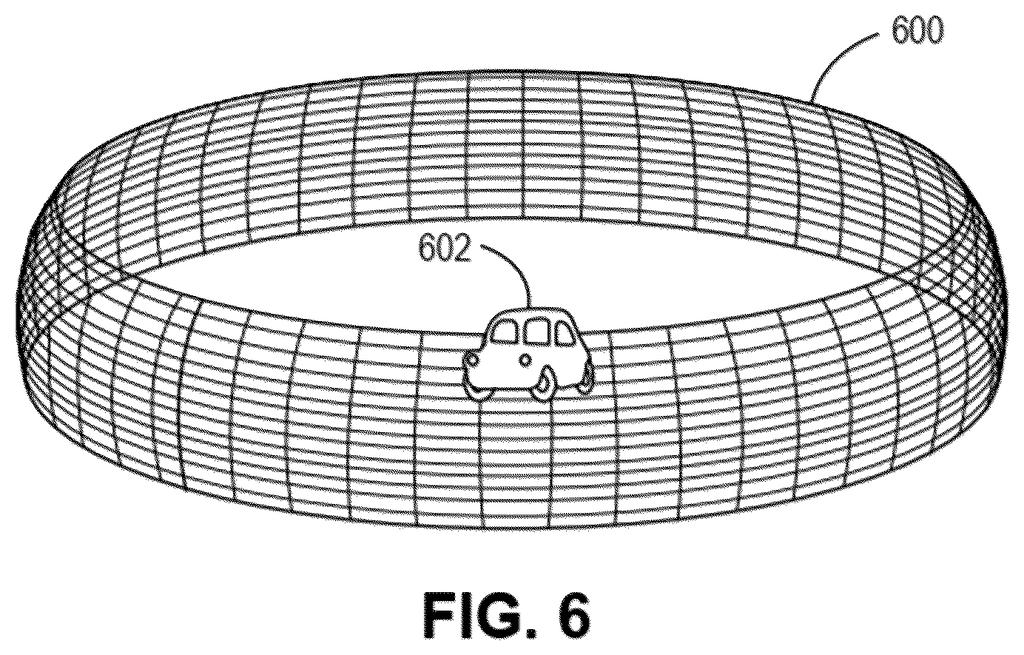
- Generalized Perspective View (GPV): Objects farther than the threshold get projected onto a surface that mimics human perspective, compressing distant space the way a camera lens does. This captures long-range structure without wasting resolution on empty nearby space.
- Grid alignment: The key engineering detail is that the sector lines of the BEV grid and the column lines of the GPV grid are deliberately designed to be collinear, meaning they share the same angular boundaries. This makes it possible to concatenate (stitch end-to-end) the two data tensors along those shared boundaries without distortion or gaps.
Once concatenated into a single tensor (a multi-dimensional data array that neural networks process), a perception model can run object detection, classification, or tracking across the full scene in one pass, rather than running separate models for near and far ranges and trying to reconcile their outputs.
… concatenating the BEV feature tensor and the GPV feature tensor along the sector lines of the BEV grid and the column lines of the GPV grid to generate a concatenated tensor …
Translation: The system then stitches those two separate maps together along matching grid lines to create a single unified view.
What this means for self-driving and robotics sensors
For self-driving vehicles and advanced driver assistance systems, the tradeoff between near-range and far-range accuracy is a genuine engineering headache. Most current approaches either pick one projection style for everything or run parallel models that have to be merged later, which adds processing cost and introduces seams where the two outputs meet. Qualcomm's approach of aligning the grids mathematically before fusion eliminates that seam at the architecture level, which could mean faster inference and fewer missed detections at the edges of each zone.
Qualcomm is primarily a chip and processor company, so this kind of perception pipeline work is aimed squarely at the silicon it sells to automakers and robotics companies. If this approach makes it into production, you would likely benefit through more reliable automatic emergency braking and highway assist features, not through anything you'd directly see or interact with.
This is solid, unglamorous sensor-fusion engineering from a company that has been building its automotive AI portfolio for years. The grid-alignment idea is the kind of detail that separates a paper prototype from something that actually runs efficiently on real hardware. It's not a flashy consumer feature, but it's the kind of patent that tends to show up inside the next generation of ADAS chips.
There are more where this came from
We read every patent application Big Tech publishes and send you the ones worth knowing. Plain English, free, every week.
The drawings
22 drawing sheets from US 2026/0229043 A1 · click any drawing to enlarge


Want this weekly breakdown for a company we don't cover? Patentlyze Pro →
Be the first to weigh in