
Samsung Patents a System That Keeps Your Satellite Connection Alive When the Network Can't Respond
When a satellite overhead can't immediately pass your phone's message to a ground network, the connection usually just fails. Samsung is filing a patent for a smarter retry system that tells your device exactly when and where to try again.
What Samsung's satellite store-and-forward fix actually does
Imagine you're in a remote area with no cell towers, and your phone is connecting through a satellite. The satellite overhead receives your phone's request, say, to register on the network, but it can't get a full response back to you right now because it's not yet in range of a ground station. Without a plan, your phone just sits there or throws an error.
Samsung's patent describes a way to handle that awkward gap. When the network can't complete your phone's request right away, it sends back a special message that includes two pieces of information: a timer (telling your phone how long to wait) and a list of other satellites that might be able to finish the job. Your phone holds on, and when the time is right, it tries one of those other satellites instead of spinning uselessly.
This "store and forward" approach means the satellite essentially saves your request, the network tells your phone what to do next, and the whole process picks up where it left off. It's the difference between a dropped call and a call that waits for a better connection.
… receiving, from the satellite, a response message as a response of the request message from the satellite, the response message including first information indicating a timer for waiting subsequent NAS procedure and second information indicating a list of one or more identifiers related to one or more satellites for attempting the subsequent NAS procedure …
Translation: The satellite replies with a wait timer and a list of other satellites to try.
How the timer-and-satellite-list handoff works
The patent centers on what cellular engineers call Non-Access Stratum (NAS) procedures, the behind-the-scenes signaling your phone does to register with a network, attach to services, or manage connections. These happen before any actual call or data flows. In a normal terrestrial network, this signaling completes in milliseconds. Over satellites, especially in Low Earth Orbit (LEO) constellations, a satellite may not always have a live link to a ground-based core network at the moment your phone transmits.
The patent proposes a store and forward (S&F) service: the satellite or a network node onboard the satellite holds the phone's NAS message and waits until connectivity to the ground network is restored. The key addition is what the network sends back to the phone while it waits.
The response message includes:
- A wait timer, how long the phone should hold off before retrying
- A list of satellite IDs, specific satellites the phone should target for its retry attempt
- An indication that S&F mode is active, so the phone knows the delay is expected, not an error
The phone then attempts the follow-up NAS procedure with one of those listed satellites, rather than blindly retransmitting. This keeps the signaling orderly and avoids congestion from many devices retrying at random.
Determining, by a core network node, that at least one NAS procedure initiated by UE cannot be completed due to store and forward (S&F) operation, wherein core network node onboard the network; and providing, by core network node, at least one S&F information to UE …
Translation: The network realizes it cannot finish your request right now and sends back instructions to wait.
What this means for satellite-connected phones
As phone makers including Apple and Qualcomm push satellite connectivity into consumer devices, one of the real engineering headaches is making cellular protocols that were designed for always-on ground networks behave gracefully in a world where your connection orbits overhead at 17,000 mph. A satellite is only in range for a few minutes at a time, and its link to ground infrastructure isn't always live.
For you as a user, this patent is about reliability: fewer silent failures when your phone tries to register or send a message over a satellite link. For Samsung, it positions the company in the standards work that will define how 5G Non-Terrestrial Networks (NTN) actually behave, a space where being an early patent filer carries real weight in industry standards bodies like 3GPP.
This is unglamorous plumbing work, but it's exactly the kind of low-level protocol patent that shapes cellular standards. Samsung is one of the largest contributors to 3GPP, and filings like this one are how companies stake out positions in the rules that every phone and satellite operator will eventually have to follow. Not exciting to read about, but worth tracking if you follow satellite connectivity standards.
There are more where this came from
We read every patent application Big Tech publishes and send you the ones worth knowing. Plain English, free, every week.
The drawings
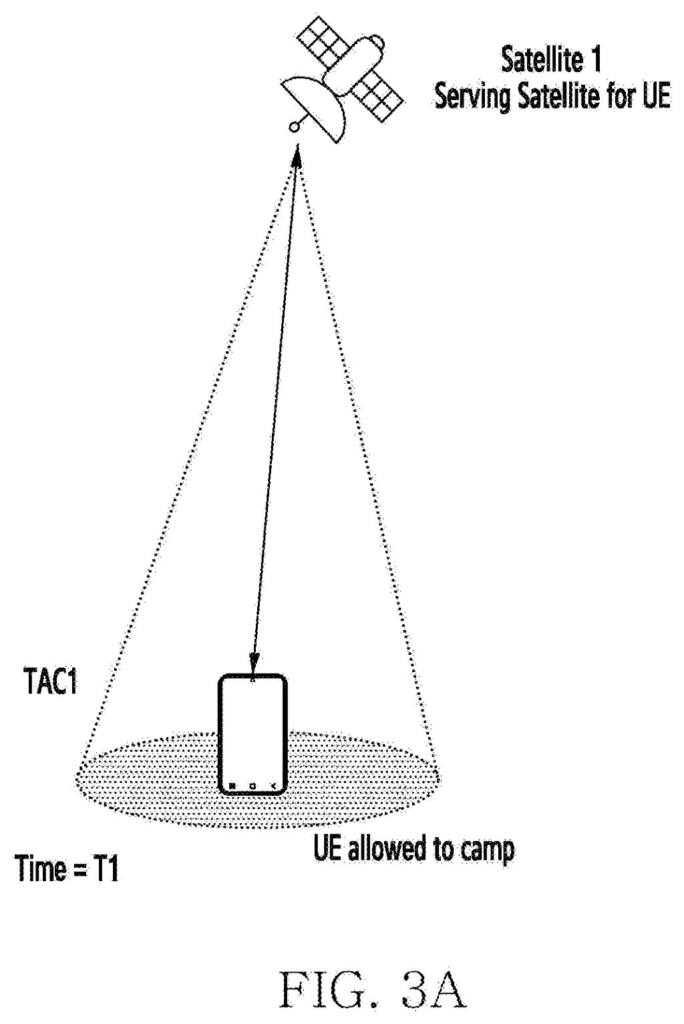
13 drawing sheets from US 2026/0230170 A1 · click any drawing to enlarge


Want this weekly breakdown for a company we don't cover? Patentlyze Pro →
Be the first to weigh in