
Samsung Patents a Dual-Exhaust Airflow System for Smart Clothing Cabinets
Samsung is refining how air moves inside its clothing care cabinets — and the key insight is that not all the air should go through the heater. A two-exhaust system lets the machine heat some air while bypassing the heat exchanger with the rest, giving it finer control over temperature and drying conditions.
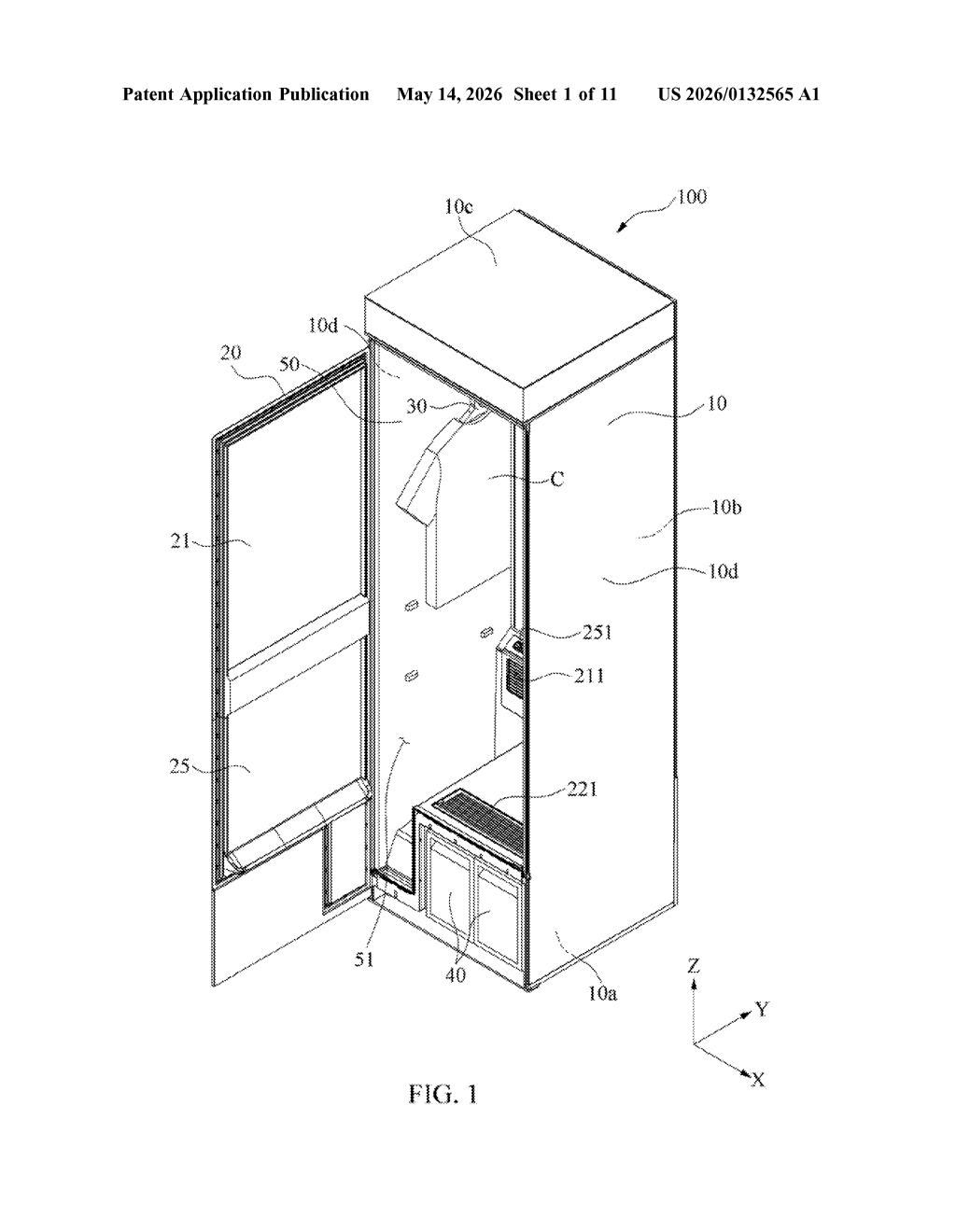
What Samsung's clothing care cabinet airflow actually does
Imagine hanging your clothes in a cabinet that steams out wrinkles, deodorizes fabric, and gently dries everything without a full wash cycle. Samsung already sells products like this — the AirDresser — and this patent is about making the internal airflow smarter.
Inside the cabinet, there are two separate vents that pull air out of the clothing area. One of them sends air directly to the fan, skipping the heating element entirely. The other routes air through the heat exchanger first, warming it up before it circulates back in. Fresh air re-enters through a vent at the top.
The result is a system that can blend heated and unheated air more precisely — think of it like a mixing valve on a shower, but for a clothing cabinet. Better airflow control means more consistent drying and steaming without overheating delicate fabrics.
How Samsung's dual exhaust ports split and route airflow
The patent describes the physical architecture of a clothing management cabinet — essentially a wardrobe-sized appliance with an outer case (the structural shell) and an inner case (the insulated chamber where your clothes hang).
Air circulation works like this:
- An air supply port on the top surface of the inner case pushes conditioned air down into the clothing space.
- A first exhaust port on a side surface (somewhere between top and bottom) pulls air out and routes it around the heat exchanger directly to the fan.
- A second exhaust port on the bottom surface pulls air out and routes it through the heat exchanger before it reaches the fan.
The heat exchanger (the component that heats the air, similar to what you'd find in a heat pump dryer) only processes air from one of those two return paths. The fan, sitting in the gap between the outer and inner cases, draws from both streams.
By splitting the return airflow into a heated path and a bypass path, the system can modulate the effective temperature of the air being recirculated without simply toggling the heater on and off. It's a more nuanced approach to thermal management inside a sealed garment-care enclosure.
What this means for Samsung's AirDresser product line
Samsung's AirDresser line has been a quiet success in markets like South Korea and Japan, and the company has been steadily filing patents to improve the underlying hardware. Dual-path airflow is a meaningful engineering refinement — it's the kind of detail that separates a cabinet that works adequately from one that handles silk differently than denim.
For you as a consumer, this could translate to faster cycle times, lower energy use, or better fabric protection on a future AirDresser model. It also signals that Samsung is investing in the internal mechanics of these appliances rather than just adding software features — which is usually a sign that a hardware refresh is in the pipeline.
This is an incremental but legitimate hardware engineering patent — not flashy, but exactly the kind of low-level airflow optimization that makes or breaks a premium appliance. If Samsung is filing this now, there's a reasonable chance it shows up in a next-generation AirDresser. Worth a bookmark if you follow Samsung's home appliance roadmap.
There are more where this came from
We read every patent application Big Tech publishes and send you the ones worth knowing. Plain English, free, every week.
Want this weekly breakdown for a company we don't cover? Patentlyze Pro →