
Zoox Patents a Branching Path-Search System to Help Its Robo-Taxis Dodge Collisions
When a self-driving car has milliseconds to react, how does it pick the right path? Zoox's latest patent describes a system that generates a branching menu of possible moves and searches through them to find the safest one.
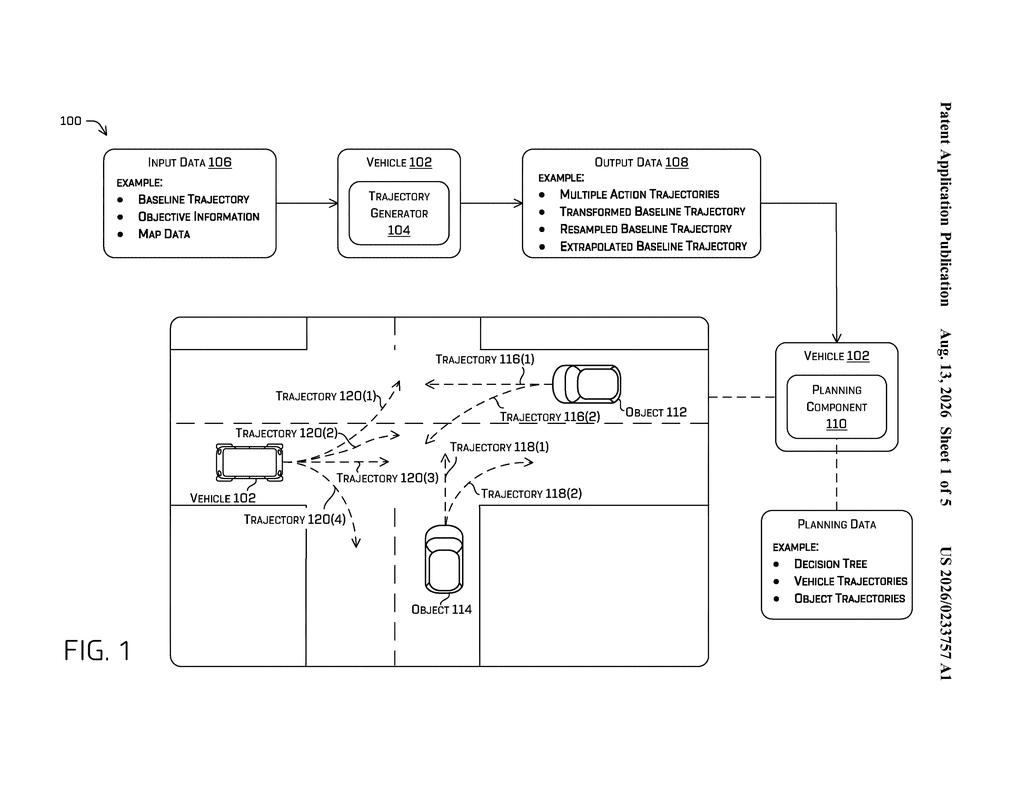
How Zoox's robo-taxi picks its next move
You're in the back of a Zoox robotaxi when a cyclist cuts across the street. The car needs to decide: brake hard, swerve left, or ease off the gas? It can't just guess, and it can't try them all in the real world.
Zoox's patent describes a system that builds a kind of decision tree, similar to the branching choices in a flow chart. The car starts from its current planned route, then generates several modified versions of that route, one that brakes earlier, one that steers slightly differently, and so on. It searches through that tree to find the path that best avoids a collision.
The key idea is that the car isn't choosing blindly. It uses a model to create action references, structured variations of the baseline route, which give the search something concrete to work with. The result is a candidate trajectory: the specific path the car actually follows.
… performing a search of a tree structure, the tree structure comprising a first set of nodes associated with the trajectory and a second set of nodes associated with the modified trajectory, the first set of nodes and the second set of nodes having a common start node; …
Translation: The software explores a branching map of possible driving paths that all begin at the same current location.
How the tree search selects the safest path
At its core, this patent is about how a self-driving vehicle generates and evaluates possible driving paths in real time.
The system works in a few layered steps:
- Baseline trajectory: The vehicle starts with a planned route for the near future, maybe the next few seconds of driving.
- Modified trajectories: A model takes that baseline and generates several variations, adjusting speed, steering angle, or timing in different ways. These become the branches of a decision tree.
- Tree search: The system searches through the tree structure, where each node represents a moment in time and each branch a different action, to find the path that scores best on safety and comfort criteria.
- Candidate trajectory: The winning path from the search is what the vehicle actually executes.
The technical term action reference generation pipeline refers to the automated process of producing those structured route variations. Think of it as the car's ability to rapidly sketch out alternative futures before committing to one.
The tree structure itself is important because it lets the system share a common starting point across all options, a single start node, and then branch out from there. That shared root makes the search computationally efficient: the car isn't re-evaluating the beginning of every path from scratch each time.
… the model may represent one or more trajectory generators that modify a baseline trajectory in different ways to output a set of actions trajectories that are usable to define a tree structure.
Translation: Algorithms tweak the standard driving route to create multiple alternative paths for avoiding obstacles.
What this means for self-driving collision avoidance
Collision avoidance is the single most safety-critical function a self-driving vehicle performs. Systems that rely on a single planned path are brittle; if that path becomes unsafe, the car needs an alternative ready almost instantly. A tree-search approach, where multiple options are pre-generated and ranked, gives the vehicle a structured fallback rather than forcing it to compute a new path from zero under pressure.
Zoox operates a fully autonomous ride-hail service with no human safety driver, so the stakes for getting this right are higher than for driver-assistance systems that can defer to a person. This patent sits in a dense field of new Big Tech patents around autonomous vehicle planning, where the race is less about sensing the world and more about deciding what to do with what you see.
Selecting a safe path in real time when the environment changes faster than a single planned route can handle is a real problem, and an expensive one when it fails. Tree-search planning is a well-established technique in game AI and robotics, so Zoox isn't introducing an entirely new idea here. What the patent adds is a specific pipeline for generating the action references that populate the tree, which is the part that's hardest to get right in practice. For a company running driverless vehicles on public streets without backup drivers, that generation step is the difference between a system that works and one that freezes.
Get our take in your Top Stories
Liked this breakdown? Add Patentlyze as a preferred source on Google, and our plain-English take shows up more often in your Top Stories the next time Amazon patent news breaks.
There are more where this came from
We read every patent application Big Tech publishes and send you the ones worth knowing. Plain English, free, every week.
The drawings
5 drawing sheets from US 2026/0233757 A1 · click any drawing to enlarge


Want this weekly breakdown for a company we don't cover? Patentlyze Pro →
Be the first to weigh in