
Nvidia Patent Maps All Possible Driver Behaviors at Once for Self-Driving AI
Most self-driving systems react to what other drivers are doing right now. Nvidia's new patent describes a system that thinks ahead, mapping out a branching tree of what every nearby driver might do next, then planning a route that handles all of those possibilities at once.
How Nvidia's self-driving planner thinks ahead
Imagine you're merging onto a highway. The car in the lane beside you might speed up, slow down, or hold steady. A human driver instinctively prepares for all three. Most self-driving software, though, picks one likely scenario and plans around that, which can cause hesitation or abrupt corrections when drivers do the unexpected.
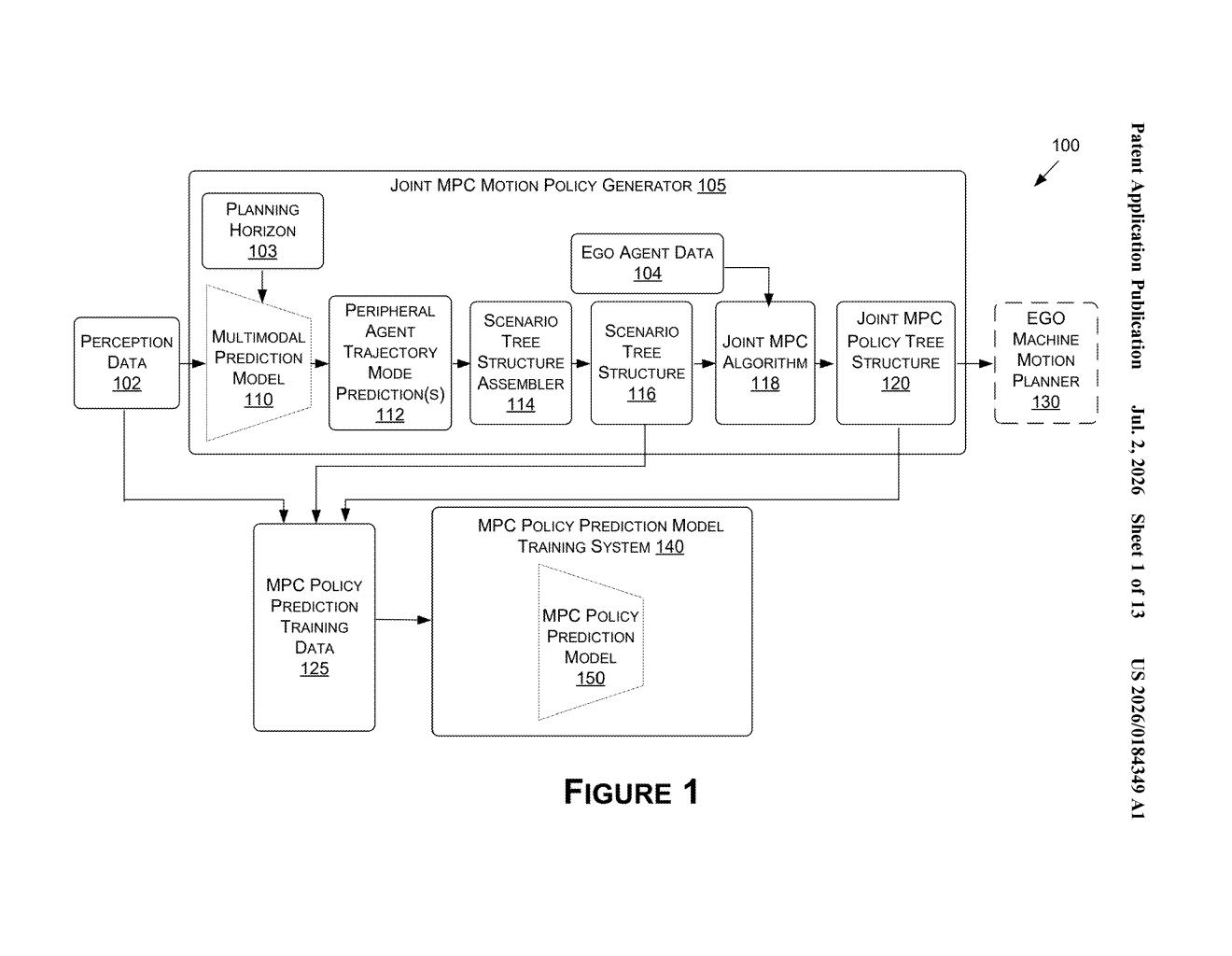
Nvidia's patent describes a planning system that builds a kind of decision tree: a map of what each nearby driver might do, branching out like a flowchart of futures. The self-driving car's AI then figures out a single route through your environment that works across all those possible futures, not just the most probable one.
To make this fast enough to use in a real car, Nvidia trains a machine learning model on thousands of simulated scenarios first. The trained model can then predict good routes instantly, without running the full, slow math every time the car needs to make a decision.
How the policy tree and MPC model work together
The system works in two phases: an offline training phase and a real-time prediction phase.
During training, Nvidia uses a joint Model Predictive Control (MPC) algorithm (a type of math that optimizes decisions by simulating future consequences) to solve a complex problem: find a path for the self-driving car that stays safe no matter which of several plausible futures plays out. Nearby drivers' possible behaviors are laid out as a scenario tree, a branching structure where each branch represents a different thing a driver might do. The optimizer then produces a policy tree, a matching branching plan for the ego vehicle that handles every branch of the scenario tree.
Because running that full optimization in real time would be too slow for a moving car, Nvidia trains a machine learning model on the outputs of thousands of those offline runs. The model learns to predict what the optimizer would have said, given a particular traffic scene.
At runtime, the car's sensors feed perception data into that trained model, which instantly outputs a policy tree. The car then uses that tree to guide its movement, effectively anticipating multiple driver behaviors simultaneously rather than locking onto a single predicted future.
What this means for self-driving car reliability
Self-driving cars that plan for only one predicted future can be brittle: they work well in normal traffic but freeze or overcorrect when a driver does something unexpected. A system that builds contingency plans into the route itself is more resilient by design, which matters most in dense urban traffic and highway merges where human behavior is hardest to predict.
For Nvidia, this also fits a broader strategy. The company sells both the chips and the AI software stacks that autonomous vehicle makers use. A patented planning architecture like this could become part of Nvidia DRIVE, making the planning layer a proprietary differentiator on top of the hardware Nvidia already sells to automakers.
This is a real engineering problem with a real solution, not a speculative moonshot. The gap between 'optimally safe but slow' and 'fast enough for a real car but simplified' is exactly where autonomous vehicle research is stuck right now, and Nvidia's approach of using offline optimization to train a fast runtime predictor is a credible way to close it. Worth tracking if you follow the self-driving space.
Get our take in your Top Stories
Liked this breakdown? Add Patentlyze as a preferred source on Google, and our plain-English take shows up more often in your Top Stories the next time Nvidia patent news breaks.
There are more where this came from
We read every patent application Big Tech publishes and send you the ones worth knowing. Plain English, free, every week.
Want this weekly breakdown for a company we don't cover? Patentlyze Pro →