
IBM Patents a System That Uses AI to Grade Its Own Software Translations
Translating software into dozens of languages is expensive, error-prone, and hard to check at scale. IBM's new patent describes a system where an AI language model grades its own translation output using structured context about what each piece of text actually means.
How IBM's AI checks translated software text for accuracy
Imagine you work for a company that sells software in 40 countries. Every button label, error message, and menu item has to be translated into each local language, and a single mistranslation can confuse thousands of users or create legal headaches. Checking all of that by hand is slow and costs a fortune.
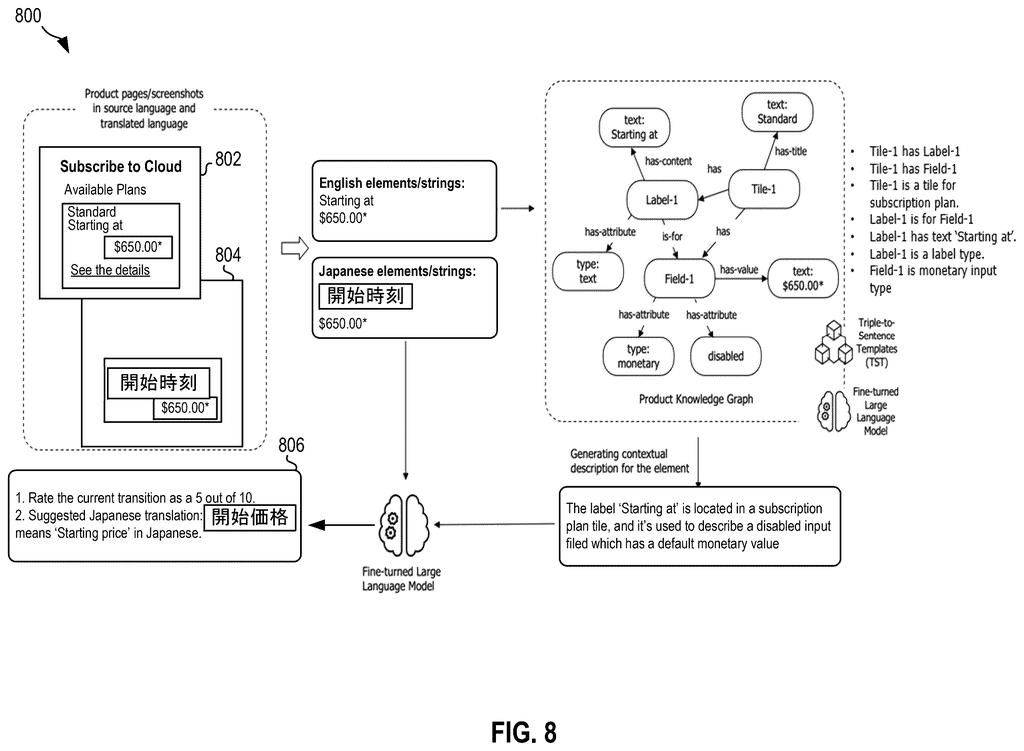
IBM's patent describes a system that pulls structured knowledge about what each piece of software text means, including how it relates to other parts of the product, and uses that context to build explanatory sentences. A fine-tuned AI model then reads those sentences alongside the translated text and assigns a grade, flagging translations that don't hold up.
The result is an automated quality check that goes beyond simple word-for-word comparison. Instead of just asking "is this word translated correctly," the system asks "does this translation make sense given everything we know about what this piece of software does?"
… causing a fine-tuned large language model (LLM) to grade a first translation element, wherein the first translation element is a translation of a first portion of the first resources to a target language; and using the grade to validate the first translation element.
Translation: The system uses an AI model to score how well a piece of text was translated and then uses that score to verify the result.
How the knowledge graph feeds context to the grading model
The patent describes a pipeline with three main stages.
- Knowledge graph retrieval: A knowledge graph (think of it as a structured database of facts and relationships, similar to how Wikipedia links related topics) is queried to pull information about the source-language text being translated. That includes what the text refers to and how it connects to other elements in the software.
- Sentence generation: The system uses that retrieved information to write plain sentences that explain the context and relationships of the text in question. This gives the AI model something richer to work with than a bare phrase like "submit" or "account settings."
- LLM grading: A fine-tuned large language model (an AI model that has been retrained on domain-specific data beyond its general training) receives the context sentences and the proposed translation, then issues a grade reflecting how well the translation captures the intended meaning.
The grade is then used to validate the translation element, either approving it or flagging it for human review. The approach leans on the LLM's language understanding while grounding it with explicit, structured context rather than asking the model to guess meaning from a short phrase alone.
… retrieving, from a knowledge graph, first information associated with first resources in a source language, and using the first information to generate sentences that detail a context of the first resources and relationships that the first resources have with second resources.
Translation: The software pulls data from a structured map of information to write sentences explaining how different items relate to each other.
What this means for enterprise software localization
Bad software translations are a real and measurable problem for large companies. Enterprise software platforms often contain hundreds of thousands of translatable strings, and even a small error rate across that volume can generate significant support costs, compliance issues in regulated markets, or plain user frustration. Automated translation tools have gotten much better, but automated checking of those translations at scale has lagged behind.
IBM sells software to large enterprises around the world, so getting localization right is a practical business concern, not just a technical exercise. A grading layer that uses structured product knowledge rather than surface-level text matching is a meaningful step toward catching the translations that read fluently but mean the wrong thing. IBM's AI and enterprise-software filings are part of the steady stream of new Big Tech patents reshaping how companies handle language at scale.
Enterprise localization at scale is one of those operational challenges that absorbs enormous budget with little visibility; the cost is real even if nobody sees it. What makes this approach interesting is that it targets the right sub-problem: context blindness. Most automated translation checkers compare strings in isolation; using a knowledge graph to inject relational context before grading is a sensible architectural choice. Whether IBM's specific fine-tuning delivers meaningfully better grades than a well-prompted general-purpose model is an open empirical question, and the patent doesn't settle it.
There are more where this came from
We read every patent application Big Tech publishes and send you the ones worth knowing. Plain English, free, every week.
The drawings
8 drawing sheets from US 2026/0236719 A1 · click any drawing to enlarge


Want this weekly breakdown for a company we don't cover? Patentlyze Pro →
Be the first to weigh in