
Samsung Patents a Hinge That Keeps Both Foldable Screens Crease-Free and Aligned
Folding a phone sounds simple, but getting two separate display panels to bend without creasing or buckling requires a hinge that does far more than just pivot. Samsung's latest patent describes one with four distinct rotation axes, each playing a different role.
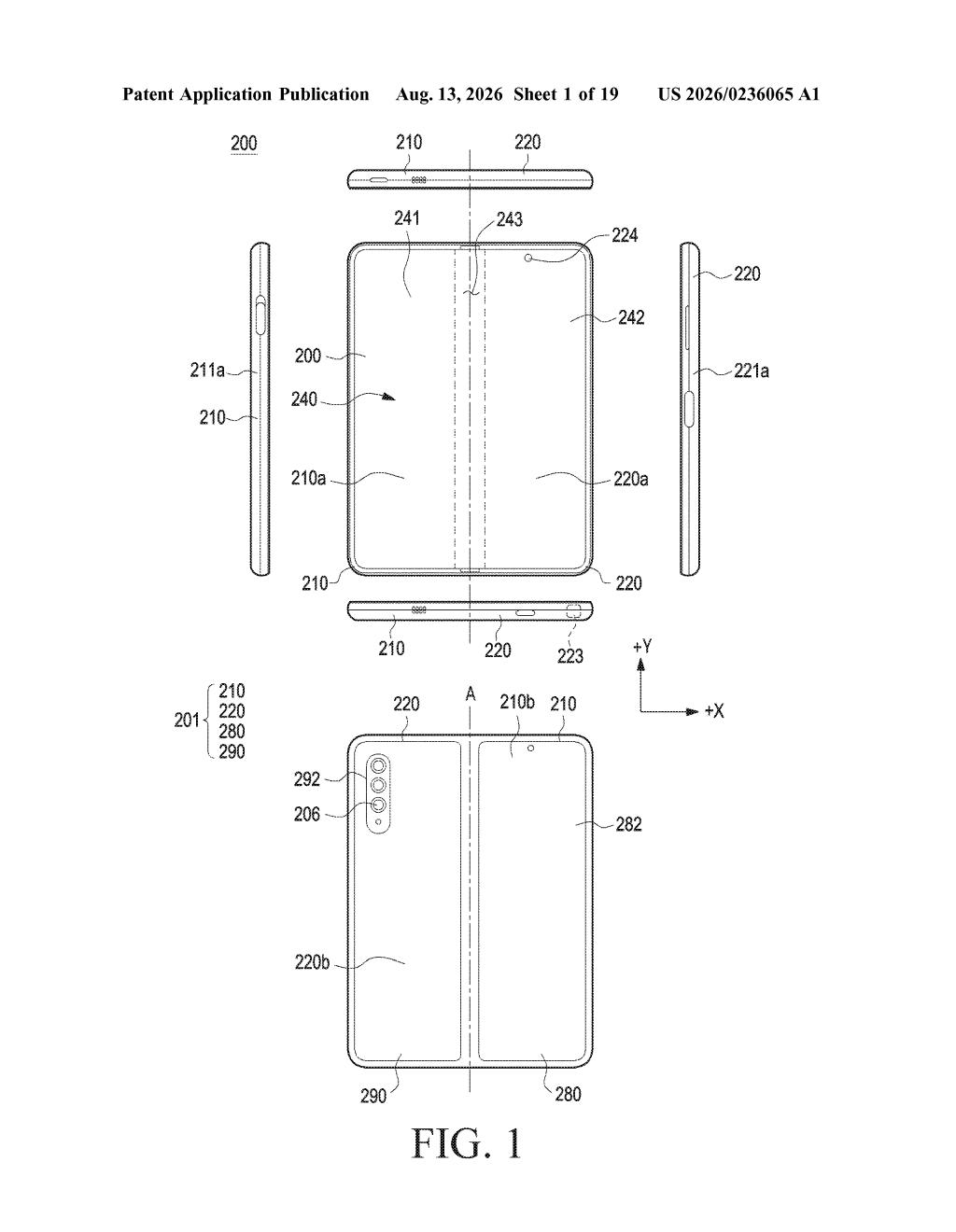
What Samsung's four-axis foldable hinge actually does
Most foldable phones today use a hinge that rotates around a single central point, which forces the flexible display to either gap open or compress and crease as the phone bends. That mismatch between where the screen wants to bend and where the hinge actually pivots is one of the hardest problems in foldable design.
Samsung's patent describes a hinge that splits the job across four separate axes. Two axes handle the physical rotation of the left and right housing halves. The other two create what the patent calls virtual rotation axes, meaning each display panel travels along a curved path as the phone folds, rather than simply pivoting around a fixed point. The result is that each screen moves the way it naturally wants to, reducing the stress that causes visible creasing.
An interlocking gear system keeps both sides in sync, so the left panel and right panel always fold at matching angles rather than one side pulling ahead of the other.
… a third rotation axis (A 3 ) configured to provide a first virtual rotation axis (DX 1 ), allowing the first display to rotate around the first virtual rotation axis by moving along a first moving path formed in the hinge module …
Translation: The screen shifts along a hidden track as you fold the device to prevent the display from creasing.
How the sliding hinge arms trace two virtual rotation paths
The hinge module described in this patent has three main components working together: hinge arms, a shaft structure, and an interlocking gear assembly.
Hinge arms and shaft slots: Each housing half connects to its own hinge arm. Each arm has a slot cut into it, and a shaft (a fixed cylindrical rod) sits inside that slot. When you fold the phone, the hinge arm doesn't just rotate around the shaft; it slides along it at the same time. That combined sliding-and-rotating motion is what produces the curved, path-following movement the patent calls a virtual rotation axis.
Virtual rotation axes: Because each display panel follows a path (not a fixed pivot point), the hinge can be tuned so the screen's natural bending radius matches the mechanical path exactly. Think of it like a door hinge that also shifts the door sideways as it swings, so the edge never scrapes the frame.
Interlocking gears: A gear on the first housing meshes with a gear on the second housing. This synchronizes the fold angle on both sides, preventing the asymmetric buckling that can happen when one panel moves faster than the other.
Hinge cover: The shaft structure is anchored to a hinge cover (the decorative spine visible on the outside of the fold), which keeps the whole assembly stable and protects it from debris.
… the first hinge arm is configured to slide and rotate with respect to the first shaft based on a folding angle of the electronic device, and wherein the second hinge arm is configured to slide and rotate with respect to the second shaft based on the folding angle of the electronic device.
Translation: The hinge arms slide and pivot automatically to adjust the screen position as you open or close the phone.
What this means for Galaxy Z Fold screen durability
For anyone who owns or is considering a foldable phone, the hinge is the most failure-prone part of the device. Screen creases appear at the fold line precisely because the display material is asked to bend around a fixed axis that doesn't match the screen's preferred radius. A hinge that lets each display follow its own virtual path directly attacks that problem, and if it works as described, it could meaningfully extend the usable life of the screen.
Samsung already leads the commercial foldable market with the Galaxy Z Fold and Z Flip lines, so this kind of mechanical refinement is directly relevant to those products. The engineering tradeoff is real: more rotation axes and sliding components mean more parts that can wear, stick, or accumulate grit over years of use. Whether that complexity pays off depends on manufacturing tolerances Samsung can hold at scale. Foldable display engineering is one of the more active areas among new Big Tech patents right now, reflecting how much is still being worked out in this product category.
The four-axis sliding approach trades mechanical simplicity for geometric precision, and that trade has a real cost: every additional moving interface in a hinge is another surface that can wear, bind, or let in dust over thousands of fold cycles. Samsung is betting that tighter screen-path control justifies a more complex mechanism, and the gear synchronization adds yet another dependency. If the tolerances hold in mass production the payoff is real; if they slip, users end up with a hinge that feels gritty after a year. The engineering logic is sound; the proof will be in long-term durability data.
There are more where this came from
We read every patent application Big Tech publishes and send you the ones worth knowing. Plain English, free, every week.
The drawings
19 drawing sheets from US 2026/0236065 A1 · click any drawing to enlarge


Want this weekly breakdown for a company we don't cover? Patentlyze Pro →
Be the first to weigh in