
Qualcomm Patent Offloads Camera Processing to Companion Device When Battery Drains
Your phone's camera does a lot of heavy lifting, and Qualcomm has a patent for making it hand off that work to another device the moment your battery starts struggling.
How Qualcomm's battery-aware camera offloading works
You're shooting video at a concert and your phone is down to 15% battery. The camera still needs to clean up grainy, low-light footage in real time, which is exactly the kind of work that drains a battery fast.
Qualcomm's patent describes a system that watches your phone's power situation and decides, on the fly, how much of that camera work to keep on the phone versus send to a companion device nearby, like a laptop, a tablet, or a wearable. The more your battery struggles, the more work gets pushed off to the other device.
The specific example the patent calls out is denoising, which is the process of removing the speckly grain you get in dark or fast-moving shots. Instead of your phone's chip doing all of that, it ships the raw image data over to the companion device, which does the heavy processing and sends back a clean result.
select, based on at least a characteristic of power usage of the apparatus, an imaging scheme from a plurality of imaging schemes, wherein each of the plurality of imaging schemes represents a different division of image processing operations between the at least one processor and a companion device; …
Translation: It changes how camera work is split up based on battery levels.
How the chip decides where image processing happens
The patent describes an adaptive split imaging system built around a simple idea: image processing doesn't have to happen entirely on one device.
Here's the core loop the patent lays out:
- The phone's processor monitors a characteristic of power usage, things like battery level, thermal load, or power draw rate.
- Based on that reading, it picks an imaging scheme from a menu of options. Each scheme represents a different split, more work on the phone, more work on the companion device, or some mix.
- Raw or partially processed image data gets sent to the companion device, which runs at least one image processing operation (the patent specifically names denoising) and returns the finished result.
Denoising is the AI-driven process of reconstructing clean pixel detail from a noisy, grainy image. Modern phones do this constantly, especially in low light, and it is computationally expensive. Offloading it frees up the phone's chip for other tasks and reduces the energy cost on the phone's battery.
The claim is written broadly enough to cover any division of processing steps between a phone and a companion device, not just denoising. The companion device is left undefined in the claim, which means it could be a smartwatch, a laptop, a car's infotainment system, or a Qualcomm-powered PC.
The system sends image data to the companion device for processing the image data using at least one image processing operation to generate processed image data according to the imaging scheme.
Translation: Photos are sent to another device to handle the heavy editing tasks.
What this means for phone cameras and battery life
For users, this is about keeping your phone's camera running well even when the battery is low. High-quality computational photography, the AI processing that makes modern phone cameras look as good as they do, is one of the biggest battery drains on any device. A system that can dial back how much of that work the phone does, without visibly degrading the output, would be a real quality-of-life fix.
For Qualcomm specifically, this fits a broader push to make its chips central to multi-device ecosystems, where a phone, a PC, and a headset all share workloads. Qualcomm already sells chips into laptops, phones, and wearables, so a patented framework that connects those devices at the camera-processing layer gives it something to offer device makers as a bundled platform feature. This filing sits alongside other interesting tech patents in the imaging and mobile-chip space that show how companies are rethinking which device in your pocket actually does the work.
Claim 1 is written at a high level of abstraction: any main device, any companion device, any image processing operation that includes denoising, selected by any characteristic of power usage. That breadth cuts both ways, covering a wide range of competitors' cross-device camera pipelines while also making a bigger target for prior-art challenges in examination. The practical core is solid: power-aware workload shifting for camera AI is a real problem, and the denoising anchor keeps the claim out of pure abstract-idea territory. Survive or shrink, the underlying system is exactly the plumbing you'd expect in a future Snapdragon platform pitch.
There are more where this came from
We read every patent application Big Tech publishes and send you the ones worth knowing. Plain English, free, every week.
The drawings
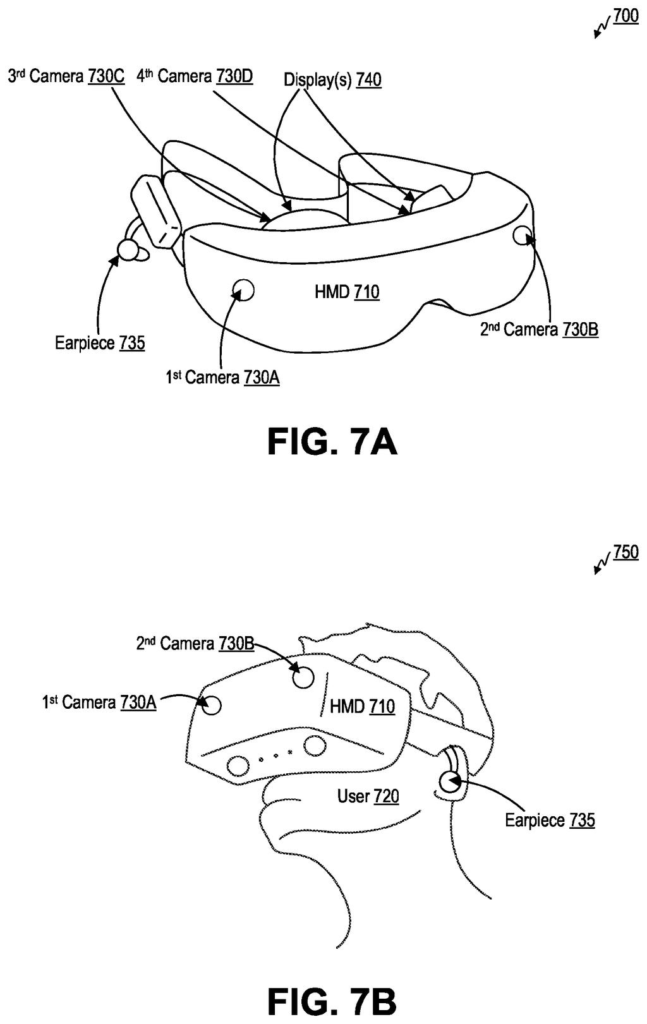
12 drawing sheets from US 2026/0238881 A1 · click any drawing to enlarge


Want this weekly breakdown for a company we don't cover? Patentlyze Pro →
Be the first to weigh in