
Google Patents a Way to Send Head-Movement Data Back Through Your Wireless Headphone Link
Most wireless headphones track your head movements but send that data through a separate channel. Google's new patent collapses the feedback loop by bundling head-orientation data with the routine acknowledgement packet your headphones already send back to your phone.
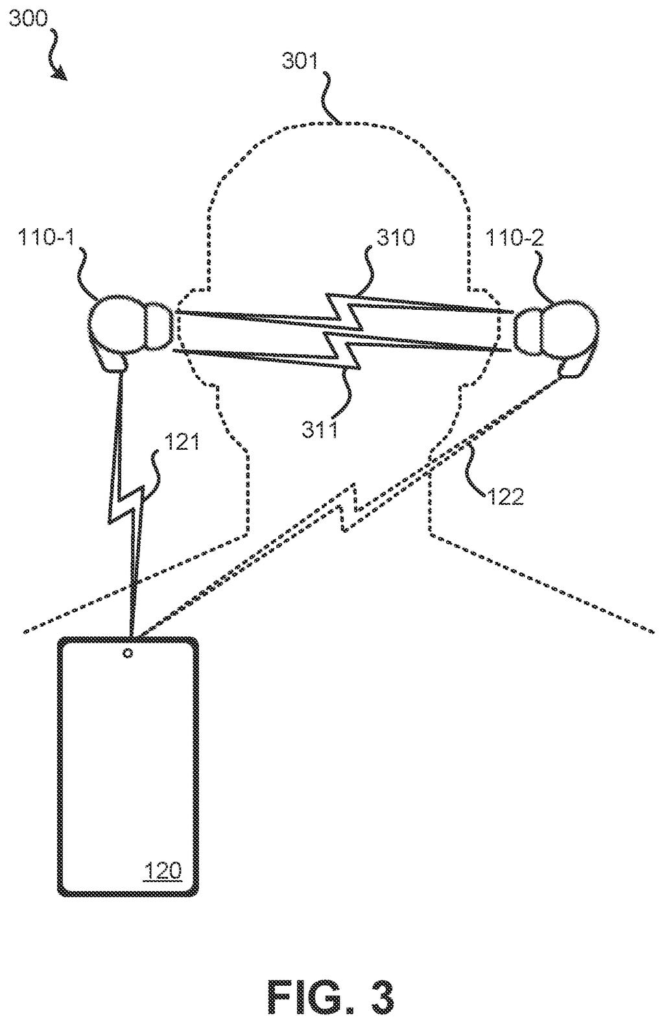
How Google's spatial audio feedback loop works
Imagine you're watching a movie on your phone with wireless earbuds, and the audio is supposed to feel like it's coming from the screen in front of you. When you turn your head, the sound should shift to stay anchored to that screen. Making that work requires your earbuds to constantly tell your phone where your head is pointing.
Right now, that head-tracking data often travels over a separate, slower pipeline, which can make the audio feel slightly off or laggy. Google's patent proposes a tidier approach: every time your headphones receive a chunk of audio and send back a routine "got it" confirmation, they would also slip your head-position data into that same return message. No extra channel, no extra delay.
The result, at least in theory, is that your phone knows where your head is pointing almost as quickly as it can push audio to your ears, letting it adjust the sound in real time.
… wirelessly transmitting, by the audio output system directly to the audio source device, the IMU data with an acknowledgement of receipt of the audio packet.
Translation: Headphones send your movement data back to your phone right along with the confirmation that the music arrived.
How IMU data piggybacks on the audio acknowledgement
The patent describes a system where an audio output system (think wireless earbuds or a headset) continuously tracks its own movement using an inertial measurement unit (IMU), the same type of tiny motion sensor that's already inside your phone and smartwatch to detect tilts, rotations, and acceleration.
When the headphones receive an audio packet over the wireless link from a source device (your phone, tablet, or laptop), they are required to send back an acknowledgement, sometimes called an ACK, confirming successful receipt. The patent's core idea is to attach the fresh IMU data directly to that ACK. The source device therefore gets head-orientation information on the exact same return trip as the confirmation signal, without opening a second wireless channel.
The claim also allows for upstream audio (for example, microphone input from the user) to ride along in the same return message. Key elements include:
- An audio output device with an embedded IMU
- A direct audio communication link between the headphones and the source device (no intermediary device or cloud hop)
- IMU data bundled with the ACK, transmitted in response to each successfully received audio packet
Bundling the data this way keeps the round-trip tight and predictable, which matters because spatial audio rendering (the math that shifts audio to match head position) is extremely sensitive to timing.
… the audio output system can transmit to the audio source device the IMU data, an acknowledgement, and possibly upstream audio to the audio source device via the audio communication link.
Translation: The system sends back your head tracking data, a delivery receipt, and microphone audio all at the same time.
What this means for wireless headphone spatial audio
The practical payoff here is reducing the time between your head moving and the audio adjusting. Even a few extra milliseconds of lag can make spatial audio feel "swimmy" or artificial, the way subtitles feel wrong when they're even slightly out of sync with speech. If Google can shave latency by reusing an already-required wireless message, the spatial audio experience in a future Pixel Buds or similar device could feel noticeably more anchored and stable during fast head movements.
This is a focused, infrastructure-level fix rather than a headline feature, but it's the kind of detail that separates spatial audio that feels convincing from spatial audio that feels like a demo. Wireless audio patents sit among the interesting tech patents that shape what earbuds can actually do, and this one signals Google is working the latency problem at the protocol level rather than just tuning signal processing on the device.
If you've ever tried spatial audio on wireless earbuds and found it believable for about two seconds before it felt laggy, this patent is aimed squarely at that failure. Bundling head-orientation data with an already-mandatory acknowledgement packet is an elegant fix: it costs nothing in terms of extra transmissions and tightens the timing loop that spatial audio quality depends on. The payoff would be most obvious during quick head turns in video calls or immersive content, exactly the moments where current wireless headphones tend to fall apart.
There are more where this came from
We read every patent application Big Tech publishes and send you the ones worth knowing. Plain English, free, every week.
The drawings
7 drawing sheets from US 2026/0238952 A1 · click any drawing to enlarge


Want this weekly breakdown for a company we don't cover? Patentlyze Pro →
Be the first to weigh in