
Google Patent Reveals Wearables That Search the Web Through Your Camera
Google has filed a patent for a wearable device that can search the internet based on what its camera is currently looking at, turning a passing glance into a full query without you having to type or describe anything.
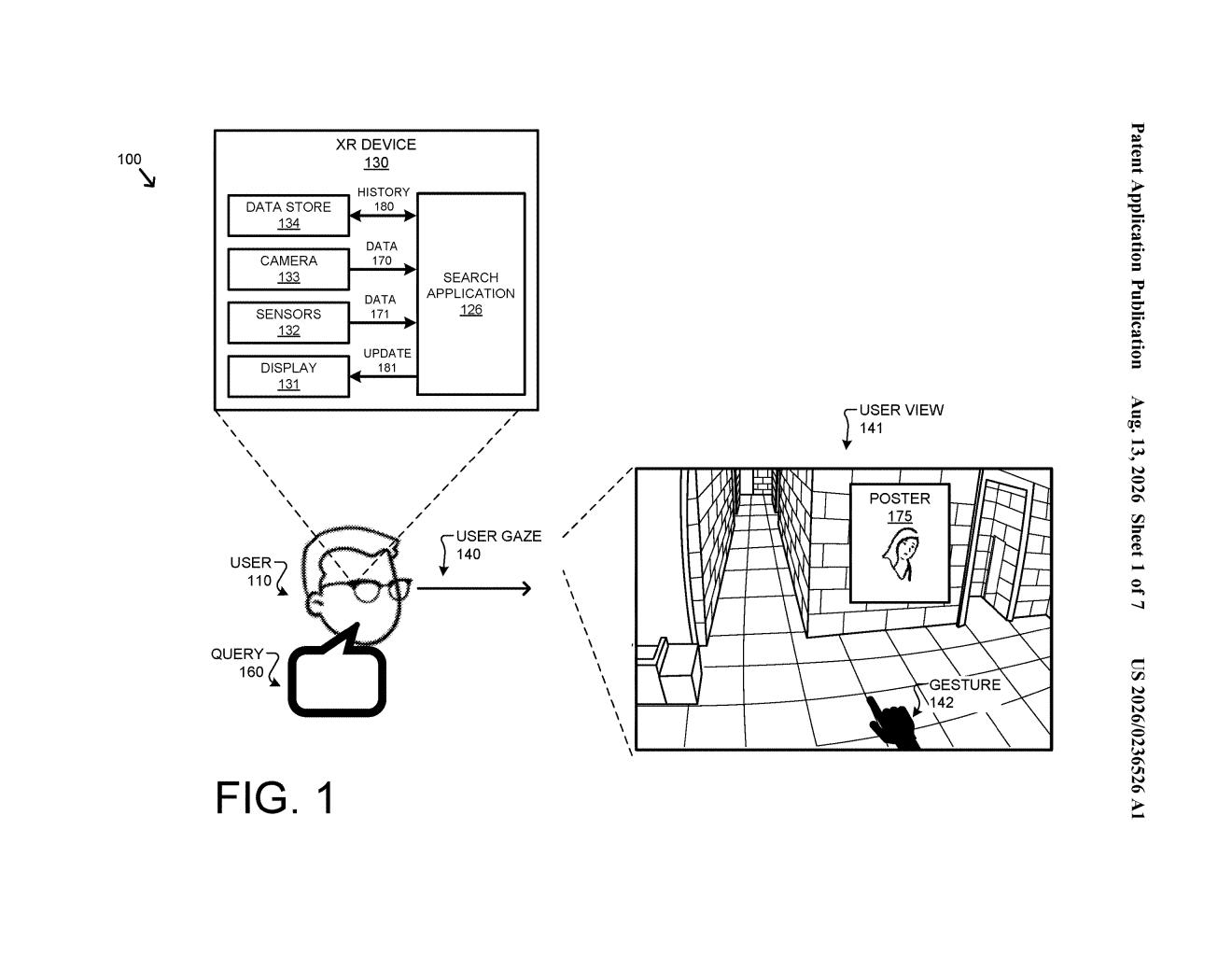
How Google's glasses-based visual search actually works
Ever tried to describe something to a search engine when you don't know what it's called? Google's new patent tackles exactly that problem, for people wearing camera-equipped devices like smart glasses.
The idea is straightforward: you ask a question out loud (or type it), and the device automatically pulls in images from its camera to give your question more context. So if you're looking at an unfamiliar plant and ask "is this edible?", the glasses can figure out what plant you mean and search accordingly, without you uploading a photo manually.
What makes this more than a simple voice search is that the system picks a specific portion of the camera image most relevant to your question, rather than dumping the whole frame into the search. That focus step is what helps the device return a useful answer instead of a confused one.
… identifying context associated with the query, the context comprising a set of images captured by a camera on the device, the camera configured to capture a perspective associated with the user; selecting a portion of an image in the set of images based on the query; generating at least one search based on the query, the context, and the portion of the image; …
Translation: The glasses figure out what you want by looking at photos taken from your point of view.
How the device crops images to sharpen search queries
The patent describes a pipeline that starts the moment a user asks a question on a wearable device. The device grabs a set of recent images from its camera, which is pointed in the direction the user is facing, giving it a first-person view of whatever they're looking at.
From there, the system does something important: rather than sending the entire camera image to a search engine, it selects a cropped portion of an image based on what the query is actually about. If you ask about a logo on someone's jacket, the system isolates that region rather than sending a cluttered street scene.
That cropped image, combined with the original text or voice query, is then used to generate one or more searches. The patent doesn't limit this to a single search engine call; it allows for multiple queries to be assembled and fired off in parallel or in sequence.
Finally, the results are combined and turned into a response delivered to the user, formatted for a wearable's small display or audio output. The whole loop, query to answer, is designed to happen with minimal manual input from the wearer.
… a method includes obtaining a query at a wearable device and identifying context associated with the query, the context comprising a set of images captured by the wearable device.
Translation: Wearable computers can answer your questions by looking at photos taken around you.
What this means for Google's wearable AI push
For Google, wearables are one of the few places left where search hasn't been natively embedded. A pair of glasses that can silently pull context from whatever you're looking at and answer questions in real time would give Google a significant edge in how people interact with information throughout the day. The camera-context approach also means the device gets useful without requiring you to already know what to search for, which is a much harder and more valuable problem to solve than traditional search.
The technology here is mostly a software and systems architecture question, not a new hardware problem. The cameras, microphones, and wireless chips needed already exist in devices like Google's own Android XR prototypes, which means the shortest path to shipping this is getting the pipeline reliable and fast enough for real-world use. Wearable AI search is an active area across new Big Tech patents, and Google's specific focus on image cropping as a relevance signal sets this filing apart from the broader category.
The core image-cropping step, selecting a relevant portion of a camera frame rather than submitting the whole image, is a practical engineering decision that makes the system meaningfully more useful in cluttered real-world environments. The patent reads like something close to a production design: the architecture is described in concrete terms, it doesn't depend on speculative hardware, and the pieces (camera, voice input, search API, wearable display) all exist today. What separates this filing from a shippable feature is mostly latency and reliability work.
There are more where this came from
We read every patent application Big Tech publishes and send you the ones worth knowing. Plain English, free, every week.
The drawings
7 drawing sheets from US 2026/0236526 A1 · click any drawing to enlarge


Want this weekly breakdown for a company we don't cover? Patentlyze Pro →