
Sony Patent Syncs Movie Backdrop Screens to Match Where a Camera Is Focused
When a film camera racks focus or changes its aperture, the giant LED wall behind the actors can suddenly look artificially sharp compared to the blurry foreground. Sony has filed a patent for a system that automatically softens the rendered background image to match whatever blur the camera lens is producing.
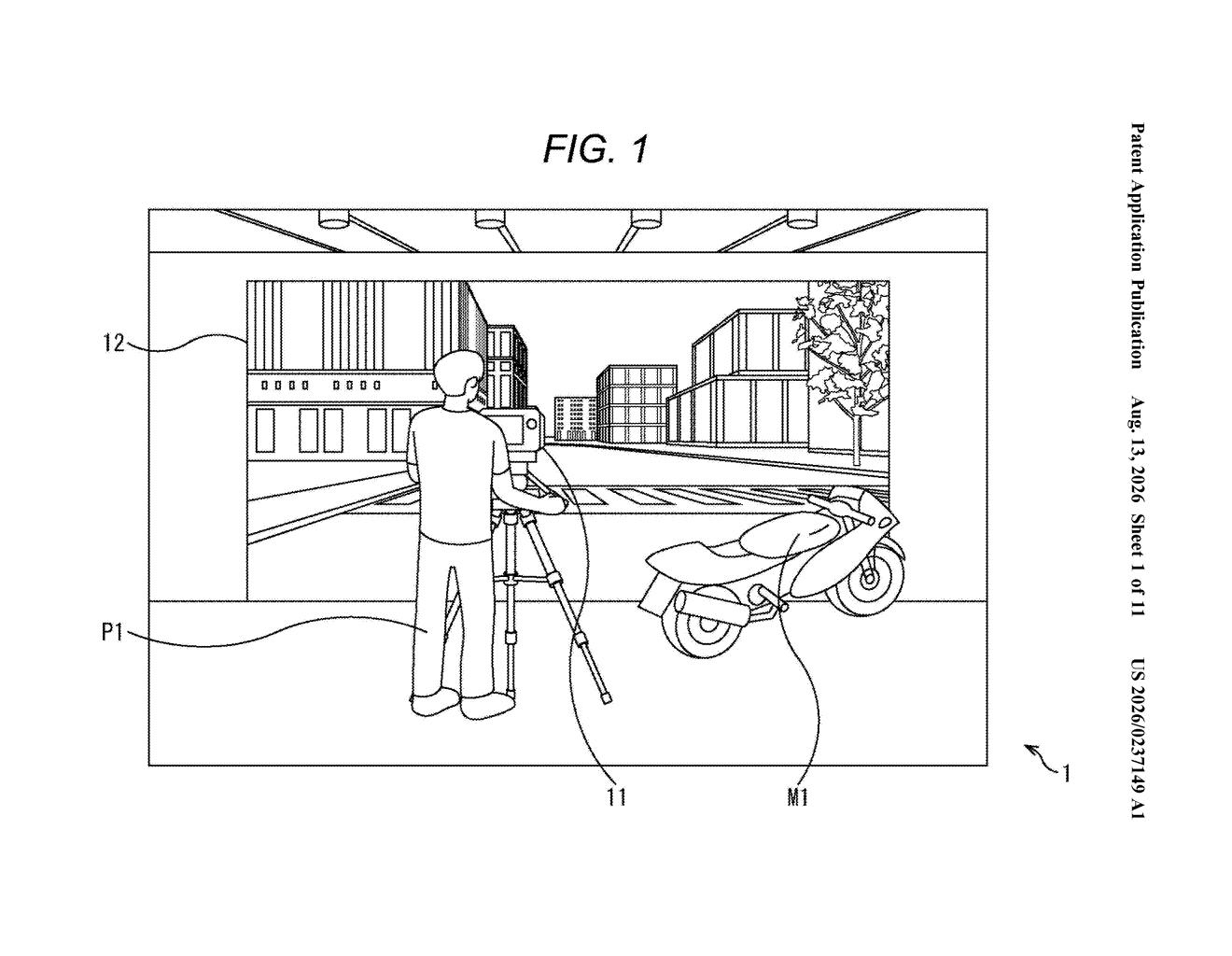
How Sony's background blur-matching system works on set
You're on a big-budget film set and the director asks for a wide-open aperture shot, the kind that throws the background into a dreamy blur. The problem: the LED wall behind the actors is displaying a crisp, computer-generated scene that doesn't blur the same way a real distant location would.
Sony's patent describes software that watches the live camera feed, measures how much blur is appearing on the screen surface, and then deliberately reduces the sharpness of the image the LED wall is showing. The idea is that if the camera can't resolve fine detail anyway, there's no point rendering it at full quality. The background stays perceptually correct rather than looking like a screen.
This kind of filmmaking technique, called virtual production, is used on major productions where actors perform in front of huge LED video walls instead of on location. Keeping the digital background looking believably cinematic as camera settings change is one of the trickier technical challenges on those sets.
… an image quality adjustment unit that reduces image quality of the area within the angle of view rendered by the rendering unit in a case where an amount of blur on the display surface in a filmed video filmed by the camera increases.
Translation: The system intentionally lowers the resolution of the background screen when the camera lens makes the image look blurry.
How the renderer and image quality unit coordinate in real time
The patent centers on two software components working together inside what Sony calls an information processing device.
The rendering unit takes in data about how the camera is set up: its field of view, its position relative to the LED display, and so on. From that, it draws a two-dimensional region on the display that corresponds to the three-dimensional virtual space the camera is supposed to be looking into. Think of it as the display showing exactly the slice of a virtual world that would appear through that particular camera lens at that moment.
The image quality adjustment unit monitors the live filmed video and measures the amount of blur present on the display surface. Blur here is the natural optical softening that a real camera lens creates when something is outside its focal range (sometimes called defocus or bokeh). When that blur amount goes up, the system automatically lowers the image quality of the rendered region by a corresponding amount.
The key insight is that blur and rendering resolution are linked: a camera that can't resolve sharp edges in the real world also can't expose the fact that an LED panel is showing a suspiciously perfect digital image. By degrading the rendered output to match what the camera physically captures, the system keeps the composite image coherent without extra manual work from the visual effects team.
The present technology can be applied to, for example, a filming system used for virtual production in which a subject is filmed with a video displayed on a display as a background.
Translation: This invention is designed for movie sets that use large digital screens instead of traditional physical backdrops.
What this means for LED volume filmmaking budgets and quality
For productions using LED volume stages (the technology made famous by shows like The Mandalorian), one of the persistent pain points is that camera operators have to coordinate focus and aperture changes carefully to avoid breaking the illusion. If the background suddenly looks sharper than the foreground subject, the audience's brain flags it immediately as fake. A system that handles this adjustment automatically could give cinematographers more freedom to make creative choices without a visual effects supervisor intervening every time.
The broader significance is that this is a software-only fix to a problem that currently often requires either expensive reshoots or post-production cleanup. The patent describes the logic in terms of a general information processing device, which means it could in principle run on existing production hardware rather than requiring new cameras or display panels. Sony's camera and professional display divisions both have stakes in the virtual production market, so this filing sits at a natural intersection of their product lines, and it joins a growing wave of new Big Tech patents addressing the optics and rendering pipeline challenges specific to LED volume filmmaking.
The shortest route to a shippable product here is actually pretty direct: the core logic is software running on top of existing render engines and camera signal feeds, with no new hardware required. What has to exist first is a production pipeline where camera metadata (aperture, focus distance) flows into the rendering system in real time, which is already standard practice on high-end LED volume stages. Sony could plausibly fold this into its existing virtual production software toolkit without waiting for a new camera generation. The main open question is latency: adjusting rendered output frame-by-frame in sync with live camera data is a tight loop, and the patent doesn't specify how that timing is managed.
There are more where this came from
We read every patent application Big Tech publishes and send you the ones worth knowing. Plain English, free, every week.
The drawings
11 drawing sheets from US 2026/0237149 A1 · click any drawing to enlarge


Want this weekly breakdown for a company we don't cover? Patentlyze Pro →
Be the first to weigh in